


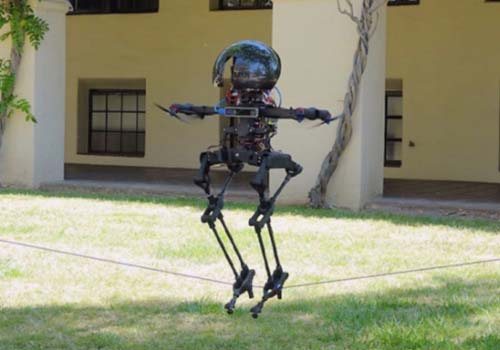
No dia 9 de outubro, pesquisadores do Instituto de Tecnologia da Califórnia desenvolveram um robô bípede que combina movimentos bípedes de andar e voar, tornando-o extremamente flexível e capaz de realizar movimentos complexos, como deslizar. Skate, caminhada na corda bamba, etc.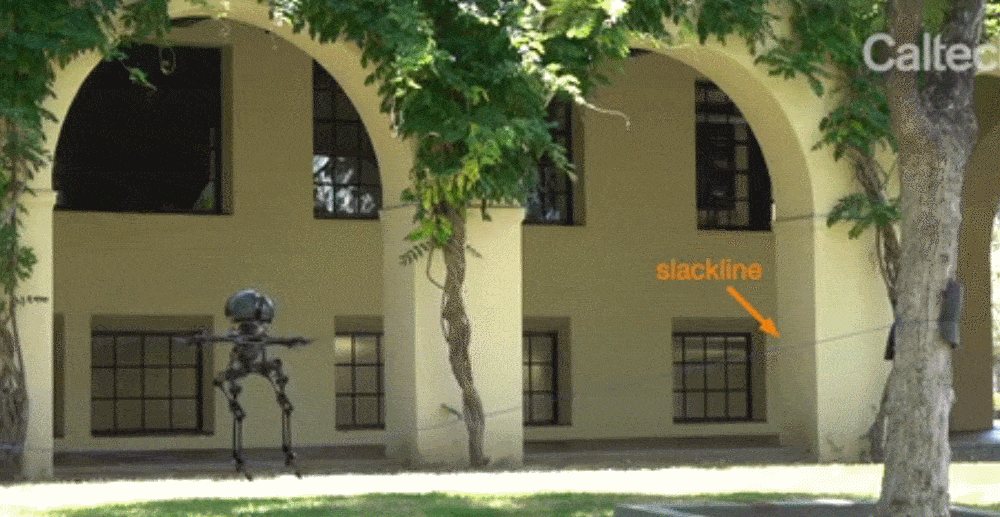
▲LEO walks along the rope tied between the treesThe design of this robot is inspired by the various behaviors of birds between walking and flying. The researchers named it LEONARDO (legs on the "legsonboarddrone" drone, or LEO for short). LEO can achieve fine control of its own balance through multi-articulated legs and propeller-based propellers.
The researchers stated in the research paper that LEO can perform various tasks that are difficult for humans and traditional robots to perform thanks to its hybrid motion capabilities. High-altitude operations will be one of the most suitable applications for LEO, such as the maintenance of high-voltage lines, and spray paint on high-altitude bridges.
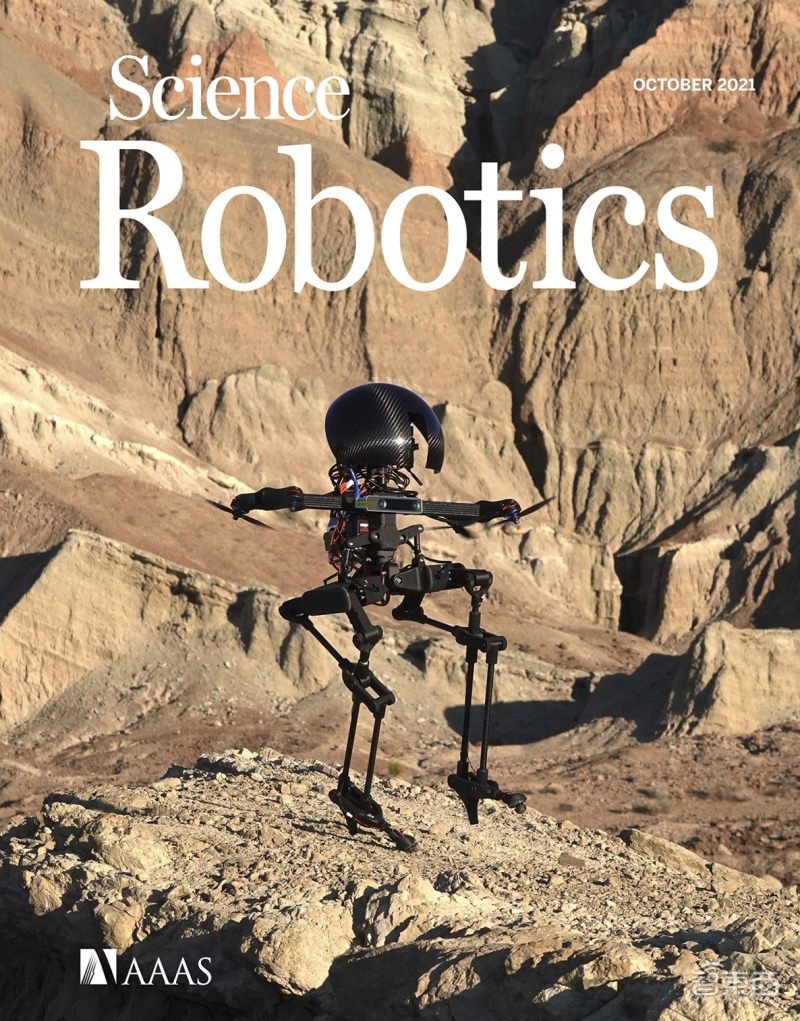
A pesquisa foi publicada esta quarta-feira na Science Robotics, subjornal da Science, e apareceu na capa da revista este mês. O título da tese é "Robô bípede que pode voar, fazer slackline e skate (um robô bípede que pode voar, andar na corda bamba e andar de skate)".
 Primeiro. Mude a forma tradicional de movimento, para que o robô possa correr e voar
A maioria dos robôs existentes pode se mover no solo ou no ar, mas quase não existem robôs que possuam ambos os modos de movimento. Além disso, os robôs existentes raramente têm a capacidade de realizar tarefas complexas.
Ground robots have legged, wheeled, crawling and other forms. Among them, biped robots have attracted much attention because they have the appearance of humans and can walk, run, and jump like humans. However, the movement of ground robots is easily restricted by rugged terrain, and its application range is also limited to near the ground, making it difficult to work at heights.
Flying robots can ignore all kinds of rugged terrain and engage in aerial work such as remote sensing, delivery, search and rescue, and inspection. But its own shortcomings are also very obvious, such as high energy consumption, short flight time, and limited load capacity. In addition, because aerial robots need to take care of their own stability when working in the air, it is more difficult to physically interact with objects than ground robots.
Os pesquisadores combinaram as vantagens desses dois robôs, permitindo que o LEO combinasse modos de movimento de caminhada e vôo para movimentos mistos e se adaptasse a vários terrenos acidentados, alternando entre diferentes modos de movimento.
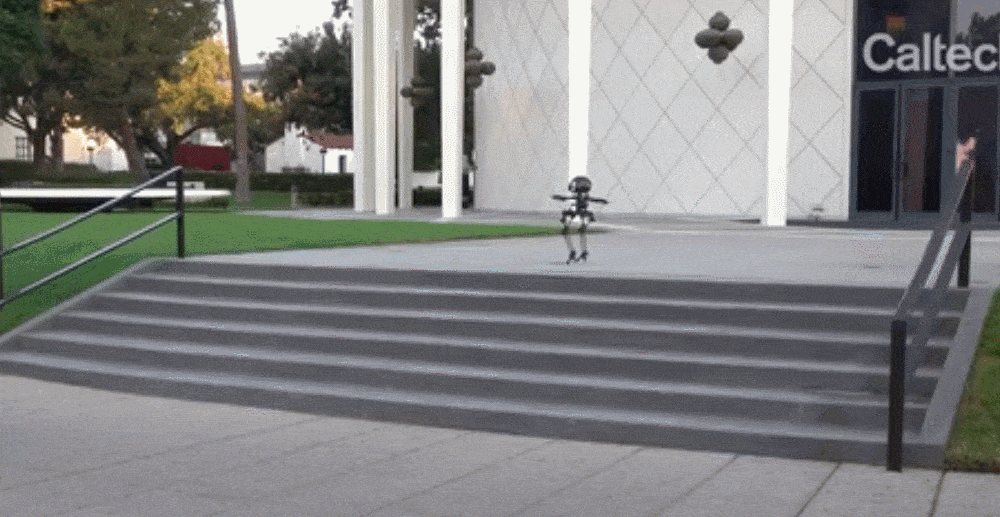
▲ LEO caminhou até a frente da escada e desceu voandoSegundo. A altura de 75 cm é de apenas 5 kg e o peso é de 4 hélices.
O peso do LEO é de 2,58 kg e a altura total ao caminhar é de 75 cm. É composto principalmente por um torso, um sistema de propulsão de hélice e duas pernas com saltos pontiagudos.
In order to make it light enough, LEO’s leg structure uses carbon fiber tubes and 3D printed carbon fiber reinforced nylon joints to support ball bearings. Its two legs are symmetrical. Each leg has 3 servo motors. One is located at the pelvis and the other two are located at the front and back of the hip. The three servo motors jointly control the movement of the legs.
Os ombros do LEO estão equipados com 4 hélices colocadas simetricamente para estabilizar e controlar os movimentos de caminhada e voo.
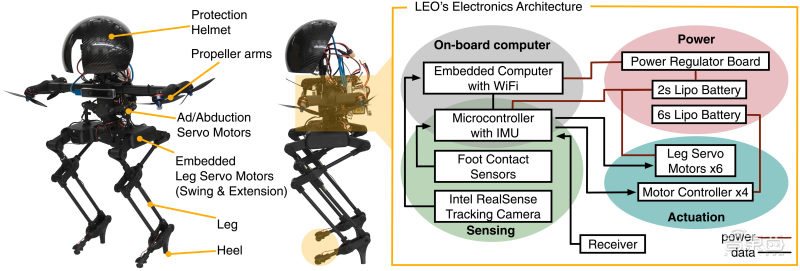
▲ Peças eletrônicas e mecânicas do LEO O LEO pode operar de forma totalmente autônoma por meio de seu computador de bordo e conjunto de sensores. Dependendo do tipo de obstáculo que precisa ser transposto, ele pode optar por caminhar ou voar, ou misturar os dois conforme necessário.
Durante a caminhada, as hélices do LEO garantem que ele possa permanecer em pé enquanto caminha, e os atuadores das pernas movem o centro de gravidade do robô para frente, alterando a posição das pernas para conseguir caminhar. Em vôo, o LEO pode usar hélices sozinho e voar como um drone.Terceiro, esquiar, andar na corda bamba e operar em grandes altitudes é a maior direção de aplicação
Graças à sua capacidade de misturar esportes, os pesquisadores descobriram que ele consegue realizar algumas ações que são difíceis para os robôs convencionais, como andar sobre cordas e deslizar em skates. E também tem uma capacidade anti-interferência muito alta e pode permanecer estável mesmo com velocidades de vento de até 3,8 m/s.
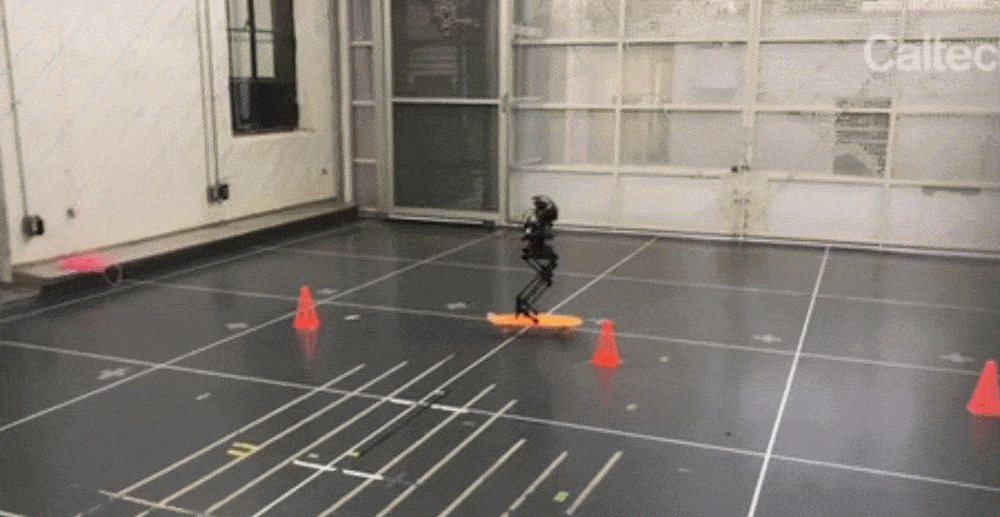
▲ Skate LEO para contornar obstáculosOs pesquisadores disseram no artigo: "Talvez as aplicações mais adequadas para LEO sejam aquelas que envolvem operações em grandes altitudes. Essas tarefas geralmente são perigosas para os humanos e exigem robôs para substituí-las."
For example, the current high-voltage line inspection is done by professionals, who not only have to remotely inspect the line, but also go on the line for inspection and maintenance. Using LEO, there is no need to send personnel to climb up the wires, and only use the robot to fly onto high-voltage lines and walk along the wires for maintenance work. This will reduce maintenance costs and reduce the possibility of falling casualties.
In addition to these effects, the technology designed for LEO can also promote the development of adaptive landing gear systems. The research team envisions that future Martian rotorcraft can be equipped with legged landing gear so that they can maintain their balance when landing on sloping or uneven terrain, thereby reducing the risk of landing failure.
Next, the team plans to improve the performance of LEO by improving the leg design to make it stronger to support heavier robots and increase the thrust of the propeller. In addition, they also hope that LEO can be more autonomous, so that when the robot is walking on rugged terrain, it can understand how much weight the legs support and how much thrust is required by the propeller.
The researchers also plan to equip LEO with a newly developed control algorithm that uses a deep neural network to control the landing of the drone, allowing the robot to better understand the environment and decide on its own the best combination of walking, flying or mixed motion. The safest and least energy-consuming way to move from one place to another.
Conclusão:Robot Leo pode correr e voar, para que o espaço de aplicação dos robôs bípedes seja mais amplo
Devido à sua aparência humana, os robôs bípedes podem imitar os humanos para realizar diversas tarefas. No entanto, devido às condições ambientais e do terreno, o movimento dos robôs bípedes será restringido em muitos casos.
LEO combina andar e voar para permitir que robôs bípedes corram e voem, quebrando os obstáculos do terreno e tornando-o mais amplamente utilizado. Robô humanóide; Robô de serviço de IA; Cobot móvel


