


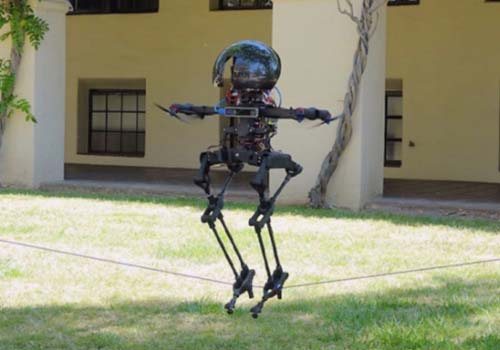
El 9 de octubre, investigadores del Instituto de Tecnología de California desarrollaron un robot bípedo que combina movimientos bípedos de caminar y volar, lo que lo hace extremadamente flexible y capaz de realizar movimientos complejos, como deslizarse. Andar en patineta, caminar sobre la cuerda floja, etc.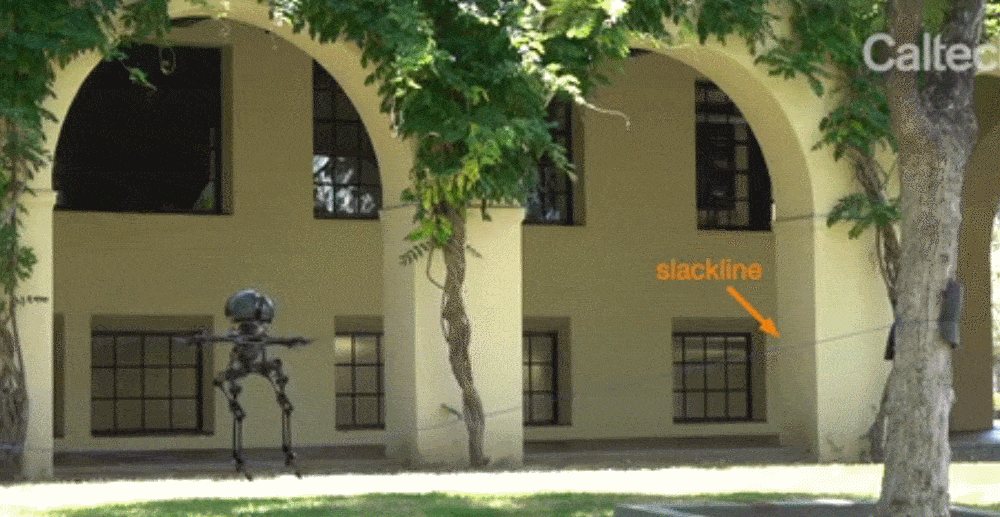
▲LEO walks along the rope tied between the treesThe design of this robot is inspired by the various behaviors of birds between walking and flying. The researchers named it LEONARDO (legs on the "legsonboarddrone" drone, or LEO for short). LEO can achieve fine control of its own balance through multi-articulated legs and propeller-based propellers.
The researchers stated in the research paper that LEO can perform various tasks that are difficult for humans and traditional robots to perform thanks to its hybrid motion capabilities. High-altitude operations will be one of the most suitable applications for LEO, such as the maintenance of high-voltage lines, and spray paint on high-altitude bridges.
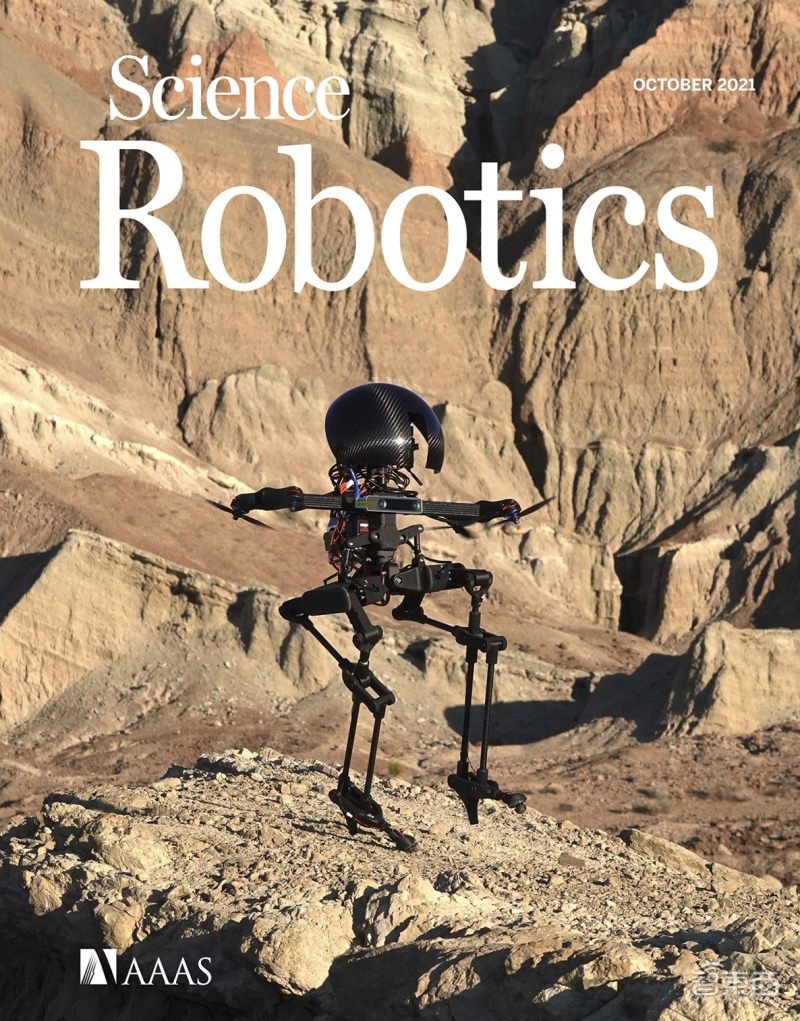
La investigación fue publicada este miércoles en Science Robotics, una revista secundaria de Science, y apareció en la portada de la revista este mes. El título de la tesis es "Abipedal walkingrobotthatcanfly, slackline, andskateboard (un robot bípedo caminante que puede volar, caminar sobre la cuerda floja y andar en patineta)".
 Primero. Cambiar la forma tradicional de movimiento, para que el robot pueda correr y volar
La mayoría de los robots existentes pueden moverse en tierra o en el aire, pero casi no hay robots que tengan ambos modos de movimiento. Además, los robots existentes rara vez tienen la capacidad de realizar tareas complejas.
Ground robots have legged, wheeled, crawling and other forms. Among them, biped robots have attracted much attention because they have the appearance of humans and can walk, run, and jump like humans. However, the movement of ground robots is easily restricted by rugged terrain, and its application range is also limited to near the ground, making it difficult to work at heights.
Flying robots can ignore all kinds of rugged terrain and engage in aerial work such as remote sensing, delivery, search and rescue, and inspection. But its own shortcomings are also very obvious, such as high energy consumption, short flight time, and limited load capacity. In addition, because aerial robots need to take care of their own stability when working in the air, it is more difficult to physically interact with objects than ground robots.
Los investigadores combinaron las ventajas de estos dos robots, lo que permitió a LEO combinar modos de movimiento de caminar y volar para movimientos mixtos y adaptarse a varios terrenos accidentados cambiando entre diferentes modos de movimiento.
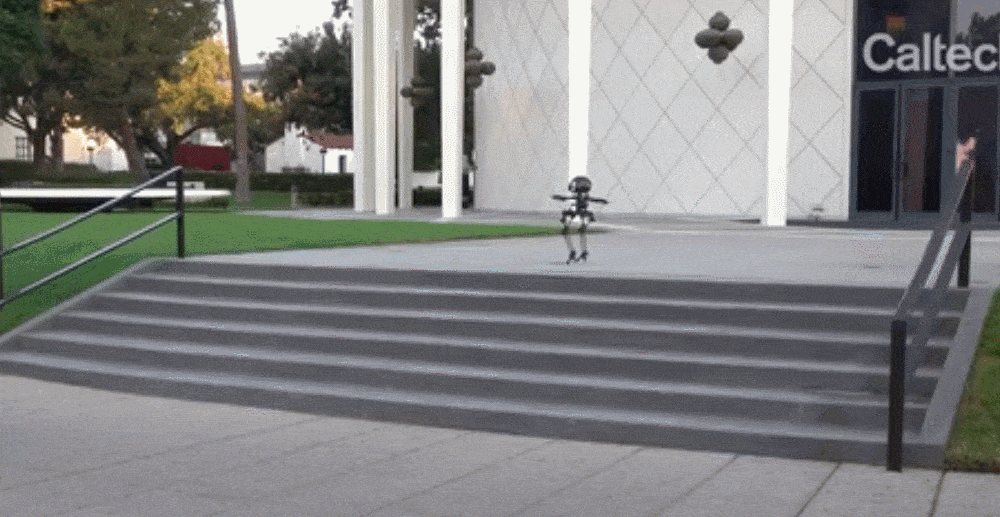
▲ LEO caminó hacia el frente de los escalones y bajó volando los escalones.Segundo. La altura de 75 cm es de solo 5 kg y el peso es de 4 hélices.
El peso de LEO es de 2,58 kg y la altura total al caminar es de 75 cm. Se compone principalmente de un torso, un sistema de propulsión por hélice y dos piernas con talones puntiagudos.
In order to make it light enough, LEO’s leg structure uses carbon fiber tubes and 3D printed carbon fiber reinforced nylon joints to support ball bearings. Its two legs are symmetrical. Each leg has 3 servo motors. One is located at the pelvis and the other two are located at the front and back of the hip. The three servo motors jointly control the movement of the legs.
Los hombros de LEO están equipados con 4 hélices colocadas simétricamente para estabilizar y controlar los movimientos de caminar y volar.
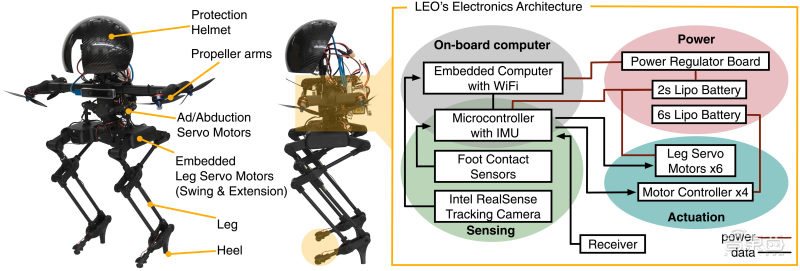
▲Partes electrónicas y mecánicas de LEO LEO puede funcionar de forma completamente autónoma a través de su computadora a bordo y su conjunto de sensores. Dependiendo del tipo de obstáculo que deba atravesarse, puede optar por caminar o volar, o combinar ambos según sea necesario.
Al caminar, las hélices de LEO aseguran que pueda permanecer erguido mientras camina, y los actuadores de las piernas mueven el centro de gravedad del robot hacia adelante cambiando la posición de las piernas para lograr caminar. En vuelo, LEO puede utilizar hélices solas y volar como un dron.En tercer lugar, esquiar, caminar sobre la cuerda floja y operar a gran altitud son las principales direcciones de aplicación.
Gracias a su capacidad para combinar deportes, los investigadores descubrieron que puede realizar algunas acciones que son difíciles para los robots convencionales, como caminar sobre cuerdas y deslizarse en patinetas. Y también tiene una capacidad antiinterferente muy alta y puede permanecer estable incluso con velocidades de viento de hasta 3,8 m/s.
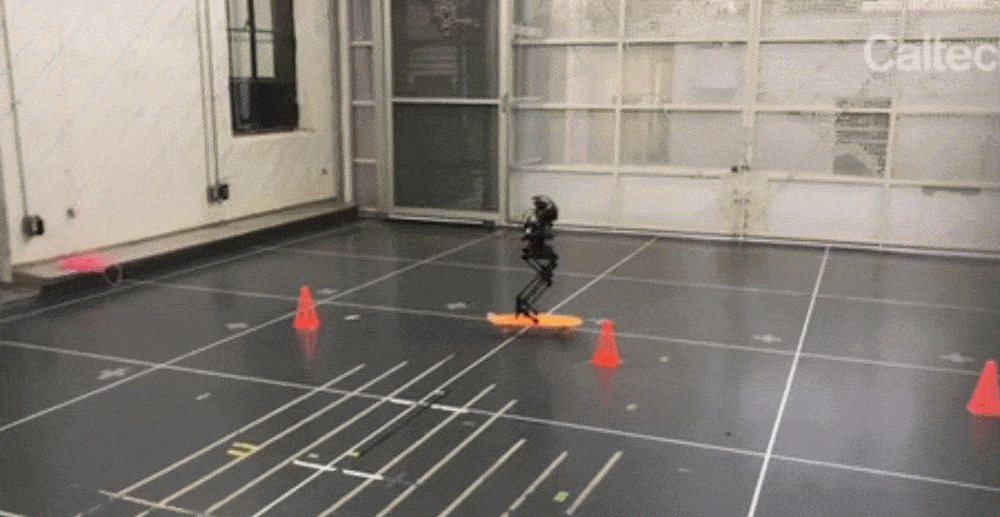
▲ Monopatín LEO para sortear obstáculosLos investigadores dijeron en el artículo: "Quizás las aplicaciones más adecuadas para LEO sean aquellas que involucran operaciones a gran altitud. Estas tareas suelen ser peligrosas para los humanos y requieren robots para reemplazarlas".
For example, the current high-voltage line inspection is done by professionals, who not only have to remotely inspect the line, but also go on the line for inspection and maintenance. Using LEO, there is no need to send personnel to climb up the wires, and only use the robot to fly onto high-voltage lines and walk along the wires for maintenance work. This will reduce maintenance costs and reduce the possibility of falling casualties.
In addition to these effects, the technology designed for LEO can also promote the development of adaptive landing gear systems. The research team envisions that future Martian rotorcraft can be equipped with legged landing gear so that they can maintain their balance when landing on sloping or uneven terrain, thereby reducing the risk of landing failure.
Next, the team plans to improve the performance of LEO by improving the leg design to make it stronger to support heavier robots and increase the thrust of the propeller. In addition, they also hope that LEO can be more autonomous, so that when the robot is walking on rugged terrain, it can understand how much weight the legs support and how much thrust is required by the propeller.
The researchers also plan to equip LEO with a newly developed control algorithm that uses a deep neural network to control the landing of the drone, allowing the robot to better understand the environment and decide on its own the best combination of walking, flying or mixed motion. The safest and least energy-consuming way to move from one place to another.
Conclusión:Robot Leo puede correr y volar, por lo que el espacio de aplicación de los robots bípedos es más amplio
Debido a su apariencia humana, los robots bípedos pueden imitar a los humanos para realizar diversas tareas. Sin embargo, debido a las condiciones ambientales y del terreno, el movimiento de los robots bípedos estará restringido en muchos casos.
LEO combina caminar y volar para permitir que los robots bípedos corran y vuelen, rompiendo los obstáculos del terreno y haciéndolo más utilizado. Robot humanoide; Robot de servicio AI; Cobot móvil


