


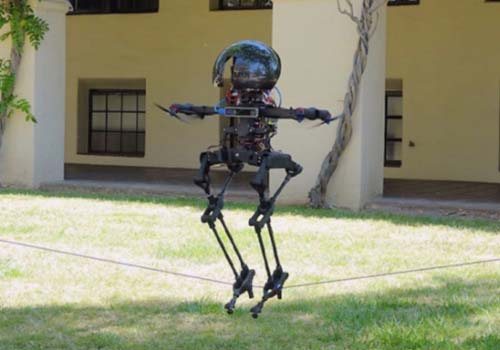
10月9日、カリフォルニア工科大学の研究者らは、二足歩行と飛行動作を組み合わせ、非常に柔軟性が高く、滑りなどの複雑な動作を実行できる二足歩行ロボットを開発した。スケートボード、綱渡りなど。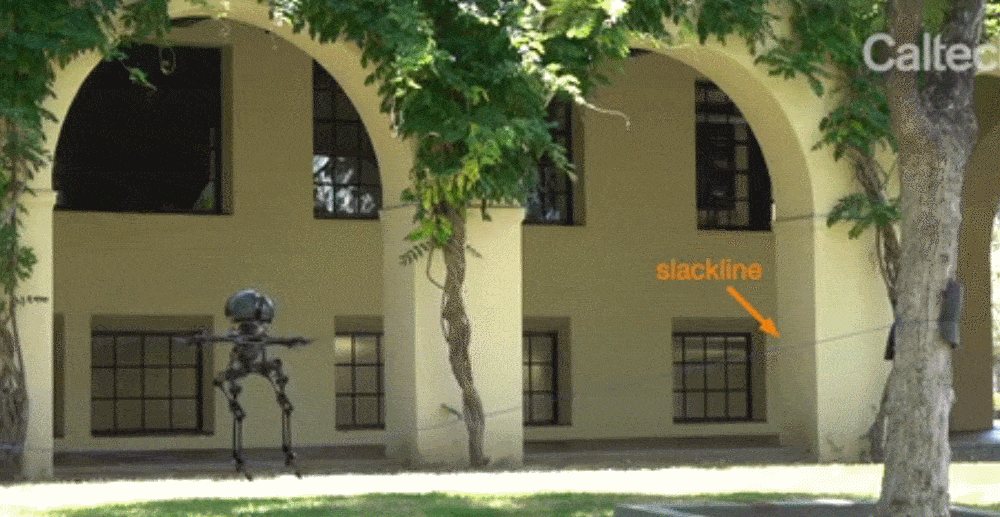
▲LEO walks along the rope tied between the treesThe design of this robot is inspired by the various behaviors of birds between walking and flying. The researchers named it LEONARDO (legs on the "legsonboarddrone" drone, or LEO for short). LEO can achieve fine control of its own balance through multi-articulated legs and propeller-based propellers.
The researchers stated in the research paper that LEO can perform various tasks that are difficult for humans and traditional robots to perform thanks to its hybrid motion capabilities. High-altitude operations will be one of the most suitable applications for LEO, such as the maintenance of high-voltage lines, and spray paint on high-altitude bridges.
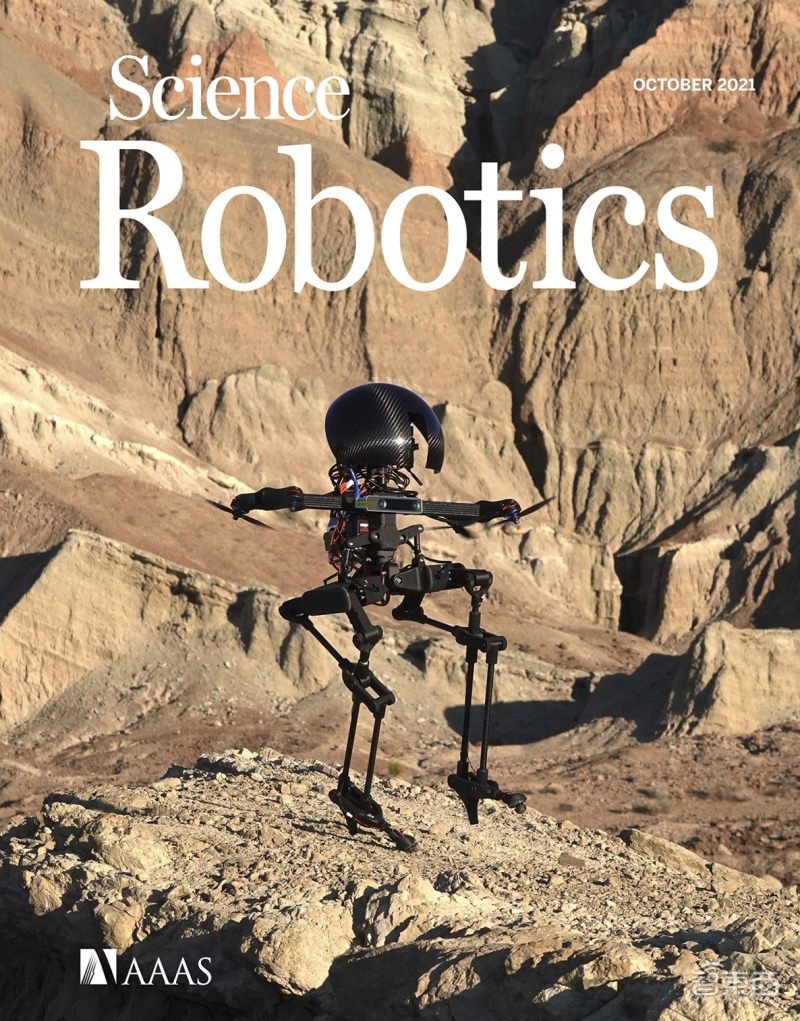
この研究は今週水曜日、サイエンス誌のサブジャーナルであるサイエンス・ロボティクス誌に掲載され、今月の同誌の表紙に掲載された。論文のタイトルは「Abipedalwalking robotthatcanfly,slackline,andskateboard(飛行、綱渡り、スケートボードができる二足歩行ロボット)」です。
 初め。従来の動作方法を変更して、ロボットが走ったり飛べたりできるようにする
既存のロボットの多くは地上と空中で移動できますが、その両方の移動モードを備えたロボットはほとんどありません。さらに、既存のロボットが複雑なタスクを実行できる能力を持っていることはほとんどありません。
Ground robots have legged, wheeled, crawling and other forms. Among them, biped robots have attracted much attention because they have the appearance of humans and can walk, run, and jump like humans. However, the movement of ground robots is easily restricted by rugged terrain, and its application range is also limited to near the ground, making it difficult to work at heights.
Flying robots can ignore all kinds of rugged terrain and engage in aerial work such as remote sensing, delivery, search and rescue, and inspection. But its own shortcomings are also very obvious, such as high energy consumption, short flight time, and limited load capacity. In addition, because aerial robots need to take care of their own stability when working in the air, it is more difficult to physically interact with objects than ground robots.
研究者らはこれら 2 つのロボットの利点を組み合わせ、LEO が歩行と飛行の動作モードを組み合わせて混合動作を実現し、異なる動作モードを切り替えることでさまざまな起伏の多い地形に適応できるようにしました。
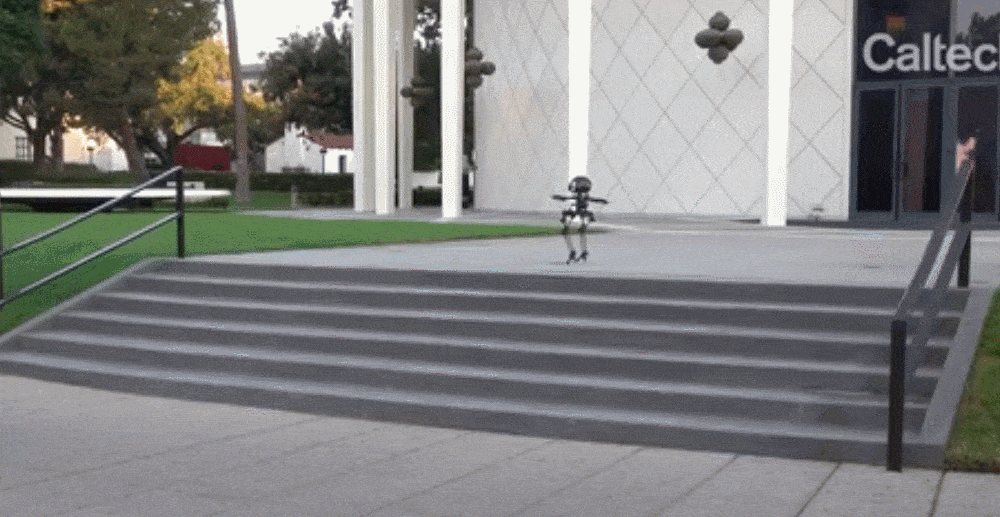
▲LEOは階段の前まで歩き、階段を飛び降りた2番。高さ75cmでも5kg、重さはプロペラ4枚分です。
LEOの重量は2.58kg、歩行時の全高は75cmです。それは主に、胴体、プロペラ推進システム、および尖ったかかとを持つ 2 本の脚で構成されています。
In order to make it light enough, LEO’s leg structure uses carbon fiber tubes and 3D printed carbon fiber reinforced nylon joints to support ball bearings. Its two legs are symmetrical. Each leg has 3 servo motors. One is located at the pelvis and the other two are located at the front and back of the hip. The three servo motors jointly control the movement of the legs.
LEO の肩には、歩行と飛行の動きを安定させ、制御するために対称的に配置された 4 つのプロペラが装備されています。
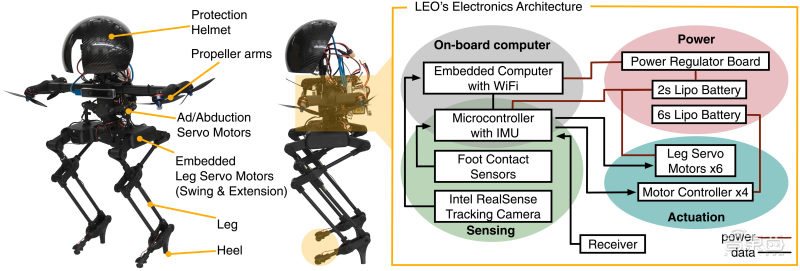
▲LEOの電子部品と機械部品LEOは、オンボードコンピュータとセンサースイートを通じて完全に自律的に動作できます。通過する必要がある障害物の種類に応じて、歩行または飛行を使用するか、必要に応じて 2 つを組み合わせて使用するかを選択できます。
歩行中、LEO のプロペラは歩行中に直立状態を維持し、脚アクチュエーターは脚の位置を変更することでロボットの重心を前方に移動させて歩行を実現します。飛行中、LEO はプロペラだけを使用してドローンのように飛行できます。第三に、スキー、綱渡り、高所作業が最大の応用方向です。
スポーツを組み合わせる能力のおかげで、研究者らは、ロープの上を歩いたり、スケートボードで滑ったりするなど、従来のロボットでは困難だったいくつかの動作を実行できることを発見しました。また、非常に高い抗干渉能力も備えており、最大3.8m/sの風速でも安定した状態を維持できます。
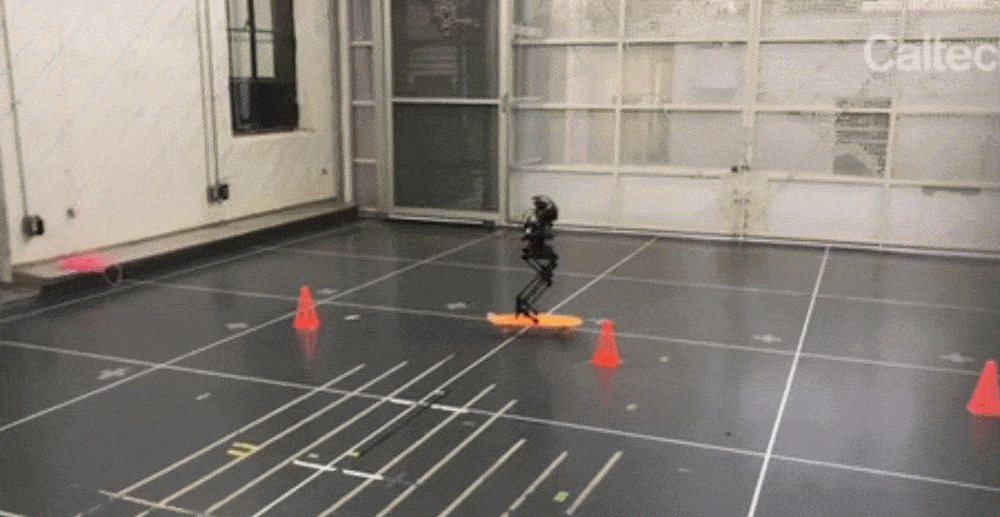
▲障害物を迂回するLEOスケートボード 研究者らは論文の中で、「おそらくLEOに最も適した用途は、高高度での作業を伴うものである。これらの作業は通常、人間にとって危険であり、ロボットの代替が必要である」と述べている。
For example, the current high-voltage line inspection is done by professionals, who not only have to remotely inspect the line, but also go on the line for inspection and maintenance. Using LEO, there is no need to send personnel to climb up the wires, and only use the robot to fly onto high-voltage lines and walk along the wires for maintenance work. This will reduce maintenance costs and reduce the possibility of falling casualties.
In addition to these effects, the technology designed for LEO can also promote the development of adaptive landing gear systems. The research team envisions that future Martian rotorcraft can be equipped with legged landing gear so that they can maintain their balance when landing on sloping or uneven terrain, thereby reducing the risk of landing failure.
Next, the team plans to improve the performance of LEO by improving the leg design to make it stronger to support heavier robots and increase the thrust of the propeller. In addition, they also hope that LEO can be more autonomous, so that when the robot is walking on rugged terrain, it can understand how much weight the legs support and how much thrust is required by the propeller.
The researchers also plan to equip LEO with a newly developed control algorithm that uses a deep neural network to control the landing of the drone, allowing the robot to better understand the environment and decide on its own the best combination of walking, flying or mixed motion. The safest and least energy-consuming way to move from one place to another.
結論:ロボットレオ 走ったり飛んだりできるので、二足歩行ロボットの応用範囲が広がります
二足歩行ロボットは人間の外観をしているため、人間を模倣してさまざまなタスクを実行できます。しかし、環境や地形の条件により、二足歩行ロボットの動作は制限される場合が多くなります。
LEO は歩行と飛行を組み合わせて二足歩行ロボットの走行と飛行を可能にし、地形の障害物を突破してより広く使用できるようにします。ヒューマノイド ロボット、AI サービス ロボット、モバイル コボット


