


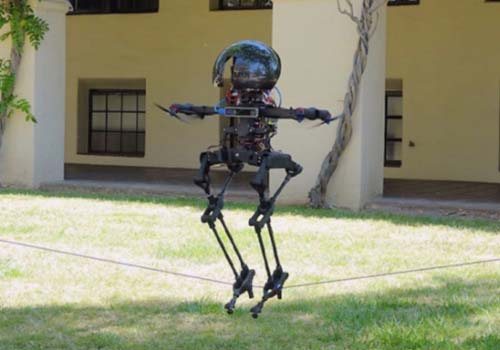
Pada 9 Oktober, penyelidik dari California Institute of Technology telah membangunkan robot bipedal yang menggabungkan pergerakan berjalan kaki dan terbang, menjadikannya sangat fleksibel dan mampu melakukan gerakan yang kompleks, seperti gelongsor. Papan luncur, berjalan tali tegang, dsb.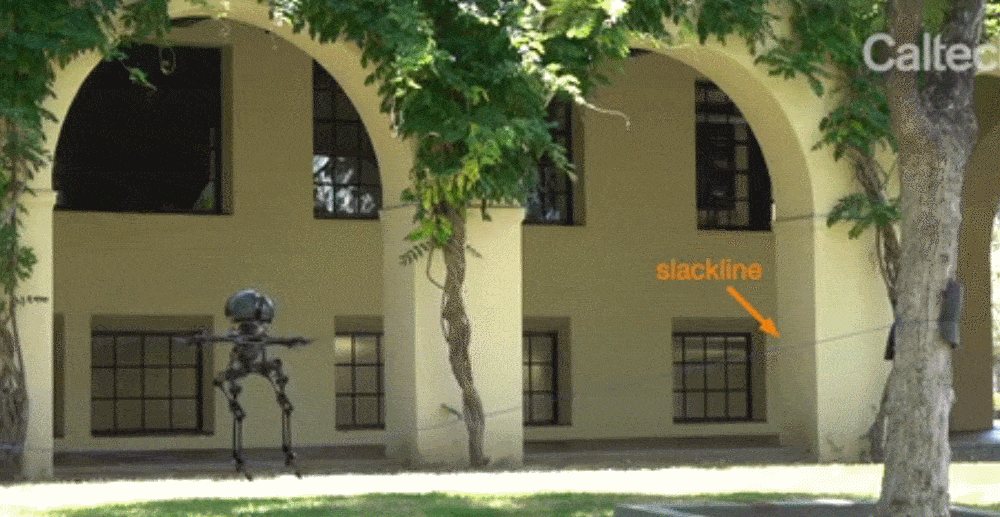
▲LEO walks along the rope tied between the treesThe design of this robot is inspired by the various behaviors of birds between walking and flying. The researchers named it LEONARDO (legs on the "legsonboarddrone" drone, or LEO for short). LEO can achieve fine control of its own balance through multi-articulated legs and propeller-based propellers.
The researchers stated in the research paper that LEO can perform various tasks that are difficult for humans and traditional robots to perform thanks to its hybrid motion capabilities. High-altitude operations will be one of the most suitable applications for LEO, such as the maintenance of high-voltage lines, and spray paint on high-altitude bridges.
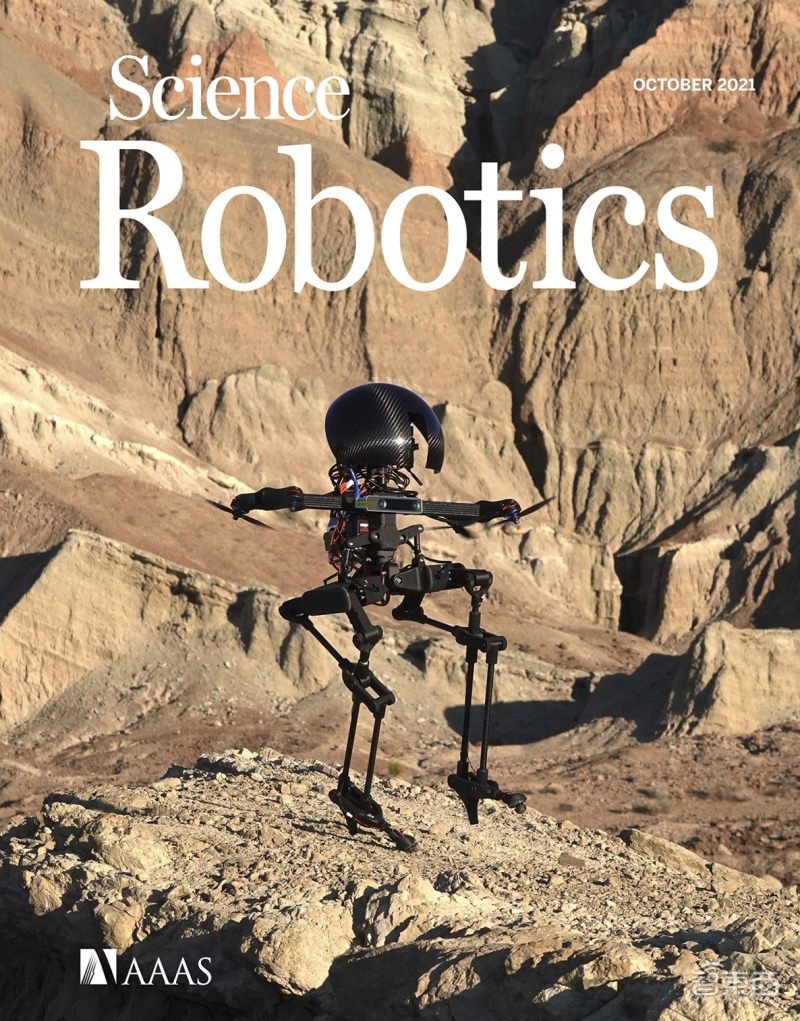
Penyelidikan itu diterbitkan pada Rabu ini dalam Science Robotics, sub-jurnal Sains, dan muncul di muka depan jurnal bulan ini. Tajuk tesis ialah "Abipedalwalkingrobotthatcanfly, slackline, andskateboard (robot berjalan berkaki dua yang boleh terbang, berjalan tali tegang, dan papan selaju)".
 Pertama. Tukar cara pergerakan tradisional, supaya robot boleh berlari dan terbang
Kebanyakan robot sedia ada boleh bergerak di atas tanah atau di udara, tetapi hampir tiada robot yang mempunyai kedua-dua mod pergerakan ini. Di samping itu, robot sedia ada jarang mempunyai keupayaan untuk melaksanakan tugas yang kompleks.
Ground robots have legged, wheeled, crawling and other forms. Among them, biped robots have attracted much attention because they have the appearance of humans and can walk, run, and jump like humans. However, the movement of ground robots is easily restricted by rugged terrain, and its application range is also limited to near the ground, making it difficult to work at heights.
Flying robots can ignore all kinds of rugged terrain and engage in aerial work such as remote sensing, delivery, search and rescue, and inspection. But its own shortcomings are also very obvious, such as high energy consumption, short flight time, and limited load capacity. In addition, because aerial robots need to take care of their own stability when working in the air, it is more difficult to physically interact with objects than ground robots.
Para penyelidik menggabungkan kelebihan kedua-dua robot ini, membolehkan LEO menggabungkan mod gerakan berjalan dan terbang untuk gerakan bercampur, dan menyesuaikan diri dengan pelbagai rupa bumi lasak dengan menukar antara mod gerakan yang berbeza.
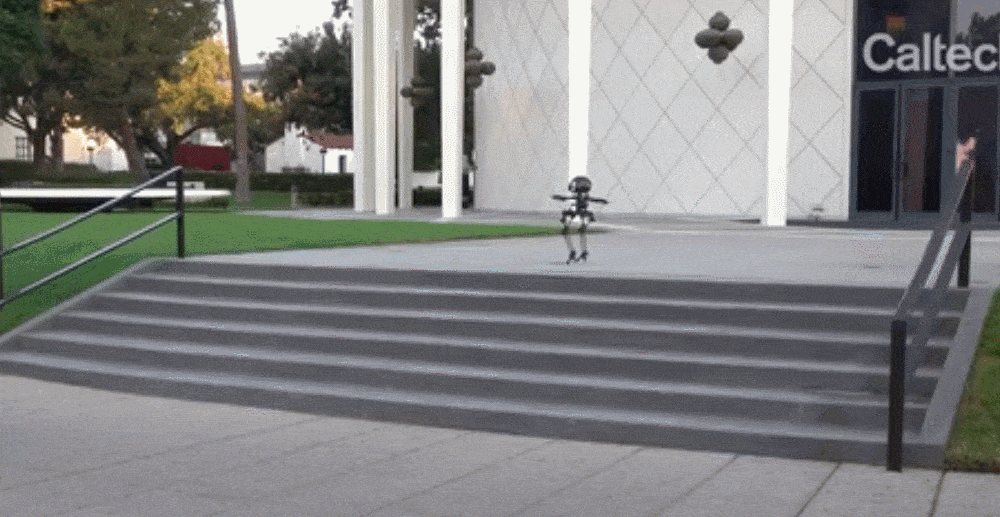
▲LEO berjalan ke hadapan anak tangga dan terbang menuruni anak tanggaKedua. Ketinggian 75 cm hanya 5 kg dan beratnya ialah 4 kipas.
Berat LEO ialah 2.58 kg dan ketinggian keseluruhan semasa berjalan ialah 75 cm. Ia terutamanya terdiri daripada batang tubuh, sistem pendorong kipas dan dua kaki dengan tumit runcing.
In order to make it light enough, LEO’s leg structure uses carbon fiber tubes and 3D printed carbon fiber reinforced nylon joints to support ball bearings. Its two legs are symmetrical. Each leg has 3 servo motors. One is located at the pelvis and the other two are located at the front and back of the hip. The three servo motors jointly control the movement of the legs.
Bahu LEO dilengkapi dengan 4 kipas yang diletakkan secara simetri untuk menstabilkan dan mengawal pergerakan berjalan dan penerbangan.
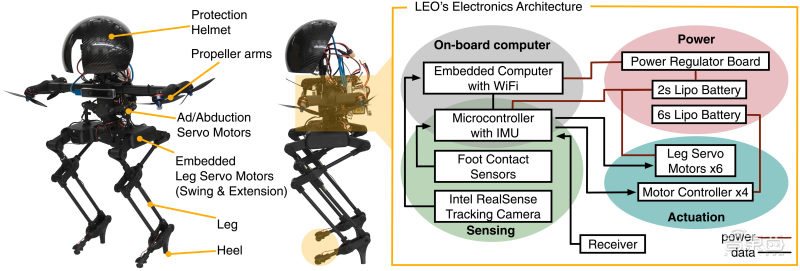
▲Bahagian elektronik dan mekanikal LEOLEO boleh beroperasi sepenuhnya secara autonomi melalui komputer onboard dan suite sensornya. Bergantung pada jenis halangan yang perlu dilalui, ia boleh memilih untuk menggunakan berjalan atau terbang, atau mencampurkan kedua-duanya mengikut keperluan.
Semasa berjalan, kipas LEO memastikan ia boleh kekal tegak semasa berjalan, dan penggerak kaki menggerakkan pusat graviti robot ke hadapan dengan menukar kedudukan kaki untuk mencapai berjalan. Dalam penerbangan, LEO boleh menggunakan kipas sahaja dan terbang seperti drone.Ketiga, bermain ski, berjalan tali tegang, operasi altitud tinggi adalah arah aplikasi terbesar
Terima kasih kepada keupayaannya untuk mencampurkan sukan, penyelidik mendapati bahawa ia boleh menyelesaikan beberapa tindakan yang sukar untuk robot konvensional, seperti berjalan di atas tali dan meluncur di atas papan selaju. Dan ia juga mempunyai keupayaan anti-gangguan yang sangat tinggi, dan ia boleh kekal stabil walaupun pada kelajuan angin sehingga 3.8m/s.
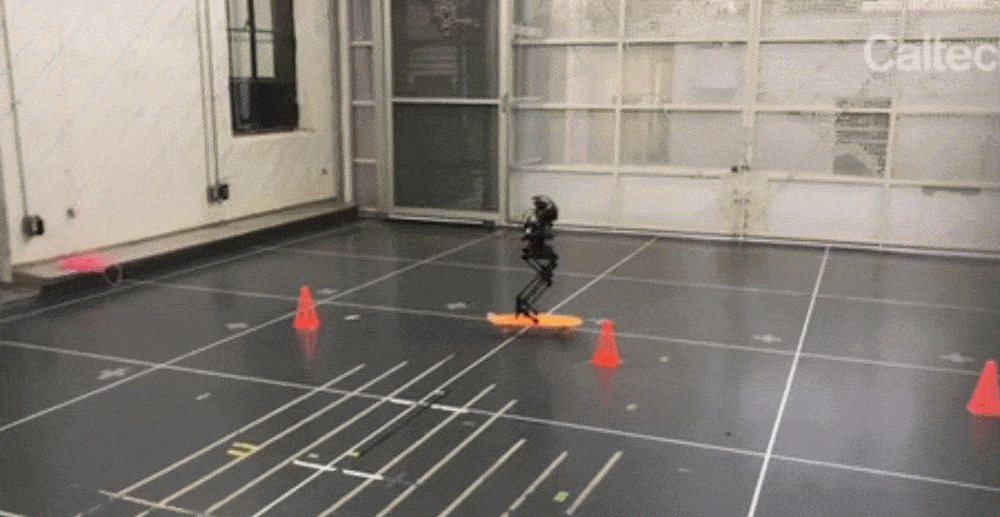
▲Papan selaju LEO untuk memintas halanganPara penyelidik berkata dalam kertas itu: "Mungkin aplikasi yang paling sesuai untuk LEO adalah yang melibatkan operasi altitud tinggi. Tugas-tugas ini biasanya berbahaya untuk manusia dan memerlukan robot untuk menggantikannya."
For example, the current high-voltage line inspection is done by professionals, who not only have to remotely inspect the line, but also go on the line for inspection and maintenance. Using LEO, there is no need to send personnel to climb up the wires, and only use the robot to fly onto high-voltage lines and walk along the wires for maintenance work. This will reduce maintenance costs and reduce the possibility of falling casualties.
In addition to these effects, the technology designed for LEO can also promote the development of adaptive landing gear systems. The research team envisions that future Martian rotorcraft can be equipped with legged landing gear so that they can maintain their balance when landing on sloping or uneven terrain, thereby reducing the risk of landing failure.
Next, the team plans to improve the performance of LEO by improving the leg design to make it stronger to support heavier robots and increase the thrust of the propeller. In addition, they also hope that LEO can be more autonomous, so that when the robot is walking on rugged terrain, it can understand how much weight the legs support and how much thrust is required by the propeller.
The researchers also plan to equip LEO with a newly developed control algorithm that uses a deep neural network to control the landing of the drone, allowing the robot to better understand the environment and decide on its own the best combination of walking, flying or mixed motion. The safest and least energy-consuming way to move from one place to another.
Kesimpulan:Robot Leo Boleh berlari dan terbang, supaya ruang aplikasi robot berkaki dua lebih luas
Kerana rupa manusianya, robot berkaki dua boleh meniru manusia untuk menyelesaikan pelbagai tugas. Walau bagaimanapun, disebabkan keadaan persekitaran dan rupa bumi, pergerakan robot berkaki dua akan dihadkan dalam banyak kes.
LEO menggabungkan berjalan dan terbang untuk membolehkan robot berkaki dua berlari dan terbang, memecahkan halangan rupa bumi dan menjadikannya lebih meluas digunakan. Robot humanoid; Robot Perkhidmatan AI; Kobot mudah alih


