


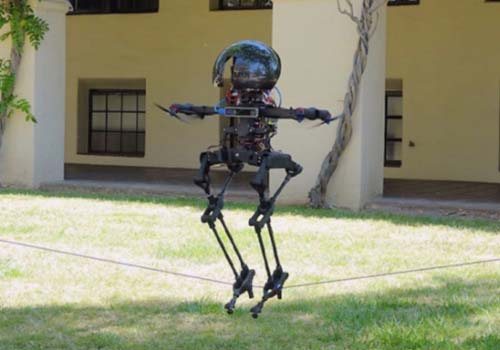
Op 9 oktober hebben onderzoekers van het California Institute of Technology een tweevoetige robot ontwikkeld die tweevoetige loop- en vliegbewegingen combineert, waardoor hij extreem flexibel is en complexe bewegingen kan uitvoeren, zoals glijden. Skateboarden, koorddansen, enz.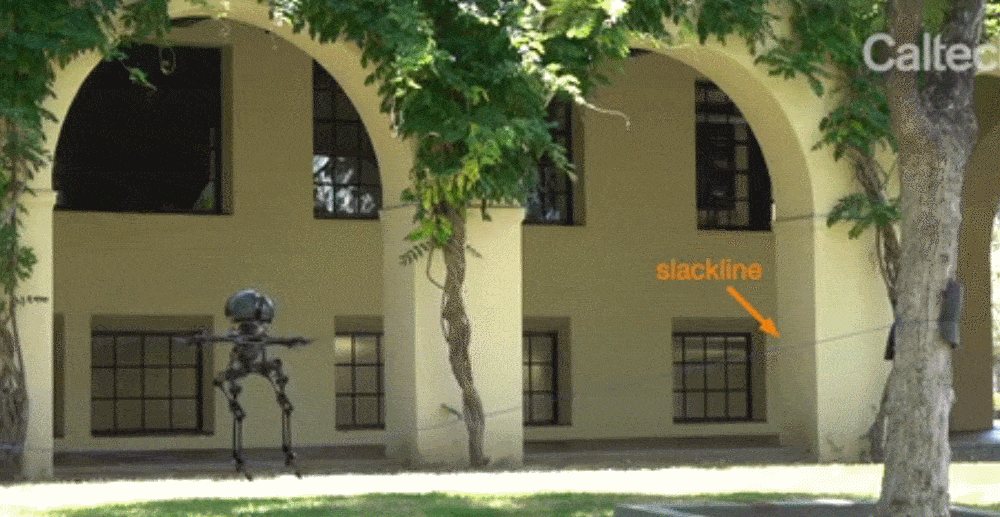
▲LEO walks along the rope tied between the treesThe design of this robot is inspired by the various behaviors of birds between walking and flying. The researchers named it LEONARDO (legs on the "legsonboarddrone" drone, or LEO for short). LEO can achieve fine control of its own balance through multi-articulated legs and propeller-based propellers.
The researchers stated in the research paper that LEO can perform various tasks that are difficult for humans and traditional robots to perform thanks to its hybrid motion capabilities. High-altitude operations will be one of the most suitable applications for LEO, such as the maintenance of high-voltage lines, and spray paint on high-altitude bridges.
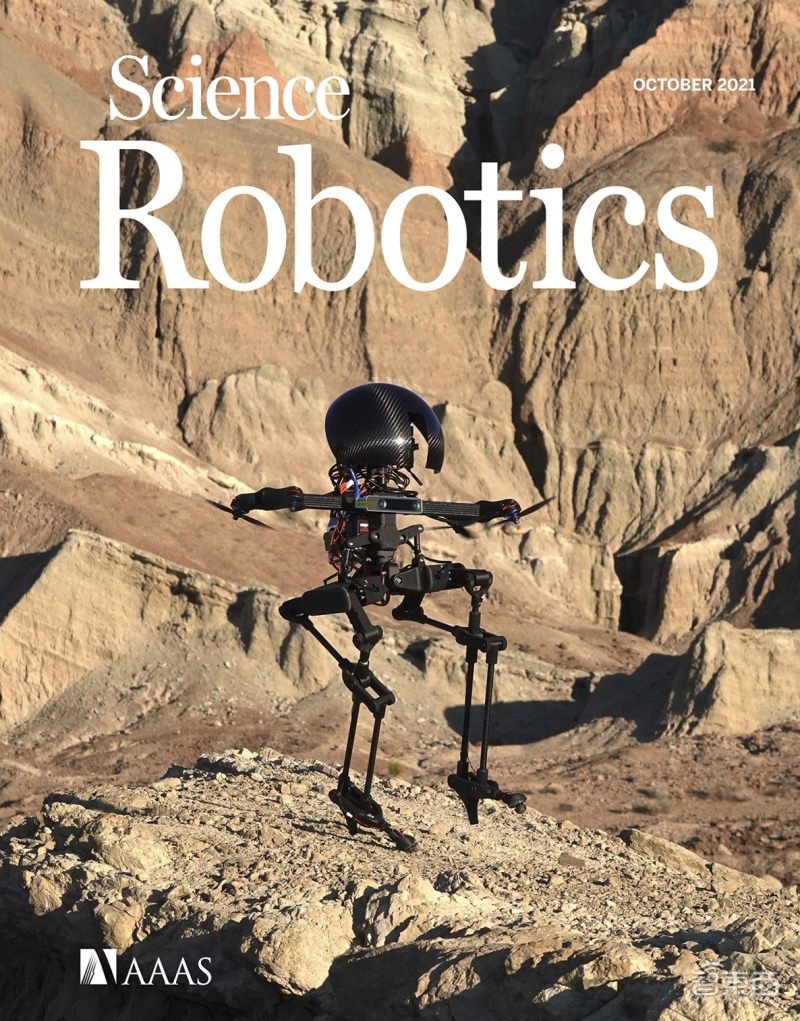
Het onderzoek werd woensdag gepubliceerd in Science Robotics, een subtijdschrift van Science, en verscheen deze maand op de cover van het tijdschrift. De titel van het proefschrift is "Abipedalwalkingrobotthatcanfly, slackline, andskateboard (een tweevoetige looprobot die kan vliegen, koorddansen en skateboarden)".
 Eerst. Verander de traditionele manier van bewegen, zodat de robot kan rennen en vliegen
De meeste bestaande robots kunnen over de grond of in de lucht bewegen, maar er zijn bijna geen robots die beide bewegingsmodi hebben. Bovendien hebben de bestaande robots zelden het vermogen om complexe taken uit te voeren.
Ground robots have legged, wheeled, crawling and other forms. Among them, biped robots have attracted much attention because they have the appearance of humans and can walk, run, and jump like humans. However, the movement of ground robots is easily restricted by rugged terrain, and its application range is also limited to near the ground, making it difficult to work at heights.
Flying robots can ignore all kinds of rugged terrain and engage in aerial work such as remote sensing, delivery, search and rescue, and inspection. But its own shortcomings are also very obvious, such as high energy consumption, short flight time, and limited load capacity. In addition, because aerial robots need to take care of their own stability when working in the air, it is more difficult to physically interact with objects than ground robots.
De onderzoekers combineerden de voordelen van deze twee robots, waardoor LEO loop- en vliegbewegingsmodi kon combineren voor gemengde bewegingen, en zich kon aanpassen aan verschillende ruige terreinen door te schakelen tussen verschillende bewegingsmodi.
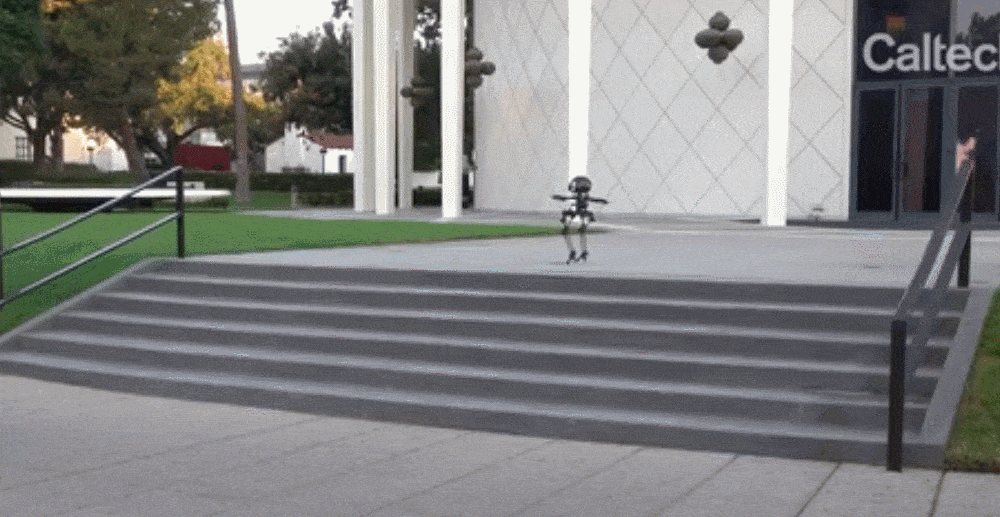
▲LEO liep naar de voorkant van de trap en vloog de trap afSeconde. De hoogte van 75 cm is slechts 5 kg en het gewicht is 4 propellers.
Het gewicht van LEO is 2,58 kg en de totale lengte bij lopen is 75 cm. Het bestaat voornamelijk uit een torso, een propelleraandrijfsysteem en twee benen met puntige hakken.
In order to make it light enough, LEO’s leg structure uses carbon fiber tubes and 3D printed carbon fiber reinforced nylon joints to support ball bearings. Its two legs are symmetrical. Each leg has 3 servo motors. One is located at the pelvis and the other two are located at the front and back of the hip. The three servo motors jointly control the movement of the legs.
De schouders van LEO zijn uitgerust met 4 symmetrisch geplaatste propellers om de loop- en vliegbewegingen te stabiliseren en te controleren.
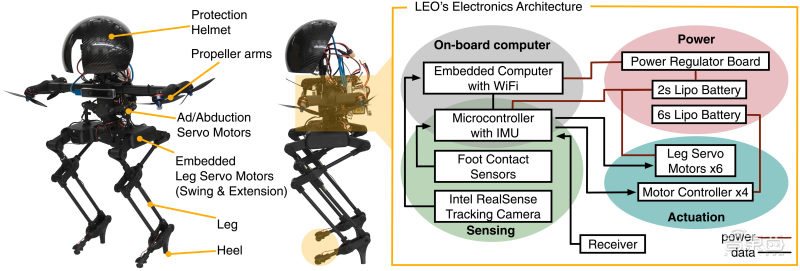
▲LEO's elektronische en mechanische onderdelenLEO kan volledig autonoom werken via de boordcomputer en sensorsuite. Afhankelijk van het type obstakel dat moet worden overwonnen, kan hij ervoor kiezen om te lopen of te vliegen, of indien nodig een combinatie van deze twee.
Tijdens het lopen zorgen de propellers van LEO ervoor dat hij tijdens het lopen rechtop kan blijven staan, en de beenactuators verplaatsen het zwaartepunt van de robot naar voren door de positie van de benen te veranderen om lopen mogelijk te maken. Tijdens de vlucht kan LEO alleen propellers gebruiken en vliegen als een drone.Ten derde zijn skiën, koorddansen en operaties op grote hoogte de grootste toepassingsrichting
Dankzij het vermogen om sporten te combineren, ontdekten onderzoekers dat het een aantal acties kan uitvoeren die moeilijk zijn voor conventionele robots, zoals lopen over touwen en glijden op skateboards. En het heeft ook een zeer hoog anti-interferentievermogen en kan stabiel blijven, zelfs bij windsnelheden tot 3,8 m/s.
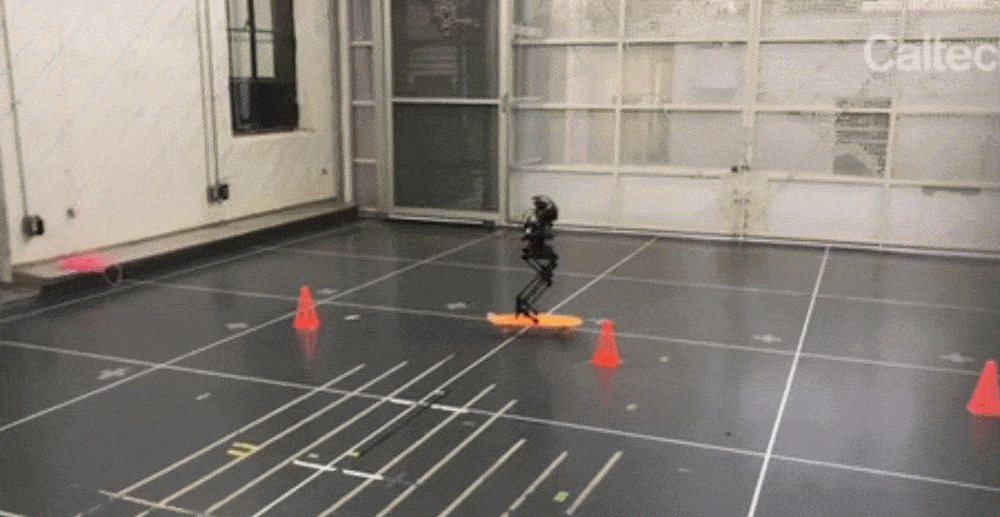
▲LEO-skateboard om obstakels te omzeilenDe onderzoekers zeiden in de paper: "Misschien zijn de meest geschikte toepassingen voor LEO die waarbij operaties op grote hoogte betrokken zijn. Deze taken zijn meestal gevaarlijk voor mensen en vereisen dat robots ze vervangen."
For example, the current high-voltage line inspection is done by professionals, who not only have to remotely inspect the line, but also go on the line for inspection and maintenance. Using LEO, there is no need to send personnel to climb up the wires, and only use the robot to fly onto high-voltage lines and walk along the wires for maintenance work. This will reduce maintenance costs and reduce the possibility of falling casualties.
In addition to these effects, the technology designed for LEO can also promote the development of adaptive landing gear systems. The research team envisions that future Martian rotorcraft can be equipped with legged landing gear so that they can maintain their balance when landing on sloping or uneven terrain, thereby reducing the risk of landing failure.
Next, the team plans to improve the performance of LEO by improving the leg design to make it stronger to support heavier robots and increase the thrust of the propeller. In addition, they also hope that LEO can be more autonomous, so that when the robot is walking on rugged terrain, it can understand how much weight the legs support and how much thrust is required by the propeller.
The researchers also plan to equip LEO with a newly developed control algorithm that uses a deep neural network to control the landing of the drone, allowing the robot to better understand the environment and decide on its own the best combination of walking, flying or mixed motion. The safest and least energy-consuming way to move from one place to another.
Conclusie:Robot Leo Kan rennen en vliegen, waardoor de toepassingsruimte van tweevoetige robots breder is
Vanwege hun menselijke uiterlijk kunnen tweevoetige robots mensen imiteren om verschillende taken uit te voeren. Vanwege omgevings- en terreinomstandigheden zal de bewegingsvrijheid van tweevoetige robots echter in veel gevallen beperkt zijn.
LEO combineert lopen en vliegen om tweevoetige robots te laten rennen en vliegen, waardoor het obstakel van het terrein wordt doorbroken en het op grotere schaal wordt gebruikt.humanoïde robot;AI-servicerobot;mobiele cobot


