


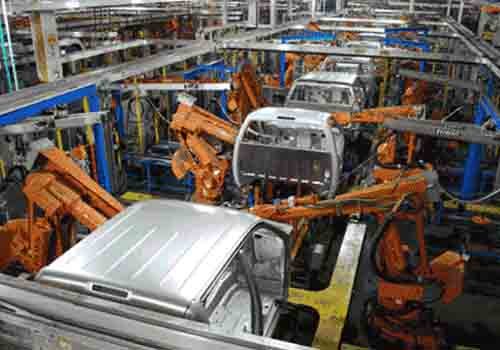
Robôs industriais are important equipment in the upgrading of advanced manufacturing, and they are also an important indicator of the technological level of a country's manufacturing industry. The robot industry with industrial robots as the main body is an important way to solve the problems of rising industrial costs and environmental constraints in my country. An industrial robot is a multi-joint manipulator or a multi-degree-of-freedom machine device oriented to the industrial field.
It can automatically perform work and is a machine that relies on its own power and control capabilities to achieve various functions. It can be commanded by humans, and it can also be run in accordance with pre-arranged programs. Modern industrial robots can also perform tasks in accordance with principles and guidelines established by artificial intelligence technology.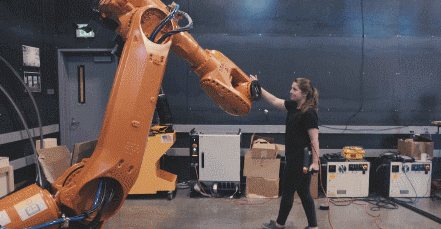 O primeiro robô industrial em conformidade com a norma ISO foi produzido por Bill Griffith Taylor em 1937 e publicado na revista Meccano em março de 1938.
Este robô industrial semelhante a um guindaste é feito de peças Meccano e movido por um único motor elétrico. Este robô industrial pode empilhar blocos de madeira de forma pré-programada.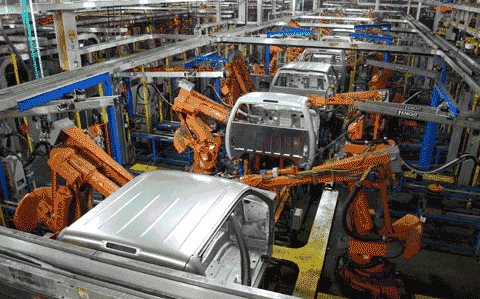 A metade do século 20 foi um período crítico para a pesquisa e desenvolvimento de robôs industriais.
Especially in the industrial environment, the work of repetitive motion and lifting heavy objects made the machine a great help to humans. Most industrial robots are used in work environments that are too dirty, tiring, or dangerous for humans.George Devol first proposed the concept of industrial robots, and applied for a patent in 1954 (patent approved in 1961). In 1956, Davor and Joseph Engelberg jointly established Unimation based on Davor's original patent.
Em 1959, o primeiro robô industrial da Unimation nasceu nos Estados Unidos, abrindo uma nova era no desenvolvimento de robôs.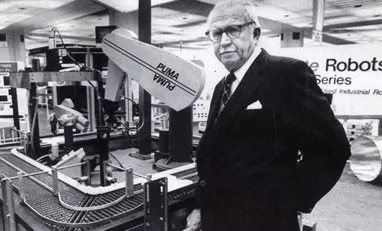 ▲ George DavorRobotics is a multidisciplinary field that combines the fields of mechanics, electronics, computer science, control, artificial intelligence, physics and mathematics. Industrial robots are composed of six basic components: dynamic units, end-of-arm machines, digital computer controllers, actuators, input devices and detectors.
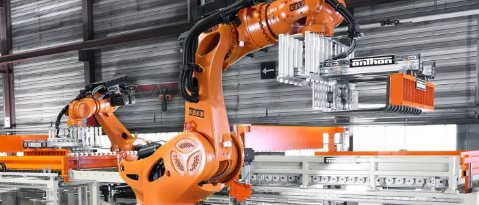
Industrial robot actuator: The actuator controls each axis and maintains the direction of movement. Since the robot needs to handle the weight of various components, its motion varies greatly. Send commands about the direction of movement from the robot computer and constantly check the feedback to ensure that the moving parts follow the correct route. This process requires high-speed equipment to send commands and read the movement of the system at a reasonable speed.Digital computer controller: For the robot, it controls the normal operation of each component.
O controlador do computador pode inserir e armazenar vários programas para determinar a conexão e o relacionamento da sequência de trabalho.Sensores: O robô usa sensores para reconhecer e avaliar mudanças de posição, diferenças de estilo e obstáculos ou mau funcionamento de sistemas externos.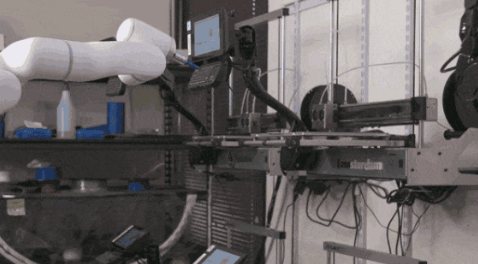 Sistema de feedback: O dispositivo de feedback do robô industrial pode medir a posição, velocidade de movimento e aceleração de cada eixo.
The axis must set any point to zero as a reference point in order to achieve relatively linear motion.Dynamic system: the motion part of the robot system including the industrial robot arm. The structure of the dynamic system is realized by connecting many rotation or linear motion joints.The motion provided by industrial robot joints can place the robot structure or robot arm in a specific position. The different types of joint configurations are listed below——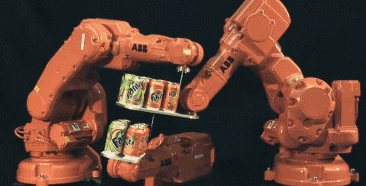
▲ O robô industrial ABB completou o desafio "Fanta Tank"Configuração articulada: O braço articulado é o braço robótico mais comum, muito semelhante a um braço humano. Geralmente máquinas de seis eixos, elas fornecem redundância e se movem de maneira mais suave.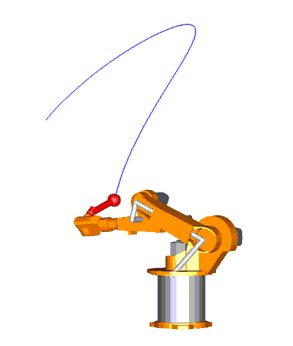 ▲ Configuração de junta articulada
There are six rotary joints in the articulated configuration system, and each rotary joint is placed on the previous joint. They have a variety of configurations to reach a point within the working envelope or the ability to place equipment anywhere.SCARA configuration: This four-axis arm mainly performs assembly tasks. They are small in size, but have the greatest carrying capacity.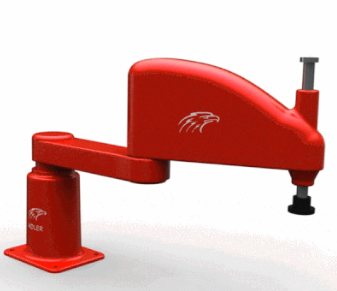
▲ Configuração SCARA configuração conjunta
The four-axis arm of the SCARA configuration is composed of basic rotation, linear vertical movement and two rotational movements. The linear vertical movement is in the same vertical plane. The four-axis arm of the SCARA configuration is very rigid in the vertical direction and can be ensured to be consistent with the horizontal plane.Cartesian configuration: Cartesian robots are simple robôs de três eixosque contêm apenas acionamentos lineares com três fusos.
Usually used for picking and placing, handling, palletizing, plastic molding, assembly and machine maintenance.Parallel configuration: One of the new design developments is the parallel or incremental robot configuration, as shown in the figure below——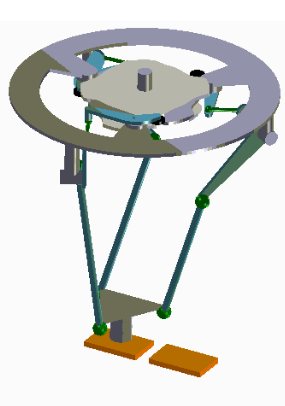
▲ Robô industrial paraleloUm mecanismo paralelo pode ser definido como um mecanismo de circuito fechado no qual a plataforma móvel e a plataforma fixa são conectadas por pelo menos duas cadeias cinemáticas independentes, o mecanismo tem dois ou mais graus de liberdade e é acionado em paralelo.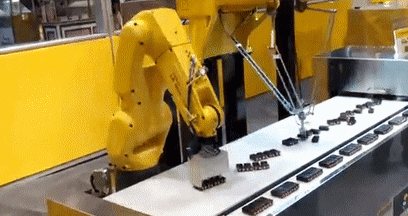 As aplicações típicas de robôs industriais incluem soldagem, pintura, montagem, coleta e colocação (como embalagem, paletização e SMT), inspeção e teste de produtos, etc.; todas as tarefas são concluídas com alta eficiência, durabilidade, velocidade e precisão.
 Para executar tarefas de trabalho com mais precisão, os robôs industriais geralmente incluem subsistemas de visão de máquina como seus sensores de visão, conectados a computadores ou controladores poderosos.
For modern industrial robots, robôs de inteligência artificialtornaram-se equipamentos cada vez mais importantes.


