


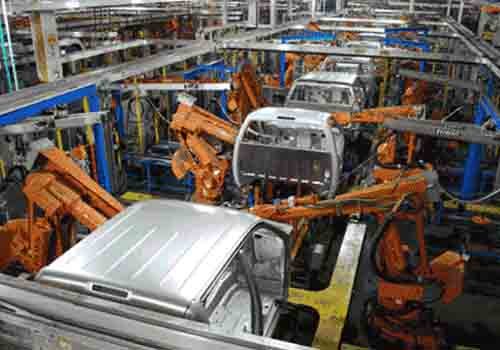
Industriële robots are important equipment in the upgrading of advanced manufacturing, and they are also an important indicator of the technological level of a country's manufacturing industry. The robot industry with industrial robots as the main body is an important way to solve the problems of rising industrial costs and environmental constraints in my country. An industrial robot is a multi-joint manipulator or a multi-degree-of-freedom machine device oriented to the industrial field.
It can automatically perform work and is a machine that relies on its own power and control capabilities to achieve various functions. It can be commanded by humans, and it can also be run in accordance with pre-arranged programs. Modern industrial robots can also perform tasks in accordance with principles and guidelines established by artificial intelligence technology.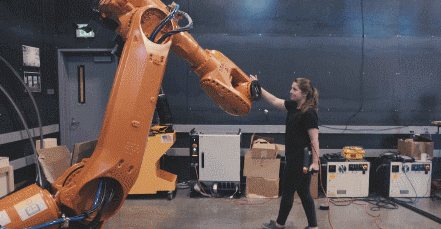 De eerste industriële robot die aan de ISO-norm voldeed, werd in 1937 geproduceerd door Bill Griffith Taylor en in maart 1938 gepubliceerd in het tijdschrift Meccano.
Deze kraanachtige industriële robot is gemaakt van Meccano-onderdelen en wordt aangedreven door een enkele elektromotor. Deze industriële robot kan op voorgeprogrammeerde wijze houten blokken stapelen.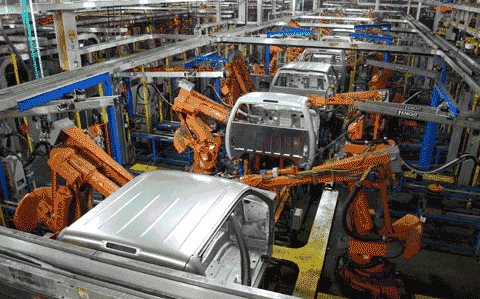 Het midden van de 20e eeuw was een cruciale periode voor het onderzoek en de ontwikkeling van industriële robots.
Especially in the industrial environment, the work of repetitive motion and lifting heavy objects made the machine a great help to humans. Most industrial robots are used in work environments that are too dirty, tiring, or dangerous for humans.George Devol first proposed the concept of industrial robots, and applied for a patent in 1954 (patent approved in 1961). In 1956, Davor and Joseph Engelberg jointly established Unimation based on Davor's original patent.
In 1959 werd de eerste industriële robot van Unimation geboren in de Verenigde Staten, waarmee een nieuw tijdperk van robotontwikkeling werd geopend.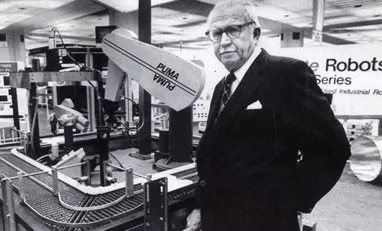 ▲ George DavorRobotics is a multidisciplinary field that combines the fields of mechanics, electronics, computer science, control, artificial intelligence, physics and mathematics. Industrial robots are composed of six basic components: dynamic units, end-of-arm machines, digital computer controllers, actuators, input devices and detectors.
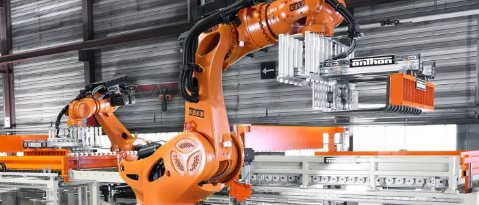
Industrial robot actuator: The actuator controls each axis and maintains the direction of movement. Since the robot needs to handle the weight of various components, its motion varies greatly. Send commands about the direction of movement from the robot computer and constantly check the feedback to ensure that the moving parts follow the correct route. This process requires high-speed equipment to send commands and read the movement of the system at a reasonable speed.Digital computer controller: For the robot, it controls the normal operation of each component.
De computercontroller kan verschillende programma's invoeren en opslaan om de samenhang en relatie van het werkverloop te bepalen. Sensoren: De robot gebruikt sensoren om positieveranderingen, stijlverschillen en obstakels of storingen van externe systemen te herkennen en te evalueren.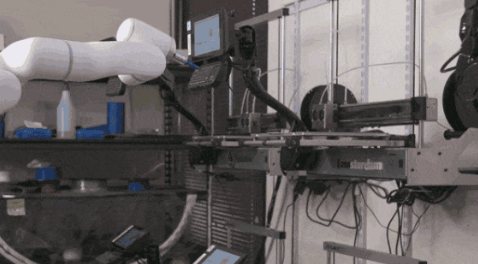 Feedbacksysteem: Het feedbackapparaat van de industriële robot kan de positie, bewegingssnelheid en versnelling van elke as meten.
The axis must set any point to zero as a reference point in order to achieve relatively linear motion.Dynamic system: the motion part of the robot system including the industrial robot arm. The structure of the dynamic system is realized by connecting many rotation or linear motion joints.The motion provided by industrial robot joints can place the robot structure or robot arm in a specific position. The different types of joint configurations are listed below——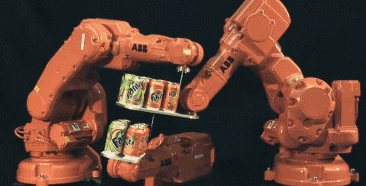
▲ De industriële robot van ABB heeft de uitdaging "Fanta Tank" voltooid Gelede configuratie: de gelede arm is de meest voorkomende robotarm en lijkt sterk op een menselijke arm. Meestal zijn het zesassige machines, ze bieden redundantie en bewegen soepeler.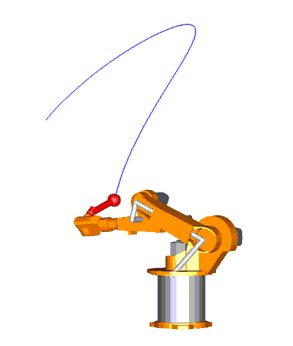 ▲ Gelede gewrichtsconfiguratie
There are six rotary joints in the articulated configuration system, and each rotary joint is placed on the previous joint. They have a variety of configurations to reach a point within the working envelope or the ability to place equipment anywhere.SCARA configuration: This four-axis arm mainly performs assembly tasks. They are small in size, but have the greatest carrying capacity.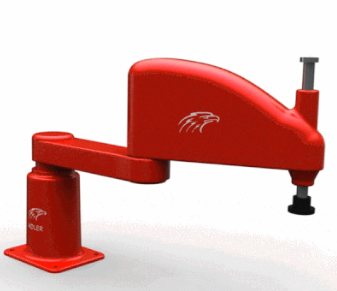
▲ SCARA-configuratie gezamenlijke configuratie
The four-axis arm of the SCARA configuration is composed of basic rotation, linear vertical movement and two rotational movements. The linear vertical movement is in the same vertical plane. The four-axis arm of the SCARA configuration is very rigid in the vertical direction and can be ensured to be consistent with the horizontal plane.Cartesian configuration: Cartesian robots are simple drie-assige robotsdie alleen lineaire aandrijvingen met drie spindels bevatten.
Usually used for picking and placing, handling, palletizing, plastic molding, assembly and machine maintenance.Parallel configuration: One of the new design developments is the parallel or incremental robot configuration, as shown in the figure below——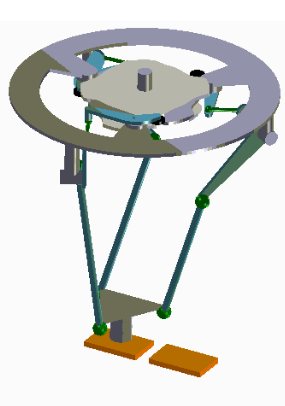
▲ Parallelle industriële robotEen parallel mechanisme kan worden gedefinieerd als een gesloten-lusmechanisme waarbij het bewegende platform en het vaste platform zijn verbonden door ten minste twee onafhankelijke kinematische ketens, het mechanisme twee of meer vrijheidsgraden heeft en parallel wordt aangedreven.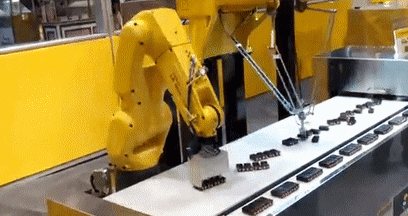 Typische toepassingen van industriële robots zijn onder meer lassen, schilderen, assembleren, verzamelen en plaatsen (zoals verpakken, palletiseren en SMT), productinspectie en testen, enz.; alle taken worden uitgevoerd met hoge efficiëntie, duurzaamheid, snelheid en nauwkeurigheid.
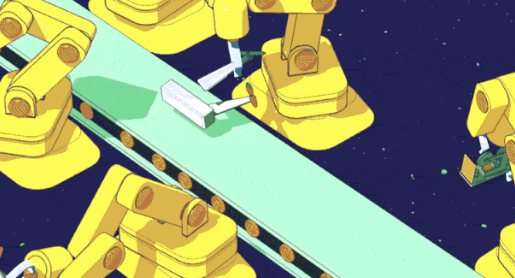 Om werktaken nauwkeuriger uit te voeren, gebruiken industriële robots meestal machine vision-subsystemen als vision-sensoren, verbonden met krachtige computers of controllers.
For modern industrial robots, kunstmatige intelligentie-robotszijn steeds belangrijker apparaten geworden.


