


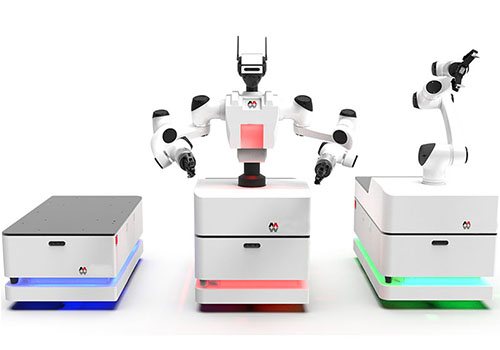
"Made in China 2025" plans the strategic goal of my country's manufacturing power, and intelligent manufacturing has become the top priority of industrial manufacturing transformation. Under the general trend of intelligence, the downstream application fields of intelligent equipment are accelerating the expansion, and the development of robots industrielson peut s'attendre.
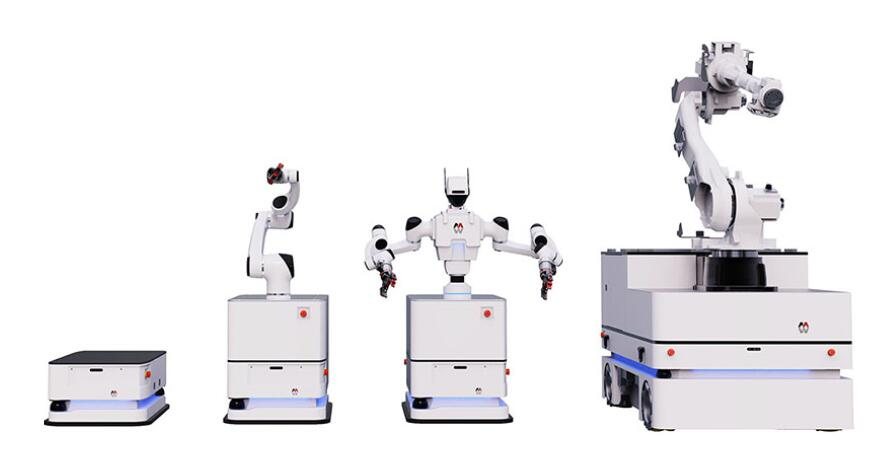
Industrial robots refer to multi-joint manipulators or multi-degree-of-freedom mechanical devices that can work intelligently under human control and can perfectly replace humans working on the production line. Compared with manpower, industrial robots have the characteristics of low cost, high efficiency and 24-hour work. In recent years, as domestic labor costs continue to rise, the labor advantage of my country's manufacturing industry is not obvious, the manufacturing industry urgently needs to transform to intelligence, and industrial robots are showing a strong development trend.
my country is a big consumer of industrial robots. Since 2013, it has become the world's largest consumer market for industrial robots for two consecutive years. There are often industrial robots in the fields of automobile manufacturing, electronics, rubber and plastics, military industry, aviation manufacturing, food industry, medical equipment and metal products. Among them, the automotive industry has the most applications, accounting for 38%.
Le Guangdong, le Jiangsu, Shanghai, Pékin et d'autres endroits sont les principales zones concentrées de l'industrie des robots industriels de mon pays, et le nombre de robots industriels détenus représente la moitié du marché national des robots industriels.
However, due to the lack of core technology, the consumption of industrial robots in my country is heavily dependent on foreign companies, especially in core components such as reducers, servo motors, and controllers. Domestic robot companies in my country are restricted by others and can only purchase expensive foreign equipment, which requires domestic industries. Robot manufacturers continue to improve their technology, increase R&D level, and get rid of the control of China's industrial robot consumer market by foreign robot brands as soon as possible.
Considering that the current density of industrial robots in the global manufacturing industry is 55, while the density of China's industrial robots is only 21, which is much lower than that of developed countries such as Japan, South Korea, Germany and the United States, and in the context of intelligent manufacturing, the policy of "machine substitution" continues to be implemented. There is still a lot of room for growth. Related concept companies such as Inovance Technology, Robotics, Zhiyun Co., Ltd., Keyuan Co., Ltd., and Qinchuan Machine Tool will achieve better development under the robot dividend.
La phase de développement des robots industriels
Le développement des robots industriels peut généralement être divisé en trois générations :
1. Première génération de robots industriels :
Usually refers to the “programmable industrial robots” that are currently commercialized and used internationally, also known as “teaching and reproducing industrial robots”, that is, in order for the industrial robot to complete a certain task, the operator will first complete the task. All kinds of knowledge (such as motion trajectory, operating conditions, operating sequence and operating time, etc.) of industrial robots can be "teached" through direct or indirect means.
After the industrial robots memorize this knowledge, they can "reproduce" Instructions, within a certain accuracy range, faithfully reproduce various taught actions repeatedly. In 1962, the first Unimate industrial robot of Universal Automation of the United States was put into use in General Motors of the United States, marking the birth of the first generation of industrial robots.
2, Deuxième génération de robots industriels :
usually refers to an "intelligent robot" with some kind of intelligence (such as touch, force, vision, etc.). That is, after the sensors receive information such as touch, force and vision, the computer controls the robot's operating machine to complete the corresponding appropriate operations. In 1982, General Motors in the United States equipped the industrial robot with a vision system on the assembly line, thus announcing the advent of a new generation of intelligent industrial robots.
3, Troisième génération de robots industriels :
is the so-called "only-type industrial robot". It not only has a perception function, but also has certain decision-making and planning capabilities. The first generation of industrial robots is still in the laboratory research stage. After the birth-growth-maturity period, industrial robots have become indispensable core equipment in the manufacturing industry. There are about 750,000 industrial robots in the world fighting side by side with workers and friends on all production lines.
As a rising star of the robot family, special robots have a tendency to come from behind due to their wide range of uses. Special robots for various purposes such as humanoid robots, agricultural robots, robots de service, des robots sous-marins, des robots médicaux, des robots militaires et des robots de divertissement sont apparus, et ils évoluent rapidement vers la praticité.Classification des robots industriels
Les robots industriels peuvent être divisés dans les types suivants selon différentes méthodes
1. Les robots industriels sont répartis dans les catégories suivantes selon la forme des coordonnées du manipulateur : (La forme des coordonnées fait référence à la forme du système de coordonnées de référence pris par le bras du manipulateur lorsqu'il est en mouvement.)
(1)Robot industriel à coordonnées cartésiennes
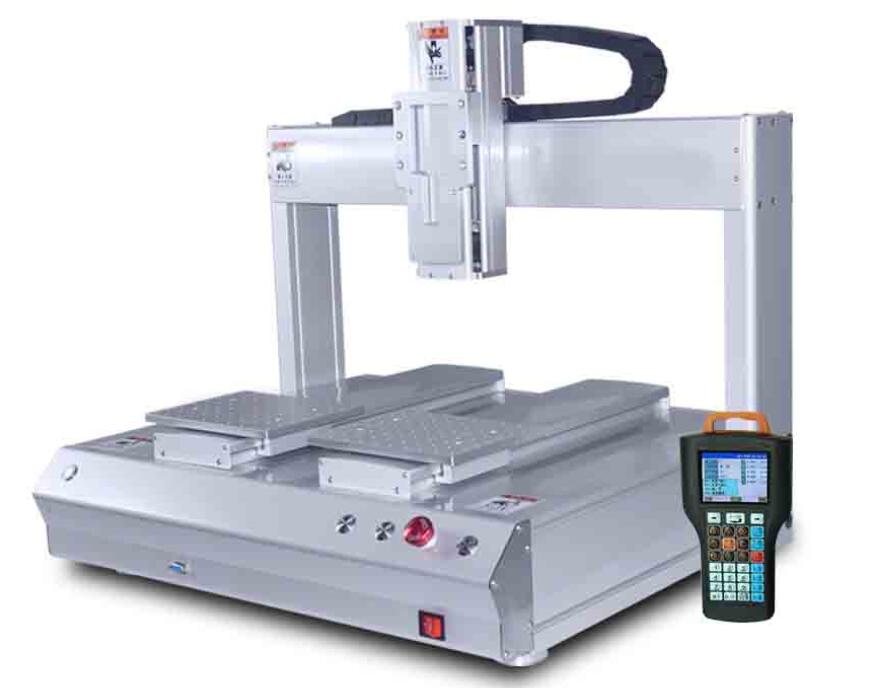
Its movement part is composed of three mutually perpendicular linear movements (namely PPP), and its working space is rectangular. Its moving distance in each axis can be read directly on each coordinate axis. It is intuitive, easy to program and calculate the position and posture, has high positioning accuracy, no coupling control, simple structure, but the body occupies a large space. The motion range is small, the flexibility is poor, and it is difficult to coordinate with other industrial robots.
(2) Robot industriel à coordonnées cylindriques
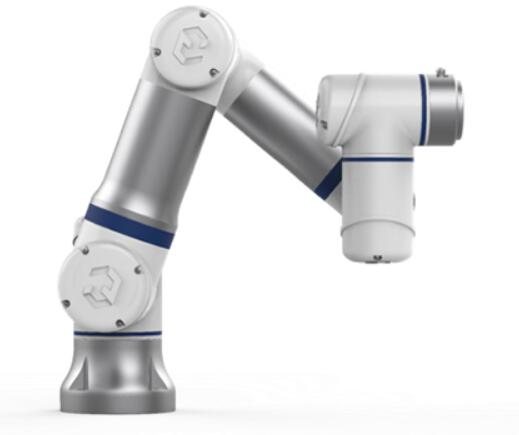
Its motion form is realized by a motion system composed of one rotation and two movements. Its working space is cylindrical. Compared with the rectangular coordinate industrial robot, under the same working space conditions, the body occupies a small volume. The range of motion is large, and its position accuracy is second only to Cartesian coordinate robots, and it is difficult to coordinate with other industrial robots.
(3) Robot industriel à coordonnées sphériques
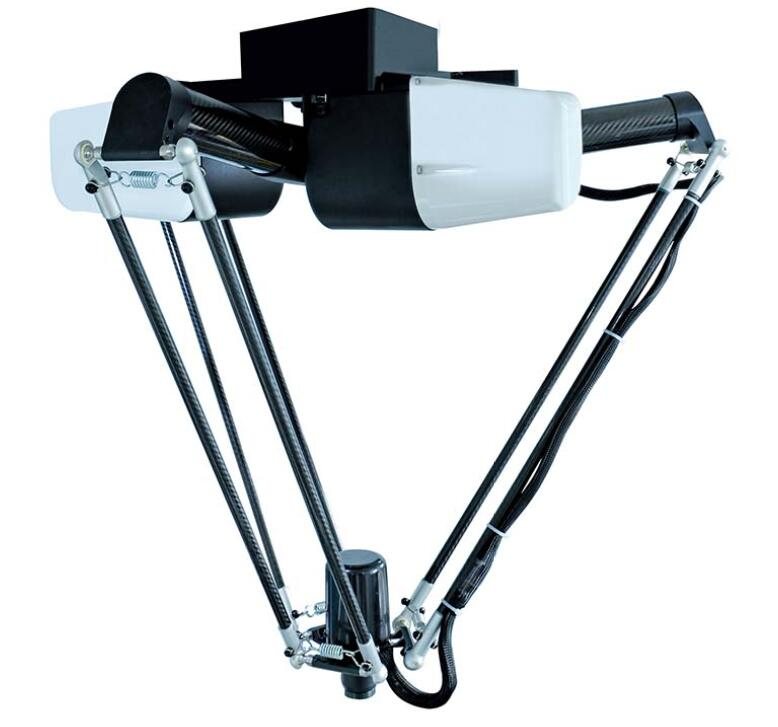
Also known as polar coordinate industrial robot, its arm movement consists of two rotations and one linear movement (ie RRP, one rotation, one pitching and one telescopic movement). Its working space is a sphere, which can make up and down pitching movements. And it can grasp the coordinated workpiece on the ground or teach low position, its position accuracy is high, and the position error is proportional to the arm length.
(4)Robot industriel multi-articulations
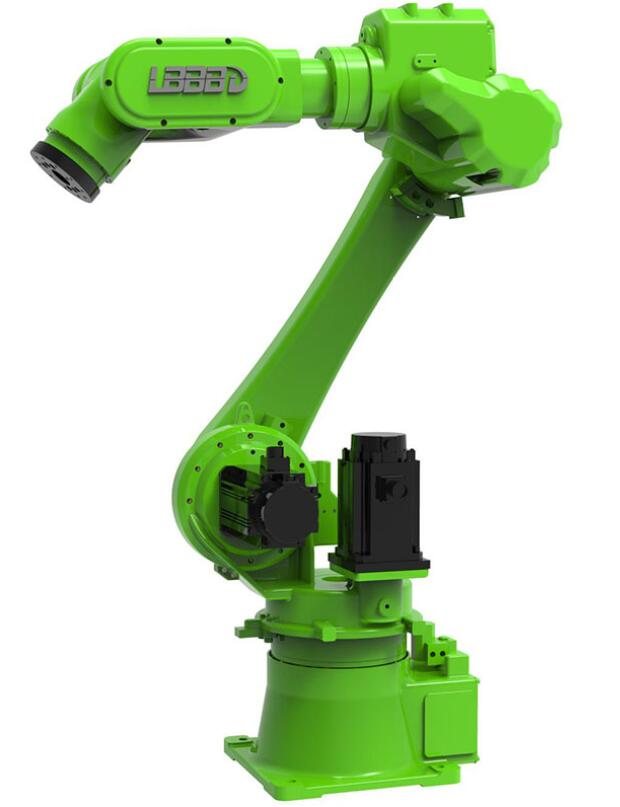
Also known as a rotary coordinate industrial robot. The arm of this industrial robot is similar to the upper limb of a human body. Its first three joints are the revolving joint (RRR). The industrial robot is generally composed of a column and a large and small arm. The column and the big arm are formed An elbow joint is formed between the shoulder joint, the upper arm and the forearm, which can make the upper arm rotate and pitch and swing, and the lower arm can make pitch swing.
Sa structure est la plus compacte, la plus flexible et présente le plus petit encombrement. Il peut fonctionner en coordination avec d'autres robots industriels, mais il présente une faible précision de position, des problèmes d'équilibre et de couplage de commande. Ce type de robot industriel est de plus en plus utilisé.
(5)Robot industriel de type joint planaire
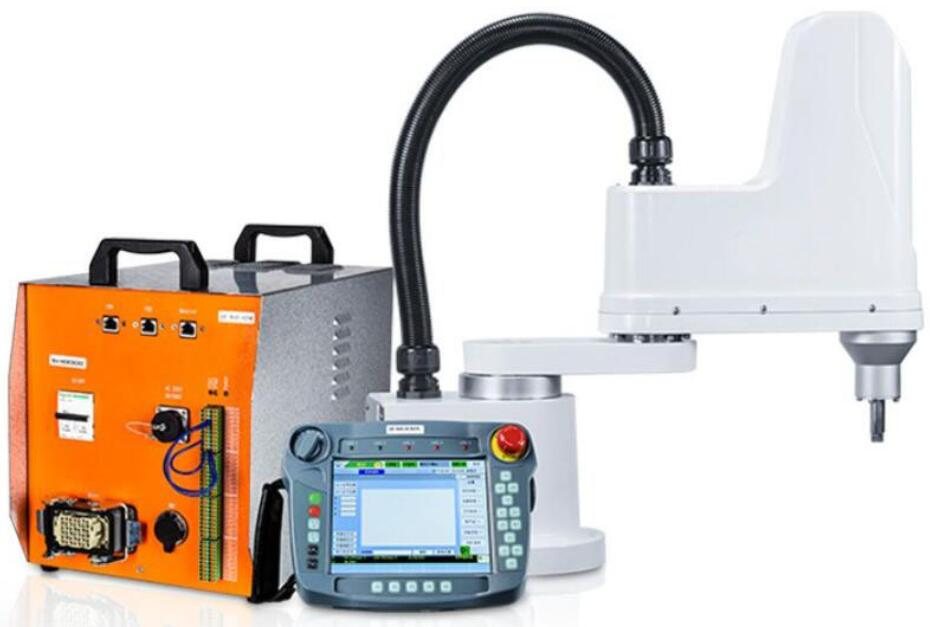
It uses a mobile joint and two rotary joints (PRR), the mobile joint realizes up and down movement, and the two rotary joints control the front and back, left and right movements. This form of industrial robot is also known as (SCARA (Seletive Compliance Assembly Robot Arm) assembly robot. It is flexible in the horizontal direction, and has great rigidity in the vertical direction. It has a simple structure and flexible movements, and is mostly used for assembly operations.
Il est particulièrement adapté à l'assemblage enfichable de pièces de petite taille, tels que l'enfichage et l'assemblage dans l'industrie électronique.2. Les robots industriels sont répartis dans les catégories suivantes selon le mode de conduite :
(1) Robot industriel pneumatique
This type of industrial robot uses compressed air to drive the manipulator. Its advantages are convenient air source, rapid action, simple structure, low cost, and no pollution. The disadvantage is that the air is compressible, resulting in poor working speed stability. The source pressure is generally only about 6kPa, so the snatch force of this type of industrial robot is small, generally only tens of Newtons, and the maximum is more than 100 Newtons.
(2) Robot industriel hydraulique
The hydraulic pressure is much higher than the air pressure, generally about 70kPa, so the hydraulic transmission industrial robot has a large snatch capacity, which can reach thousands of newtons. This type of industrial robot has compact structure, smooth transmission, and sensitive action, but it has high requirements for sealing and is not suitable for working in high or low temperature environments.
(3) Robot industriel électrique
This is the most used type of industrial robot, not only because of the large variety of electric motors, it provides a variety of options for industrial robot design, but also because they can use a variety of flexible control methods. In the early days, stepper motors were used to drive, and then DC servo drive units were developed. At present, AC servo drive units are also developing rapidly. These drive units either directly drive the manipulator, or are driven after deceleration through a device such as a harmonic reducer. The structure is very compact and simple.
Système de contrôle de robot industriel
La structure du système robotique comprend la partie mécanisme du robot, le groupe de capteurs, la partie commande et la partie traitement de l'information. Le système de contrôle est un élément essentiel de l’industrie robotique.1. Fonctions devant être réalisées par le système de contrôle du robot industriel
Le système de contrôle du robot est utilisé pour contrôler le manipulateur afin d'effectuer des tâches spécifiques. Ses fonctions de base sont les suivantes :
(1) Fonction mémoire :
Stockez la séquence de tâches, la trajectoire de mouvement, le mode de mouvement, la vitesse de mouvement et les informations liées au processus de production.
(2) Fonction d'enseignement :
Programmation hors ligne, enseignement en ligne, enseignement indirect. L'enseignement en ligne comprend une boîte pédagogique et un enseignement guidé.
(3) Fonction de contact avec les équipements périphériques :
Interface d'entrée et de sortie, interface de communication, interface réseau, interface de synchronisation.
(4) Fonction de réglage des coordonnées :
Il existe quatre systèmes de coordonnées : joint, absolu, outil et défini par l'utilisateur.
(5) Interface homme-machine :
Boîte d'enseignement, panneau de commande, écran d'affichage.
(6) Interface du capteur :
Détection de position, vision, toucher, force, etc.
(7) Fonction d'asservissement de position :
Liaison multi-axes du robot, contrôle de mouvement, contrôle de vitesse et d'accélération, compensation dynamique, etc.
(8) Fonction de protection de sécurité pour le diagnostic des défauts :
Surveillance de l'état du système pendant le fonctionnement, protection de sécurité en cas de panne et autodiagnostic des pannes.
2. Composition du système de contrôle des robots industriels
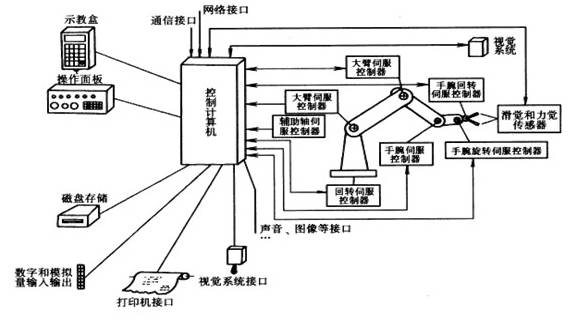 Le schéma fonctionnel du système de contrôle du robot (1) Ordinateur de contrôle :
L'organisation de la répartition et du commandement du système de contrôle. Généralement, les micro-ordinateurs et les microprocesseurs sont 32 bits, 64 bits, etc., tels que les processeurs de la série Pentium et d'autres types de processeurs.
(2) Coffret pédagogique :
Apprenez la trajectoire de travail et les paramètres des paramètres du robot, ainsi que l'interaction homme-machine, disposez de son propre processeur et unité de stockage indépendants et réalisez une interaction d'informations avec l'ordinateur hôte via une communication série.
(3) Panneau de commande :
est composé de divers boutons de fonctionnement et indicateurs d'état, et effectue uniquement les opérations fonctionnelles de base.
(4) Stockage sur disque dur et disquette :
Mémoire périphérique pour stocker les programmes de travail du robot.
(5) Entrée et sortie numériques et analogiques :
Entrée ou sortie de diverses commandes d’état et de contrôle.
(6) Interface de l'imprimante :
Enregistrez diverses informations qui doivent être sorties.
(7) Interface du capteur :
est utilisé pour la détection automatique d'informations afin de réaliser le contrôle conforme du robot, généralement des capteurs de force, de toucher et de vision.
(8) contrôleur d'axe :
Complétez le contrôle de la position, de la vitesse et de l'accélération de l'articulation du robot.
(9) Contrôle des équipements auxiliaires :
est utilisé pour contrôler les équipements auxiliaires qui coopèrent avec le robot, tels qu'un positionneur de pince, etc.
(10)Interface de communication :
Réaliser l'échange d'informations entre robots et autres appareils, généralement des interfaces série, des interfaces parallèles, etc.
(11) interface réseau
1) Ethernet interface: Direct PC communication of several or single robots can be realized through Ethernet, the data transmission rate is up to 10Mbit/s, and the application program can be programmed directly on the PC with windows library functions, and the TCP/IP communication protocol can be supported , Load data and programs into each robot controller through the Ethernet interface.
2) Interface de bus de terrain : prend en charge une variété de spécifications de bus de terrain populaires, telles que Device net, AB Remote I/O, Interbus-s, profibus-DP, M-NET, etc.
3. Classification des systèmes de contrôle de robots industriels
(1) Système de contrôle du programme :
Appliquez une certaine fonction de contrôle régulière à chaque degré de liberté et le robot peut réaliser la trajectoire spatiale requise.
(2) Système de contrôle adaptatif :
When the external conditions change, in order to ensure the required quality or to improve the control quality with the accumulation of experience, the process is based on the observation of the state of the operating machine and the servo error, and then adjust the parameters of the nonlinear model until the error Until it disappears. The structure and parameters of this system can change automatically with time and conditions.
(3) Système d'intelligence artificielle :
Il est impossible de compiler des programmes de mouvement à l'avance, mais cela nécessite une détermination en temps réel de l'effet de contrôle sur la base des informations sur l'état environnant obtenues pendant le mouvement.
Mode d'entraînement : voir système d'entraînement de robot industriel.
Méthode d'exercice :
(4) Type de points :
requires the robot to accurately control the pose of the end effector, regardless of the path;
(5) Type de piste :
nécessite que le robot se déplace selon la trajectoire et la vitesse enseignées.
(6) Bus de contrôle :
Système de contrôle de bus standard international. Utilisez un bus standard international comme bus de contrôle du système de contrôle, tel que VME, MULTI-bus, STD-bus, PC-bus.
(7) Système de contrôle de bus personnalisé :
Le bus défini et utilisé par le constructeur lui-même est utilisé comme bus du système de contrôle.
(8) Méthode de programmation :
Système de programmation de paramètres physiques. L'opérateur définit un interrupteur de fin de course fixe pour réaliser l'opération programmée de démarrage et d'arrêt, qui ne peut être utilisée que pour des opérations simples de prélèvement et de placement.
(9) Programmation en ligne :
La méthode de programmation du processus de mémoire d'exploitation des informations est complétée par un enseignement humain, y compris un enseignement direct (c'est-à-dire un enseignement au corps à corps), un enseignement par simulation et un enseignement en boîte d'enseignement.
(10) Programmation hors ligne :
N'enseignez pas directement au robot réel, mais séparez-vous de l'environnement de travail réel, générez un programme d'enseignement et générez la trajectoire du robot à distance hors ligne en utilisant des robots et des langages de programmation de haut niveau.
4. Structure du système de contrôle du robot
Les systèmes de contrôle des robots peuvent être divisés en trois catégories selon leurs méthodes de contrôle.
(1) Système de contrôle centralisé (système de contrôle centralisé) :
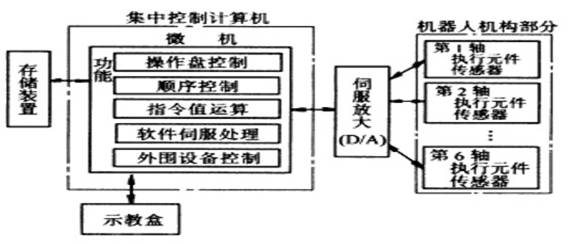 Schéma fonctionnel du système de contrôle centralisé
Un ordinateur est utilisé pour réaliser toutes les fonctions de contrôle. La structure est simple et le coût est faible, mais les performances en temps réel sont médiocres et il est difficile de l'étendre. Cette structure est souvent utilisée dans les premiers robots. Le schéma fonctionnel est présenté sur la figure.
Le système de contrôle centralisé basé sur PC tire pleinement parti de l'ouverture des ressources du PC et peut atteindre une bonne ouverture : une variété de cartes de contrôle, de capteurs, etc. peuvent être intégrés au contrôle via des emplacements PCI standard ou via des ports série standard et des ports parallèles. Système.
The advantages of centralized control systems are: low hardware costs, easy information collection and analysis, easy to achieve optimal control of the system, better integrity and coordination, and more convenient PC-based system hardware expansion. Its shortcomings are also obvious: the system control lacks flexibility, and the control danger is easy to concentrate. Once a failure occurs, its impact is wide and the consequences are serious; because the real-time requirements of industrial robots are very high, when the system performs a large amount of data calculation, it will reduce the real-time performance , The system’s responsiveness to multitasking will also conflict with the system’s real-time performance; in addition, the system’s complex wiring will reduce the system’s reliability.
(2) Système de contrôle maître-esclave :
Using master and slave two-level processors to realize all control functions of the system. The main CPU realizes management, coordinate transformation, trajectory generation and system self-diagnosis, etc.; the slave CPU realizes the motion control of all joints. Its composition block diagram, as shown in the figure.
Le système de contrôle maître-esclave a de bonnes performances en temps réel et convient au contrôle de haute précision et à grande vitesse, mais l'évolutivité de son système est médiocre et sa maintenance est difficile.
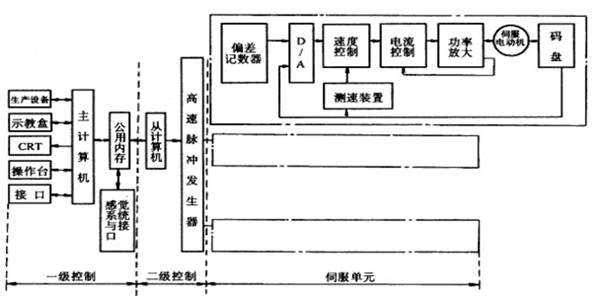 Schéma fonctionnel du système de contrôle maître et esclave
(3) Distribuer le système de contrôle :
Selon la nature et la méthode du système, le contrôle du système est divisé en plusieurs modules. Chaque module a différentes tâches de contrôle et stratégies de contrôle. Chaque mode peut être une relation maître-esclave ou une relation d'égalité.
Cette méthode a de bonnes performances en temps réel, est facile à réaliser un contrôle à grande vitesse et de haute précision, est facile à étendre et peut réaliser un contrôle intelligent. C'est une méthode populaire à l'heure actuelle.
The main idea is "decentralized control, centralized management", that is, the system can comprehensively coordinate and allocate its overall goals and tasks, and complete the control tasks through the coordination of subsystems. The entire system is functional, logical, and physical. It is decentralized, so the DCS system is also called a distributed control system or a distributed control system.
In this structure, the subsystem is composed of a controller and different controlled objects or devices, and each subsystem communicates with each other through a network. The distributed control structure provides an open, real-time and accurate robot control system. Two-level control methods are often used in distributed systems.
Two-level distributed control system, usually composed of upper computer, lower computer and network. The upper computer can carry out different trajectory planning and control algorithms, and the lower computer can carry out the research and realization of interpolation and subdivision and control optimization. The upper computer and the lower computer work in coordination with each other through the communication bus. The communication bus here can be in the form of RS-232, RS-485, EEE-488 and USB bus.
Now, the development of Ethernet and fieldbus technology provides robots with faster, stable and effective communication services. Especially the field bus, which is applied to the production site to realize two-way multi-node digital communication between microcomputerized measurement and control equipment, thus forming a new type of network integrated fully distributed control system-field bus control system FCS (Filed bus Control System) ).
In the factory production network, the devices that can be connected via fieldbus are collectively referred to as "field devices/instruments". From the perspective of system theory, industrial robots, as one of the production equipment of the factory, can also be summarized as field equipment. After the introduction of fieldbus technology in the robot system, it is more conducive to the integration of robots in the industrial production environment.
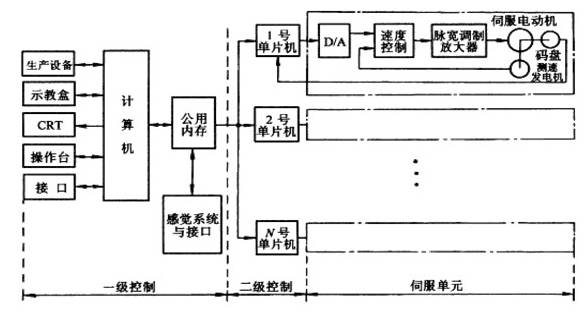 Block diagram of distributed control systemThe advantages of the distributed control system are: system flexibility is good, the risk of the control system is reduced, the use of multi-processor distributed control is conducive to the parallel execution of system functions, the processing efficiency of the system is improved, and the response time is shortened.
For industrial robots with multiple degrees of freedom, centralized control handles the coupling relationship between each control axis very well, and can be easily compensated. However, when the number of axes increases to make the control algorithm very complicated, its control performance will deteriorate. Moreover, when the number of axes in the system or the control algorithm becomes very complicated, it may lead to the redesign of the system.
En revanche, chaque axe de mouvement de la structure distribuée est traité par un contrôleur, ce qui signifie que le système a moins de couplage entre les axes et une reconfiguration plus élevée du système.
"Industry 4.0" refers to the fourth industrial revolution after steam engine, electrification and automation. It combines traditional industry with digital information technology and realizes intelligent production with the help of technologies such as big data and cloud computing. In China, "Industry 4.0" means the upgrading of the country's manufacturing industry. For this reason, China has specifically put forward the development goal of "Made in China 2025". The goal is to move from a major manufacturing country to a strong manufacturing country by 2025.


