


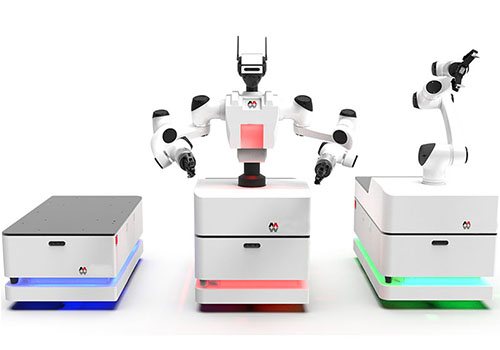
"Made in China 2025" plans the strategic goal of my country's manufacturing power, and intelligent manufacturing has become the top priority of industrial manufacturing transformation. Under the general trend of intelligence, the downstream application fields of intelligent equipment are accelerating the expansion, and the development of industriële robotskan worden verwacht.
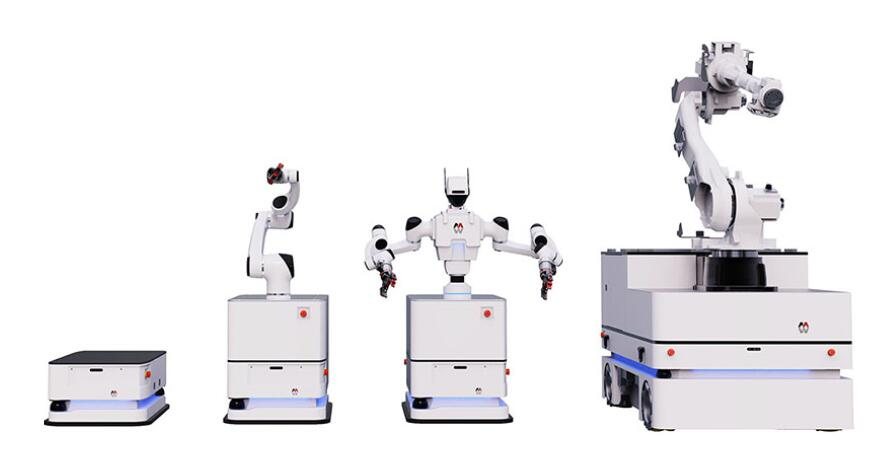
Industrial robots refer to multi-joint manipulators or multi-degree-of-freedom mechanical devices that can work intelligently under human control and can perfectly replace humans working on the production line. Compared with manpower, industrial robots have the characteristics of low cost, high efficiency and 24-hour work. In recent years, as domestic labor costs continue to rise, the labor advantage of my country's manufacturing industry is not obvious, the manufacturing industry urgently needs to transform to intelligence, and industrial robots are showing a strong development trend.
my country is a big consumer of industrial robots. Since 2013, it has become the world's largest consumer market for industrial robots for two consecutive years. There are often industrial robots in the fields of automobile manufacturing, electronics, rubber and plastics, military industry, aviation manufacturing, food industry, medical equipment and metal products. Among them, the automotive industry has the most applications, accounting for 38%.
Guangdong, Jiangsu, Shanghai, Beijing en andere plaatsen zijn de belangrijkste geconcentreerde gebieden van de industriële robotindustrie van mijn land, en het aantal industriële robots dat in bezit is, is goed voor de helft van de nationale industriële robotmarkt.
However, due to the lack of core technology, the consumption of industrial robots in my country is heavily dependent on foreign companies, especially in core components such as reducers, servo motors, and controllers. Domestic robot companies in my country are restricted by others and can only purchase expensive foreign equipment, which requires domestic industries. Robot manufacturers continue to improve their technology, increase R&D level, and get rid of the control of China's industrial robot consumer market by foreign robot brands as soon as possible.
Considering that the current density of industrial robots in the global manufacturing industry is 55, while the density of China's industrial robots is only 21, which is much lower than that of developed countries such as Japan, South Korea, Germany and the United States, and in the context of intelligent manufacturing, the policy of "machine substitution" continues to be implemented. There is still a lot of room for growth. Related concept companies such as Inovance Technology, Robotics, Zhiyun Co., Ltd., Keyuan Co., Ltd., and Qinchuan Machine Tool will achieve better development under the robot dividend.
De ontwikkelingsfase van industriële robots
De ontwikkeling van industriële robots kan doorgaans in drie generaties worden verdeeld:
1. Eerste generatie industriële robots:
Usually refers to the “programmable industrial robots” that are currently commercialized and used internationally, also known as “teaching and reproducing industrial robots”, that is, in order for the industrial robot to complete a certain task, the operator will first complete the task. All kinds of knowledge (such as motion trajectory, operating conditions, operating sequence and operating time, etc.) of industrial robots can be "teached" through direct or indirect means.
After the industrial robots memorize this knowledge, they can "reproduce" Instructions, within a certain accuracy range, faithfully reproduce various taught actions repeatedly. In 1962, the first Unimate industrial robot of Universal Automation of the United States was put into use in General Motors of the United States, marking the birth of the first generation of industrial robots.
2, tweede generatie industriële robots:
usually refers to an "intelligent robot" with some kind of intelligence (such as touch, force, vision, etc.). That is, after the sensors receive information such as touch, force and vision, the computer controls the robot's operating machine to complete the corresponding appropriate operations. In 1982, General Motors in the United States equipped the industrial robot with a vision system on the assembly line, thus announcing the advent of a new generation of intelligent industrial robots.
3, derde generatie industriële robots:
is the so-called "only-type industrial robot". It not only has a perception function, but also has certain decision-making and planning capabilities. The first generation of industrial robots is still in the laboratory research stage. After the birth-growth-maturity period, industrial robots have become indispensable core equipment in the manufacturing industry. There are about 750,000 industrial robots in the world fighting side by side with workers and friends on all production lines.
As a rising star of the robot family, special robots have a tendency to come from behind due to their wide range of uses. Special robots for various purposes such as humanoid robots, agricultural robots, dienstrobotsEr zijn onderwaterrobots, medische robots, militaire robots en entertainmentrobots ontstaan, en deze evolueert in snel tempo richting bruikbaarheid. Classificatie van industriële robots
Industriële robots kunnen volgens verschillende methoden in de volgende typen worden verdeeld
1. Industriële robots zijn onderverdeeld in de volgende categorieën, afhankelijk van de coördinatenvorm van de manipulator: (De coördinatenvorm verwijst naar de vorm van het referentiecoördinatensysteem dat door de arm van de manipulator wordt ingenomen wanneer deze beweegt.)
(1) Cartesische coördinaten industriële robot
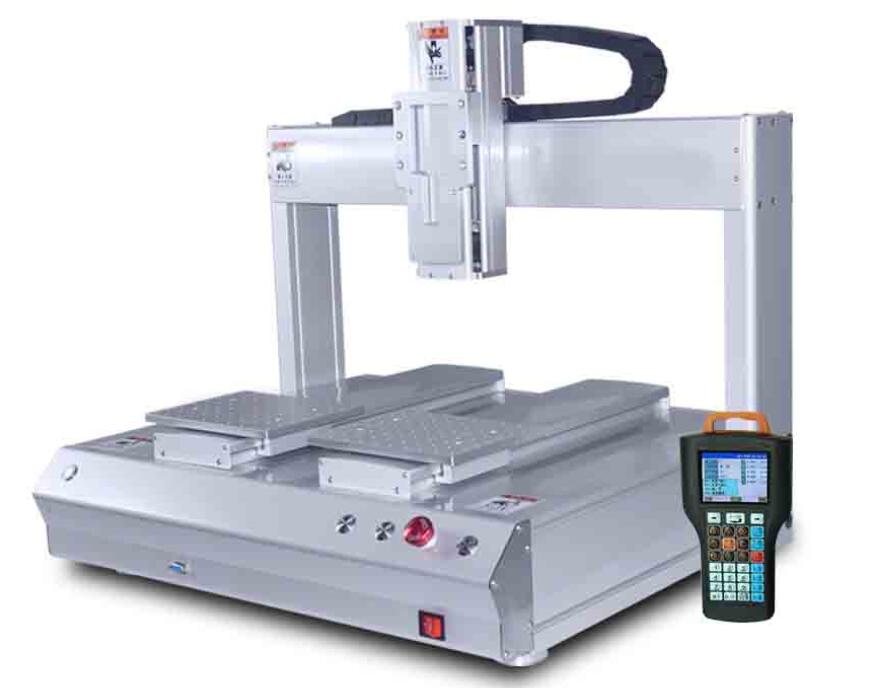
Its movement part is composed of three mutually perpendicular linear movements (namely PPP), and its working space is rectangular. Its moving distance in each axis can be read directly on each coordinate axis. It is intuitive, easy to program and calculate the position and posture, has high positioning accuracy, no coupling control, simple structure, but the body occupies a large space. The motion range is small, the flexibility is poor, and it is difficult to coordinate with other industrial robots.
(2) Industriële robot met cilindrische coördinaten
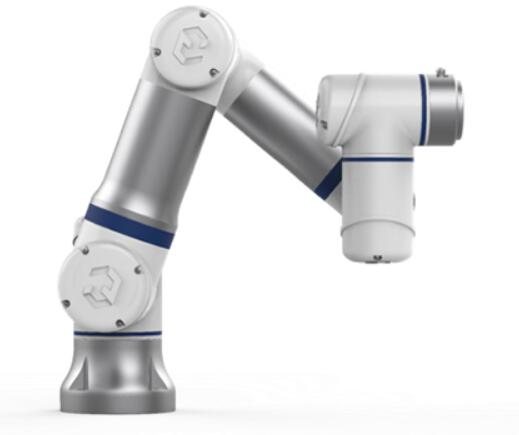
Its motion form is realized by a motion system composed of one rotation and two movements. Its working space is cylindrical. Compared with the rectangular coordinate industrial robot, under the same working space conditions, the body occupies a small volume. The range of motion is large, and its position accuracy is second only to Cartesian coordinate robots, and it is difficult to coordinate with other industrial robots.
(3) Industriële robot met bolvormige coördinaten
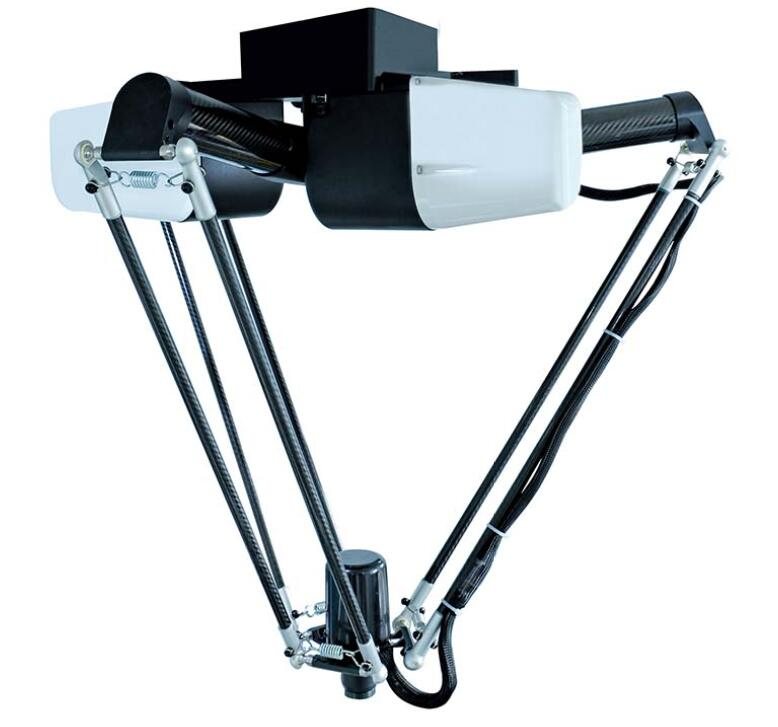
Also known as polar coordinate industrial robot, its arm movement consists of two rotations and one linear movement (ie RRP, one rotation, one pitching and one telescopic movement). Its working space is a sphere, which can make up and down pitching movements. And it can grasp the coordinated workpiece on the ground or teach low position, its position accuracy is high, and the position error is proportional to the arm length.
(4) Industriële robot met meerdere gewrichten
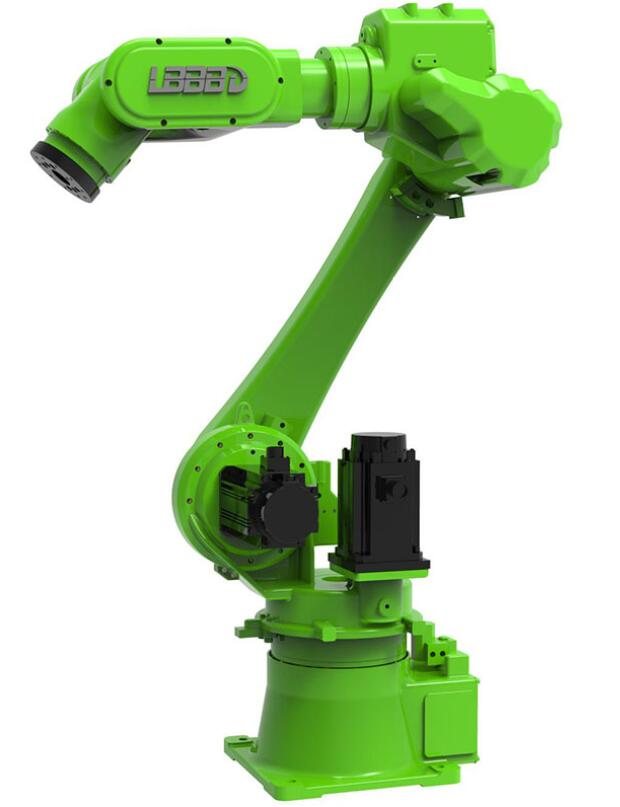
Also known as a rotary coordinate industrial robot. The arm of this industrial robot is similar to the upper limb of a human body. Its first three joints are the revolving joint (RRR). The industrial robot is generally composed of a column and a large and small arm. The column and the big arm are formed An elbow joint is formed between the shoulder joint, the upper arm and the forearm, which can make the upper arm rotate and pitch and swing, and the lower arm can make pitch swing.
De structuur is het meest compact, flexibel en heeft de kleinste voetafdruk. Het kan samenwerken met andere industriële robots, maar heeft een lage positienauwkeurigheid, balansproblemen en besturingskoppeling. Dit type industriële robot wordt steeds vaker gebruikt.
(5) Industriële robot van het vlakgewricht
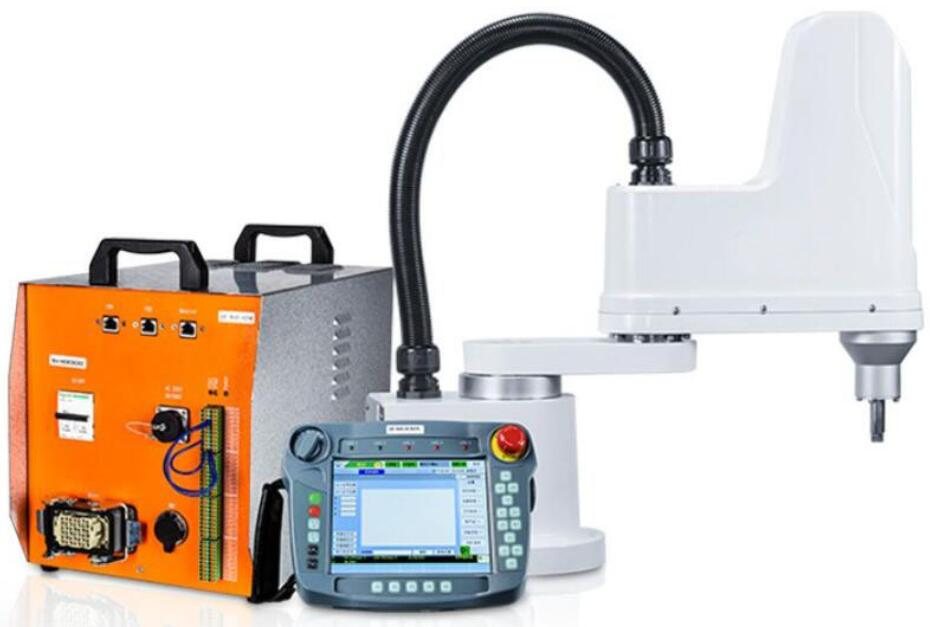
It uses a mobile joint and two rotary joints (PRR), the mobile joint realizes up and down movement, and the two rotary joints control the front and back, left and right movements. This form of industrial robot is also known as (SCARA (Seletive Compliance Assembly Robot Arm) assembly robot. It is flexible in the horizontal direction, and has great rigidity in the vertical direction. It has a simple structure and flexible movements, and is mostly used for assembly operations.
Het is vooral geschikt voor plug-in-montage van kleine onderdelen, zoals plug-in en assemblage in de elektronica-industrie.2. Industriële robots zijn afhankelijk van de rijmodus onderverdeeld in de volgende categorieën:
(1) Pneumatische industriële robot
This type of industrial robot uses compressed air to drive the manipulator. Its advantages are convenient air source, rapid action, simple structure, low cost, and no pollution. The disadvantage is that the air is compressible, resulting in poor working speed stability. The source pressure is generally only about 6kPa, so the snatch force of this type of industrial robot is small, generally only tens of Newtons, and the maximum is more than 100 Newtons.
(2) Hydraulische industriële robot
The hydraulic pressure is much higher than the air pressure, generally about 70kPa, so the hydraulic transmission industrial robot has a large snatch capacity, which can reach thousands of newtons. This type of industrial robot has compact structure, smooth transmission, and sensitive action, but it has high requirements for sealing and is not suitable for working in high or low temperature environments.
(3) Elektrische industriële robot
This is the most used type of industrial robot, not only because of the large variety of electric motors, it provides a variety of options for industrial robot design, but also because they can use a variety of flexible control methods. In the early days, stepper motors were used to drive, and then DC servo drive units were developed. At present, AC servo drive units are also developing rapidly. These drive units either directly drive the manipulator, or are driven after deceleration through a device such as a harmonic reducer. The structure is very compact and simple.
Industrieel robotbesturingssysteem
De structuur van het robotsysteem bestaat uit het robotmechanismegedeelte, de sensorgroep, het besturingsgedeelte en het informatieverwerkingsgedeelte. Het besturingssysteem is een kernonderdeel van de robotindustrie.1. Functies die moeten worden bereikt door het industriële robotbesturingssysteem
Het robotbesturingssysteem wordt gebruikt om de manipulator te besturen om specifieke taken uit te voeren. De basisfuncties zijn als volgt:
(1) Geheugenfunctie:
Bewaar taakvolgorde, bewegingspad, bewegingsmodus, bewegingssnelheid en informatie met betrekking tot het productieproces.
(2) Leerfunctie:
Offline programmeren, online lesgeven, indirect lesgeven. Online lesgeven omvat lesbox en begeleid lesgeven.
(3) Contactfunctie met randapparatuur:
Invoer- en uitvoerinterface, communicatie-interface, netwerkinterface, synchronisatie-interface.
(4) Coördinaatinstellingsfunctie:
Er zijn vier coördinatensystemen: gezamenlijk, absoluut, gereedschap en door de gebruiker gedefinieerd.
(5) Mens-machine-interface:
Lesdoos, bedieningspaneel, beeldscherm.
(6) Sensorinterface:
Positiedetectie, zicht, aanraking, kracht, etc.
(7) Positieservofunctie:
Meerassige robotkoppeling, bewegingsregeling, snelheids- en acceleratieregeling, dynamische compensatie, enz.
(8) Foutdiagnose veiligheidsbeschermingsfunctie:
Bewaking van de systeemstatus tijdens bedrijf, veiligheidsbescherming bij foutcondities en zelfdiagnose van fouten.
2. Samenstelling van het industriële robotbesturingssysteem
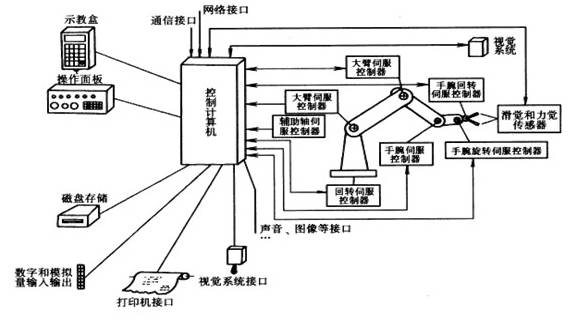 Het blokschema van het robotbesturingssysteem(1) Besturingscomputer:
De verzendings- en commandoorganisatie van het besturingssysteem. Over het algemeen zijn microcomputers en microprocessors 32-bits, 64-bits, enz., zoals CPU's uit de Pentium-serie en andere typen CPU's.
(2) Lesdoos:
Leer het werktraject en de parameterinstellingen van de robot, evenals de interactie tussen mens en computer, heb een eigen onafhankelijke CPU en opslageenheid en realiseer informatie-interactie met de hostcomputer via seriële communicatie.
(3) Bedieningspaneel:
bestaat uit verschillende bedieningsknoppen en statusindicatoren en voltooit alleen de functionele basisbewerkingen.
(4) Opslag op harde schijf en diskette:
Randgeheugen voor het opslaan van robotwerkprogramma's.
(5) Digitale en analoge invoer en uitvoer:
Invoer of uitvoer van diverse status- en besturingscommando's.
(6) Printerinterface:
Registreer verschillende informatie die moet worden uitgevoerd.
(7) Sensorinterface:
wordt gebruikt voor de automatische detectie van informatie om de conforme besturing van de robot te realiseren, over het algemeen kracht-, aanraak- en visiesensoren.
(8) ascontroller:
Voltooi de robotgewrichtspositie, snelheid en acceleratiecontrole.
(9) Controle van hulpapparatuur:
wordt gebruikt om hulpapparatuur te besturen die samenwerkt met de robot, zoals een grijperversteller, enz.
(10) Communicatie-interface:
Realiseer de uitwisseling van informatie tussen robots en andere apparaten, meestal seriële interfaces, parallelle interfaces, enz.
(11) netwerkinterface
1) Ethernet interface: Direct PC communication of several or single robots can be realized through Ethernet, the data transmission rate is up to 10Mbit/s, and the application program can be programmed directly on the PC with windows library functions, and the TCP/IP communication protocol can be supported , Load data and programs into each robot controller through the Ethernet interface.
2) Veldbusinterface: ondersteunt een verscheidenheid aan populaire veldbusspecificaties, zoals Device net, AB Remote I/O, Interbus-s, profibus-DP, M-NET, enz.
3. Classificatie van industriële robotbesturingssystemen
(1) Programmabesturingssysteem:
Pas op elke vrijheidsgraad een bepaalde reguliere besturingsfunctie toe, en de robot kan het vereiste ruimtetraject realiseren.
(2) Adaptief besturingssysteem:
When the external conditions change, in order to ensure the required quality or to improve the control quality with the accumulation of experience, the process is based on the observation of the state of the operating machine and the servo error, and then adjust the parameters of the nonlinear model until the error Until it disappears. The structure and parameters of this system can change automatically with time and conditions.
(3) Kunstmatig intelligentiesysteem:
Het is onmogelijk om bewegingsprogramma's vooraf samen te stellen, maar vereist real-time bepaling van het besturingseffect op basis van de verkregen omringende statusinformatie tijdens de beweging.
Aandrijfmodus: zie aandrijfsysteem industriële robot.
Oefenmethode:
(4) Punttype:
requires the robot to accurately control the pose of the end effector, regardless of the path;
(5) Baantype:
vereist dat de robot beweegt volgens het aangeleerde traject en de snelheid.
(6) Besturingsbus:
Internationaal standaard busbesturingssysteem. Gebruik een internationale standaardbus als besturingsbus van het besturingssysteem, zoals VME, MULTI-bus, STD-bus, PC-bus.
(7) Aangepast busbesturingssysteem:
Als besturingssysteembus wordt de door de fabrikant zelf gedefinieerde en gebruikte bus gebruikt.
(8) Programmeermethode:
Programmeersysteem voor fysieke instellingen. De operator stelt een vaste eindschakelaar in om de programmabediening van starten en stoppen te realiseren, die alleen kan worden gebruikt voor eenvoudige pick- en plaatsingshandelingen.
(9) Onlineprogrammering:
De geheugenprocesprogrammeringsmethode voor operationele informatie wordt voltooid door middel van menselijk onderwijs, inclusief direct onderwijs (dwz van hand tot hand onderwijs), simulatieonderwijs en onderwijsboxonderwijs.
(10) Offline programmeren:
Geef niet rechtstreeks les aan de daadwerkelijke robot, maar genereer los van de daadwerkelijke werkomgeving een lesprogramma en genereer het robottraject op afstand offline met behulp van robots en programmeertalen van hoog niveau.
4. Structuur van het robotbesturingssysteem
Robotbesturingssystemen kunnen op basis van hun besturingsmethoden in drie categorieën worden verdeeld.
(1) Gecentraliseerd controlesysteem (gecentraliseerd controlesysteem):
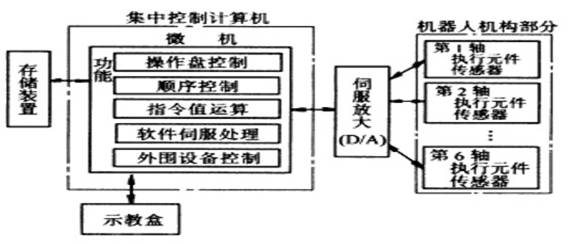 Blokschema van het gecentraliseerde besturingssysteem
Om alle besturingsfuncties te realiseren wordt gebruik gemaakt van een computer. De structuur is eenvoudig en de kosten zijn laag, maar de real-time prestaties zijn slecht en het is moeilijk uit te breiden. Deze structuur wordt vaak gebruikt in vroege robots. Het blokdiagram wordt weergegeven in de figuur.
Het pc-gebaseerde gecentraliseerde besturingssysteem maakt optimaal gebruik van de openheid van pc-bronnen en kan een goede openheid bereiken: een verscheidenheid aan controlekaarten, sensorapparaten, enz. kan in de besturing worden geïntegreerd via standaard PCI-slots of via standaard seriële poorten en parallelle poorten. Systeem.
The advantages of centralized control systems are: low hardware costs, easy information collection and analysis, easy to achieve optimal control of the system, better integrity and coordination, and more convenient PC-based system hardware expansion. Its shortcomings are also obvious: the system control lacks flexibility, and the control danger is easy to concentrate. Once a failure occurs, its impact is wide and the consequences are serious; because the real-time requirements of industrial robots are very high, when the system performs a large amount of data calculation, it will reduce the real-time performance , The system’s responsiveness to multitasking will also conflict with the system’s real-time performance; in addition, the system’s complex wiring will reduce the system’s reliability.
(2) Master-slave-besturingssysteem:
Using master and slave two-level processors to realize all control functions of the system. The main CPU realizes management, coordinate transformation, trajectory generation and system self-diagnosis, etc.; the slave CPU realizes the motion control of all joints. Its composition block diagram, as shown in the figure.
Het master-slave-besturingssysteem heeft goede real-time prestaties en is geschikt voor zeer nauwkeurige en snelle besturing, maar de schaalbaarheid van het systeem is slecht en het onderhoud is moeilijk.
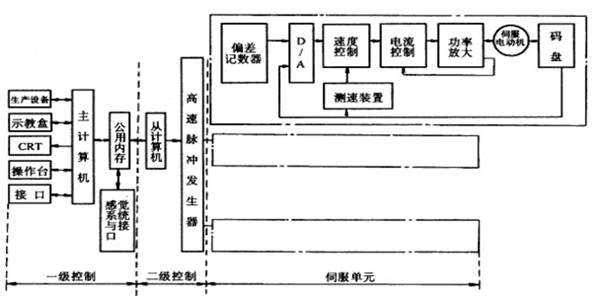 Blokschema van master- en slave-besturingssysteem
(3) Verdeel het controlesysteem:
Afhankelijk van de aard en werkwijze van het systeem is de systeembesturing opgedeeld in verschillende modules. Elke module heeft verschillende besturingstaken en besturingsstrategieën. Elke modus kan een meester-slaafrelatie of een gelijkwaardige relatie zijn.
Deze methode heeft goede real-time prestaties, is gemakkelijk te realiseren met hoge snelheid en hoge precisie, is gemakkelijk uit te breiden en kan intelligente besturing realiseren. Het is momenteel een populaire methode.
The main idea is "decentralized control, centralized management", that is, the system can comprehensively coordinate and allocate its overall goals and tasks, and complete the control tasks through the coordination of subsystems. The entire system is functional, logical, and physical. It is decentralized, so the DCS system is also called a distributed control system or a distributed control system.
In this structure, the subsystem is composed of a controller and different controlled objects or devices, and each subsystem communicates with each other through a network. The distributed control structure provides an open, real-time and accurate robot control system. Two-level control methods are often used in distributed systems.
Two-level distributed control system, usually composed of upper computer, lower computer and network. The upper computer can carry out different trajectory planning and control algorithms, and the lower computer can carry out the research and realization of interpolation and subdivision and control optimization. The upper computer and the lower computer work in coordination with each other through the communication bus. The communication bus here can be in the form of RS-232, RS-485, EEE-488 and USB bus.
Now, the development of Ethernet and fieldbus technology provides robots with faster, stable and effective communication services. Especially the field bus, which is applied to the production site to realize two-way multi-node digital communication between microcomputerized measurement and control equipment, thus forming a new type of network integrated fully distributed control system-field bus control system FCS (Filed bus Control System) ).
In the factory production network, the devices that can be connected via fieldbus are collectively referred to as "field devices/instruments". From the perspective of system theory, industrial robots, as one of the production equipment of the factory, can also be summarized as field equipment. After the introduction of fieldbus technology in the robot system, it is more conducive to the integration of robots in the industrial production environment.
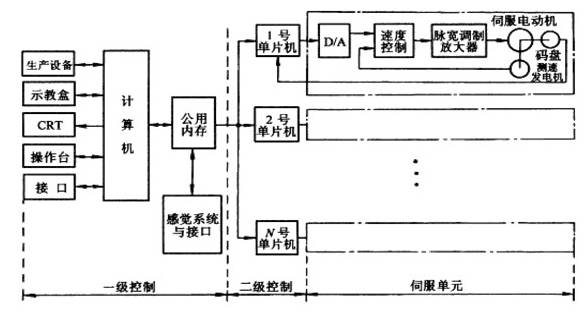 Block diagram of distributed control systemThe advantages of the distributed control system are: system flexibility is good, the risk of the control system is reduced, the use of multi-processor distributed control is conducive to the parallel execution of system functions, the processing efficiency of the system is improved, and the response time is shortened.
For industrial robots with multiple degrees of freedom, centralized control handles the coupling relationship between each control axis very well, and can be easily compensated. However, when the number of axes increases to make the control algorithm very complicated, its control performance will deteriorate. Moreover, when the number of axes in the system or the control algorithm becomes very complicated, it may lead to the redesign of the system.
Daarentegen wordt elke bewegingsas van de gedistribueerde structuur verwerkt door een controller, wat betekent dat het systeem minder koppeling heeft tussen de assen en een hogere systeemherconfiguratie.
"Industry 4.0" refers to the fourth industrial revolution after steam engine, electrification and automation. It combines traditional industry with digital information technology and realizes intelligent production with the help of technologies such as big data and cloud computing. In China, "Industry 4.0" means the upgrading of the country's manufacturing industry. For this reason, China has specifically put forward the development goal of "Made in China 2025". The goal is to move from a major manufacturing country to a strong manufacturing country by 2025.


