


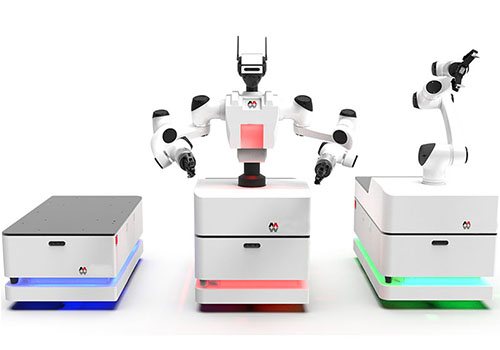
"Made in China 2025" plans the strategic goal of my country's manufacturing power, and intelligent manufacturing has become the top priority of industrial manufacturing transformation. Under the general trend of intelligence, the downstream application fields of intelligent equipment are accelerating the expansion, and the development of 산업용 로봇기대할 수 있습니다.
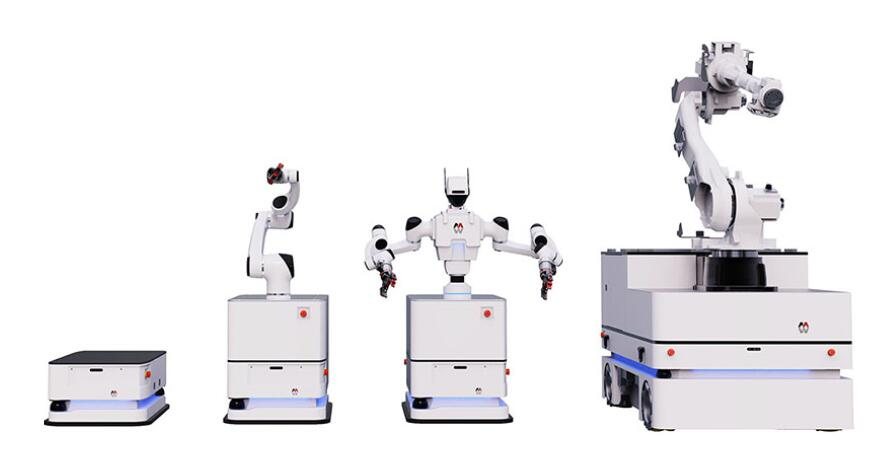
Industrial robots refer to multi-joint manipulators or multi-degree-of-freedom mechanical devices that can work intelligently under human control and can perfectly replace humans working on the production line. Compared with manpower, industrial robots have the characteristics of low cost, high efficiency and 24-hour work. In recent years, as domestic labor costs continue to rise, the labor advantage of my country's manufacturing industry is not obvious, the manufacturing industry urgently needs to transform to intelligence, and industrial robots are showing a strong development trend.
my country is a big consumer of industrial robots. Since 2013, it has become the world's largest consumer market for industrial robots for two consecutive years. There are often industrial robots in the fields of automobile manufacturing, electronics, rubber and plastics, military industry, aviation manufacturing, food industry, medical equipment and metal products. Among them, the automotive industry has the most applications, accounting for 38%.
광둥, 장쑤, 상하이, 베이징 등은 우리나라 산업용 로봇 산업의 주요 집중 지역으로, 보유 산업용 로봇 수가 전국 산업용 로봇 시장의 절반을 차지합니다.
However, due to the lack of core technology, the consumption of industrial robots in my country is heavily dependent on foreign companies, especially in core components such as reducers, servo motors, and controllers. Domestic robot companies in my country are restricted by others and can only purchase expensive foreign equipment, which requires domestic industries. Robot manufacturers continue to improve their technology, increase R&D level, and get rid of the control of China's industrial robot consumer market by foreign robot brands as soon as possible.
Considering that the current density of industrial robots in the global manufacturing industry is 55, while the density of China's industrial robots is only 21, which is much lower than that of developed countries such as Japan, South Korea, Germany and the United States, and in the context of intelligent manufacturing, the policy of "machine substitution" continues to be implemented. There is still a lot of room for growth. Related concept companies such as Inovance Technology, Robotics, Zhiyun Co., Ltd., Keyuan Co., Ltd., and Qinchuan Machine Tool will achieve better development under the robot dividend.
산업용 로봇의 개발 단계
산업용 로봇의 개발은 일반적으로 3세대로 나눌 수 있습니다.
1. 1세대 산업용 로봇:
Usually refers to the “programmable industrial robots” that are currently commercialized and used internationally, also known as “teaching and reproducing industrial robots”, that is, in order for the industrial robot to complete a certain task, the operator will first complete the task. All kinds of knowledge (such as motion trajectory, operating conditions, operating sequence and operating time, etc.) of industrial robots can be "teached" through direct or indirect means.
After the industrial robots memorize this knowledge, they can "reproduce" Instructions, within a certain accuracy range, faithfully reproduce various taught actions repeatedly. In 1962, the first Unimate industrial robot of Universal Automation of the United States was put into use in General Motors of the United States, marking the birth of the first generation of industrial robots.
2, 2세대 산업용 로봇:
usually refers to an "intelligent robot" with some kind of intelligence (such as touch, force, vision, etc.). That is, after the sensors receive information such as touch, force and vision, the computer controls the robot's operating machine to complete the corresponding appropriate operations. In 1982, General Motors in the United States equipped the industrial robot with a vision system on the assembly line, thus announcing the advent of a new generation of intelligent industrial robots.
3, 3세대 산업용 로봇:
is the so-called "only-type industrial robot". It not only has a perception function, but also has certain decision-making and planning capabilities. The first generation of industrial robots is still in the laboratory research stage. After the birth-growth-maturity period, industrial robots have become indispensable core equipment in the manufacturing industry. There are about 750,000 industrial robots in the world fighting side by side with workers and friends on all production lines.
As a rising star of the robot family, special robots have a tendency to come from behind due to their wide range of uses. Special robots for various purposes such as humanoid robots, agricultural robots, 서비스 로봇, 수중로봇, 의료로봇, 군용로봇, 엔터테인먼트로봇 등이 등장하였고, 빠른 속도로 실용화를 향해 나아가고 있다. 산업용로봇의 분류
산업용 로봇은 다양한 방법에 따라 다음과 같은 유형으로 나눌 수 있습니다.
1. 산업용 로봇은 매니퓰레이터의 좌표 형태에 따라 다음과 같은 범주로 분류됩니다. (좌표 형태는 매니퓰레이터의 팔이 움직일 때 취하는 기준 좌표계의 형태를 말합니다.)
(1) 직교 좌표 산업용 로봇
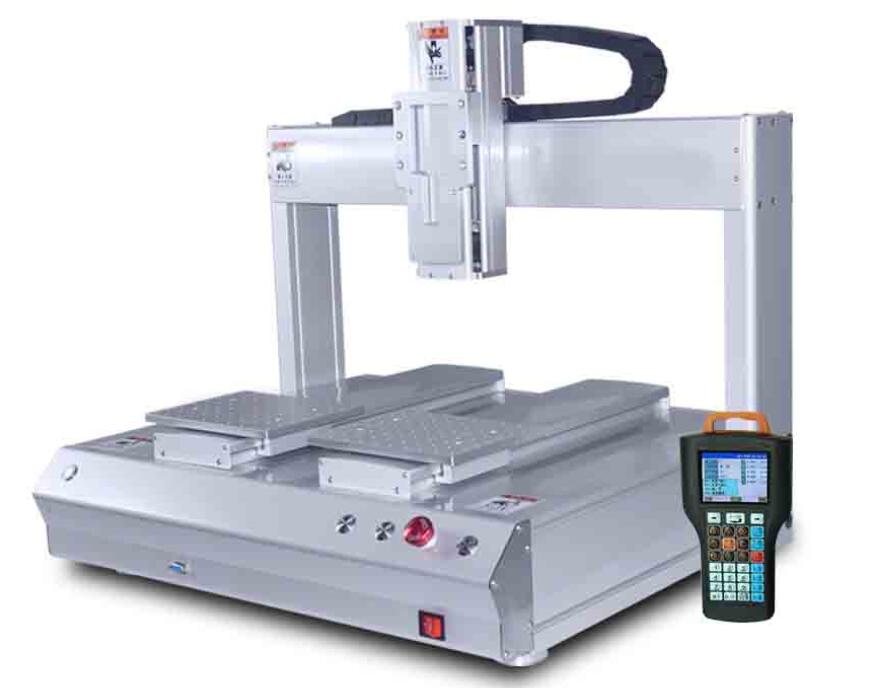
Its movement part is composed of three mutually perpendicular linear movements (namely PPP), and its working space is rectangular. Its moving distance in each axis can be read directly on each coordinate axis. It is intuitive, easy to program and calculate the position and posture, has high positioning accuracy, no coupling control, simple structure, but the body occupies a large space. The motion range is small, the flexibility is poor, and it is difficult to coordinate with other industrial robots.
(2) 원통형 좌표 산업용 로봇
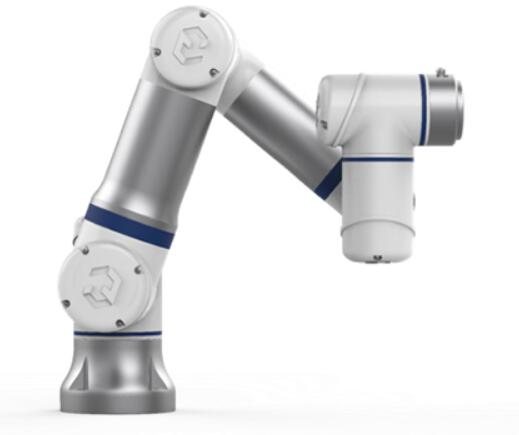
Its motion form is realized by a motion system composed of one rotation and two movements. Its working space is cylindrical. Compared with the rectangular coordinate industrial robot, under the same working space conditions, the body occupies a small volume. The range of motion is large, and its position accuracy is second only to Cartesian coordinate robots, and it is difficult to coordinate with other industrial robots.
(3) 구면좌표 산업용 로봇
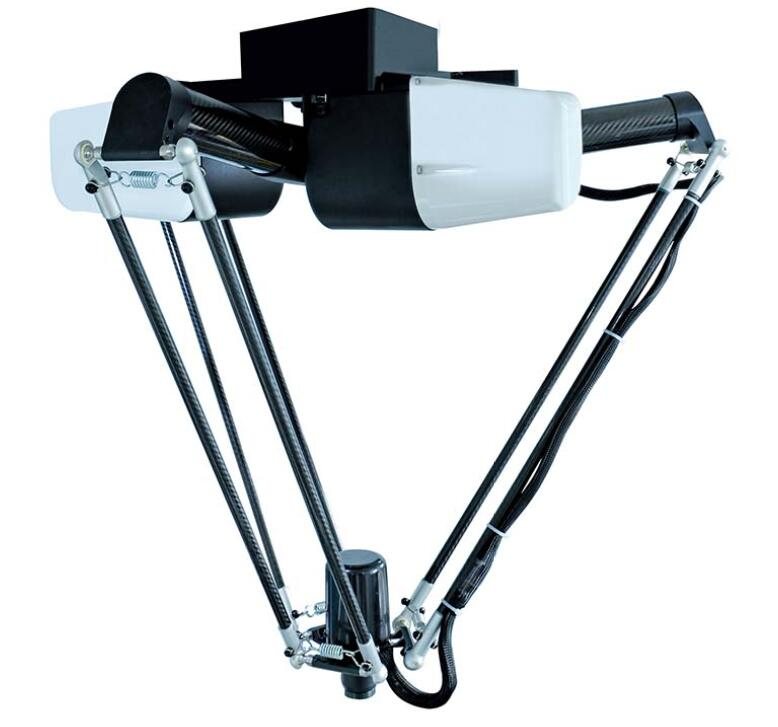
Also known as polar coordinate industrial robot, its arm movement consists of two rotations and one linear movement (ie RRP, one rotation, one pitching and one telescopic movement). Its working space is a sphere, which can make up and down pitching movements. And it can grasp the coordinated workpiece on the ground or teach low position, its position accuracy is high, and the position error is proportional to the arm length.
(4) 다관절 산업용 로봇
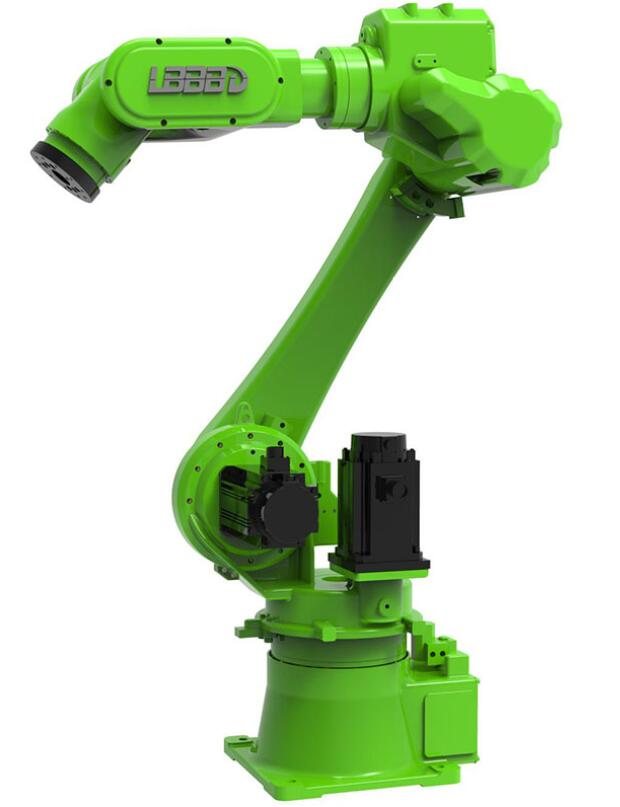
Also known as a rotary coordinate industrial robot. The arm of this industrial robot is similar to the upper limb of a human body. Its first three joints are the revolving joint (RRR). The industrial robot is generally composed of a column and a large and small arm. The column and the big arm are formed An elbow joint is formed between the shoulder joint, the upper arm and the forearm, which can make the upper arm rotate and pitch and swing, and the lower arm can make pitch swing.
그 구조는 가장 작고 유연하며 설치 공간이 가장 작습니다. 다른 산업용 로봇과 협력하여 작업할 수 있지만 위치 정확도가 낮고 균형 문제가 있으며 제어 결합이 문제입니다. 이러한 유형의 산업용 로봇은 점점 더 널리 사용되고 있습니다.
(5) 평면관절형 산업용 로봇
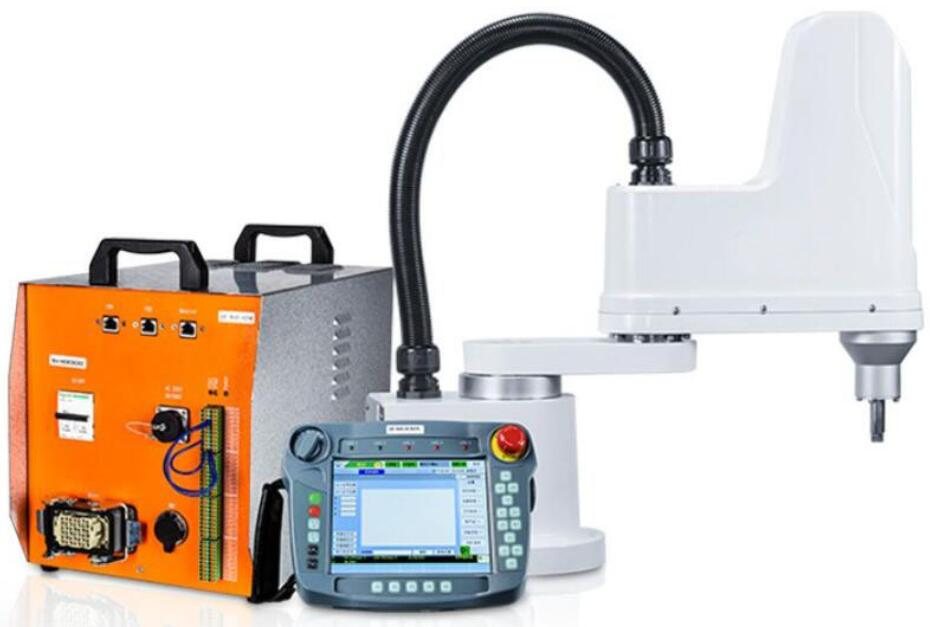
It uses a mobile joint and two rotary joints (PRR), the mobile joint realizes up and down movement, and the two rotary joints control the front and back, left and right movements. This form of industrial robot is also known as (SCARA (Seletive Compliance Assembly Robot Arm) assembly robot. It is flexible in the horizontal direction, and has great rigidity in the vertical direction. It has a simple structure and flexible movements, and is mostly used for assembly operations.
전자 산업의 플러그인 및 조립과 같은 소형 부품의 플러그인 조립에 특히 적합합니다.2. 산업용 로봇은 운전 모드에 따라 다음과 같은 범주로 구분됩니다.
(1) 공압식 산업용 로봇
This type of industrial robot uses compressed air to drive the manipulator. Its advantages are convenient air source, rapid action, simple structure, low cost, and no pollution. The disadvantage is that the air is compressible, resulting in poor working speed stability. The source pressure is generally only about 6kPa, so the snatch force of this type of industrial robot is small, generally only tens of Newtons, and the maximum is more than 100 Newtons.
(2) 유압산업용 로봇
The hydraulic pressure is much higher than the air pressure, generally about 70kPa, so the hydraulic transmission industrial robot has a large snatch capacity, which can reach thousands of newtons. This type of industrial robot has compact structure, smooth transmission, and sensitive action, but it has high requirements for sealing and is not suitable for working in high or low temperature environments.
(3) 전기 산업용 로봇
This is the most used type of industrial robot, not only because of the large variety of electric motors, it provides a variety of options for industrial robot design, but also because they can use a variety of flexible control methods. In the early days, stepper motors were used to drive, and then DC servo drive units were developed. At present, AC servo drive units are also developing rapidly. These drive units either directly drive the manipulator, or are driven after deceleration through a device such as a harmonic reducer. The structure is very compact and simple.
산업용 로봇 제어 시스템
로봇 시스템의 구조는 로봇의 기구부, 센서군, 제어부, 정보처리부로 구성된다. 제어 시스템은 로봇 산업의 핵심 부분입니다.1. 산업용 로봇 제어 시스템이 달성해야 할 기능
로봇 제어 시스템은 조작기를 제어하여 특정 작업을 완료하는 데 사용됩니다. 기본 기능은 다음과 같습니다.
(1) 메모리 기능:
작업 순서, 이동 경로, 이동 모드, 이동 속도 및 생산 프로세스와 관련된 정보를 저장합니다.
(2) 교육 기능:
오프라인 프로그래밍, 온라인 교육, 간접 교육. 온라인 교육에는 교육 상자와 안내 교육이 포함됩니다.
(3) 주변 장비와의 접촉 기능:
입력 및 출력 인터페이스, 통신 인터페이스, 네트워크 인터페이스, 동기화 인터페이스.
(4) 좌표 설정 기능:
접합, 절대, 도구 및 사용자 정의의 네 가지 좌표계가 있습니다.
(5) 인간-기계 인터페이스:
티칭 박스, 조작 패널, 디스플레이 화면.
(6) 센서 인터페이스:
위치 감지, 시각, 터치, 힘 등
(7) 위치 서보 기능:
로봇 다축 연동, 모션 제어, 속도 및 가속도 제어, 동적 보상 등
(8) 결함 진단 안전 보호 기능:
작동 중 시스템 상태 모니터링, 결함 상황에서의 안전 보호 및 결함 자체 진단.
2. 산업용 로봇 제어 시스템의 구성
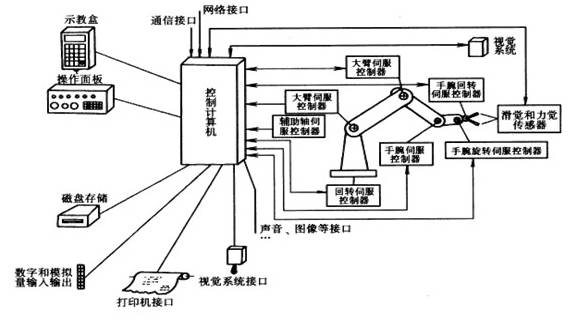 로봇 제어 시스템의 블록 다이어그램(1) 제어 컴퓨터:
제어 시스템의 파견 및 명령 조직. 일반적으로 마이크로컴퓨터와 마이크로프로세서는 펜티엄 시리즈 CPU나 기타 CPU 등 32비트, 64비트 등을 말한다.
(2) 티칭 박스:
로봇의 작업 궤적 및 매개변수 설정과 인간-컴퓨터 상호 작용을 가르치고 자체 독립 CPU 및 저장 장치를 가지며 직렬 통신을 통해 호스트 컴퓨터와의 정보 상호 작용을 실현합니다.
(3) 조작 패널:
다양한 조작 버튼과 상태 표시기로 구성되어 있으며 기본적인 기능 조작만 완료합니다.
(4) 하드 디스크 및 플로피 디스크 저장 장치:
로봇 작업 프로그램을 저장하기 위한 주변 메모리입니다.
(5) 디지털 및 아날로그 입력 및 출력:
각종 상태 및 제어 명령을 입력 또는 출력합니다.
(6) 프린터 인터페이스:
출력에 필요한 다양한 정보를 기록합니다.
(7) 센서 인터페이스:
로봇의 규정 준수 제어를 실현하기 위한 정보(일반적으로 힘, 터치 및 비전 센서)의 자동 감지에 사용됩니다.
(8) 축 컨트롤러:
로봇 관절 위치, 속도 및 가속도 제어를 완료합니다.
(9) 보조 장비 제어:
그리퍼 포지셔너 등 로봇과 연동되는 보조장비를 제어하는데 사용됩니다.
(10) 통신 인터페이스:
로봇과 기타 장치, 일반적으로 직렬 인터페이스, 병렬 인터페이스 등 간의 정보 교환을 실현합니다.
(11) 네트워크 인터페이스
1) Ethernet interface: Direct PC communication of several or single robots can be realized through Ethernet, the data transmission rate is up to 10Mbit/s, and the application program can be programmed directly on the PC with windows library functions, and the TCP/IP communication protocol can be supported , Load data and programs into each robot controller through the Ethernet interface.
2) 필드버스 인터페이스: Device net, AB Remote I/O, Interbus-s, profibus-DP, M-NET 등과 같이 널리 사용되는 다양한 필드버스 사양을 지원합니다.
3. 산업용 로봇 제어 시스템의 분류
(1) 프로그램 제어 시스템:
각 자유도에 일정한 규칙적인 제어 기능을 적용하면 로봇이 필요한 공간 궤적을 실현할 수 있습니다.
(2) 적응 제어 시스템:
When the external conditions change, in order to ensure the required quality or to improve the control quality with the accumulation of experience, the process is based on the observation of the state of the operating machine and the servo error, and then adjust the parameters of the nonlinear model until the error Until it disappears. The structure and parameters of this system can change automatically with time and conditions.
(3) 인공지능 시스템:
모션 프로그램을 미리 컴파일하는 것은 불가능하지만, 모션 중 획득된 주변 상태 정보를 기반으로 제어 효과를 실시간으로 판단해야 합니다.
구동 모드: 산업용 로봇 구동 시스템을 참조하세요.
운동 방법:
(4) 포인트 유형:
requires the robot to accurately control the pose of the end effector, regardless of the path;
(5) 트랙 유형:
로봇은 학습된 궤적과 속도에 따라 움직여야 합니다.
(6) 제어 버스:
국제 표준 버스 제어 시스템. VME, MULTI-버스, STD-버스, PC-버스와 같은 국제 표준 버스를 제어 시스템의 제어 버스로 사용합니다.
(7) 맞춤형 버스 제어 시스템:
제조업체 자체에서 정의하고 사용하는 버스가 제어 시스템 버스로 사용됩니다.
(8) 프로그래밍 방법:
물리적 설정 프로그래밍 시스템. 작업자는 고정 리미트 스위치를 설정하여 시작 및 정지 프로그램 작동을 실현합니다. 이는 간단한 선택 및 배치 작업에만 사용할 수 있습니다.
(9) 온라인 프로그래밍:
조작 정보의 메모리 프로세스 프로그래밍 방법은 직접 티칭(손 대 손 티칭) 시뮬레이션 티칭, 티칭 박스 티칭 등 인간 티칭을 통해 완성됩니다.
(10) 오프라인 프로그래밍:
실제 로봇에게 직접 티칭하는 것이 아니라, 실제 작업 환경과 별도로 고급 로봇과 프로그래밍 언어를 활용해 티칭 프로그램을 생성하고 원격으로 오프라인으로 로봇 궤적을 생성한다.
4. 로봇 제어 시스템 구조
로봇 제어 시스템은 제어 방법에 따라 세 가지 범주로 나눌 수 있습니다.
(1) 중앙집중제어시스템(중앙집중제어시스템):
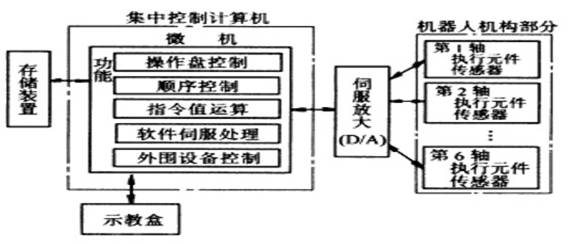 중앙 집중식 제어 시스템 블록 다이어그램
컴퓨터는 모든 제어 기능을 구현하는 데 사용됩니다. 구조가 간단하고 비용이 저렴하지만 실시간 성능이 좋지 않아 확장이 어렵다. 이 구조는 초기 로봇에 자주 사용되었습니다. 블록 다이어그램이 그림에 나와 있습니다.
PC 기반 중앙 집중식 제어 시스템은 PC 리소스의 개방성을 최대한 활용하고 우수한 개방성을 달성할 수 있습니다. 다양한 제어 카드, 센서 장치 등을 표준 PCI 슬롯이나 표준 직렬 포트 및 병렬 포트를 통해 제어 장치에 통합할 수 있습니다. 체계.
The advantages of centralized control systems are: low hardware costs, easy information collection and analysis, easy to achieve optimal control of the system, better integrity and coordination, and more convenient PC-based system hardware expansion. Its shortcomings are also obvious: the system control lacks flexibility, and the control danger is easy to concentrate. Once a failure occurs, its impact is wide and the consequences are serious; because the real-time requirements of industrial robots are very high, when the system performs a large amount of data calculation, it will reduce the real-time performance , The system’s responsiveness to multitasking will also conflict with the system’s real-time performance; in addition, the system’s complex wiring will reduce the system’s reliability.
(2) 마스터-슬레이브 제어 시스템:
Using master and slave two-level processors to realize all control functions of the system. The main CPU realizes management, coordinate transformation, trajectory generation and system self-diagnosis, etc.; the slave CPU realizes the motion control of all joints. Its composition block diagram, as shown in the figure.
마스터-슬레이브 제어 시스템은 실시간 성능이 좋고 고정밀, 고속 제어에 적합하지만 시스템 확장성이 좋지 않고 유지 관리가 어렵다.
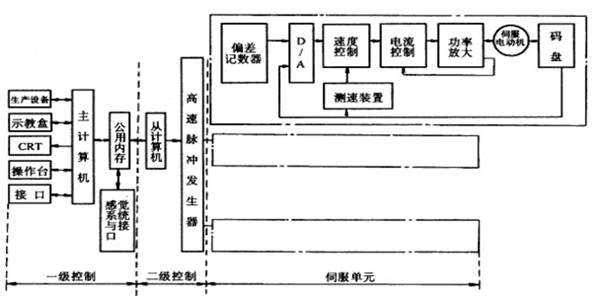 마스터 및 슬레이브 제어 시스템의 블록 다이어그램
(3) 분산 제어 시스템:
시스템의 성격과 방법에 따라 시스템 제어는 여러 모듈로 구분됩니다. 각 모듈에는 서로 다른 제어 작업과 제어 전략이 있습니다. 각 모드는 마스터-슬레이브 관계 또는 동등 관계일 수 있습니다.
이 방법은 실시간 성능이 뛰어나고 고속, 고정밀 제어를 구현하기 쉽고 확장이 쉽고 지능형 제어를 실현할 수 있습니다. 현재 인기 있는 방법입니다.
The main idea is "decentralized control, centralized management", that is, the system can comprehensively coordinate and allocate its overall goals and tasks, and complete the control tasks through the coordination of subsystems. The entire system is functional, logical, and physical. It is decentralized, so the DCS system is also called a distributed control system or a distributed control system.
In this structure, the subsystem is composed of a controller and different controlled objects or devices, and each subsystem communicates with each other through a network. The distributed control structure provides an open, real-time and accurate robot control system. Two-level control methods are often used in distributed systems.
Two-level distributed control system, usually composed of upper computer, lower computer and network. The upper computer can carry out different trajectory planning and control algorithms, and the lower computer can carry out the research and realization of interpolation and subdivision and control optimization. The upper computer and the lower computer work in coordination with each other through the communication bus. The communication bus here can be in the form of RS-232, RS-485, EEE-488 and USB bus.
Now, the development of Ethernet and fieldbus technology provides robots with faster, stable and effective communication services. Especially the field bus, which is applied to the production site to realize two-way multi-node digital communication between microcomputerized measurement and control equipment, thus forming a new type of network integrated fully distributed control system-field bus control system FCS (Filed bus Control System) ).
In the factory production network, the devices that can be connected via fieldbus are collectively referred to as "field devices/instruments". From the perspective of system theory, industrial robots, as one of the production equipment of the factory, can also be summarized as field equipment. After the introduction of fieldbus technology in the robot system, it is more conducive to the integration of robots in the industrial production environment.
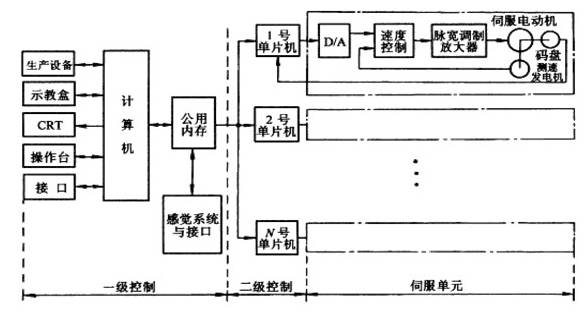 Block diagram of distributed control systemThe advantages of the distributed control system are: system flexibility is good, the risk of the control system is reduced, the use of multi-processor distributed control is conducive to the parallel execution of system functions, the processing efficiency of the system is improved, and the response time is shortened.
For industrial robots with multiple degrees of freedom, centralized control handles the coupling relationship between each control axis very well, and can be easily compensated. However, when the number of axes increases to make the control algorithm very complicated, its control performance will deteriorate. Moreover, when the number of axes in the system or the control algorithm becomes very complicated, it may lead to the redesign of the system.
대조적으로, 분산 구조의 각 동작 축은 컨트롤러에 의해 처리됩니다. 이는 시스템이 축 간의 결합이 적고 시스템 재구성이 더 높다는 것을 의미합니다.
"Industry 4.0" refers to the fourth industrial revolution after steam engine, electrification and automation. It combines traditional industry with digital information technology and realizes intelligent production with the help of technologies such as big data and cloud computing. In China, "Industry 4.0" means the upgrading of the country's manufacturing industry. For this reason, China has specifically put forward the development goal of "Made in China 2025". The goal is to move from a major manufacturing country to a strong manufacturing country by 2025.


