


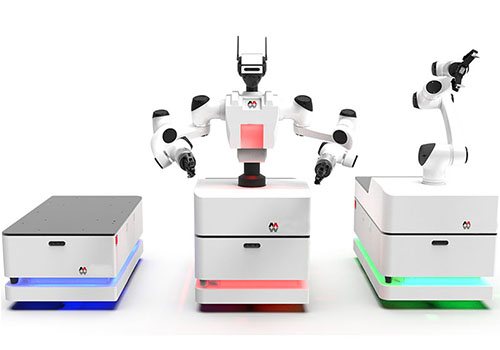
"Made in China 2025" plans the strategic goal of my country's manufacturing power, and intelligent manufacturing has become the top priority of industrial manufacturing transformation. Under the general trend of intelligence, the downstream application fields of intelligent equipment are accelerating the expansion, and the development of 産業用ロボット期待できる。
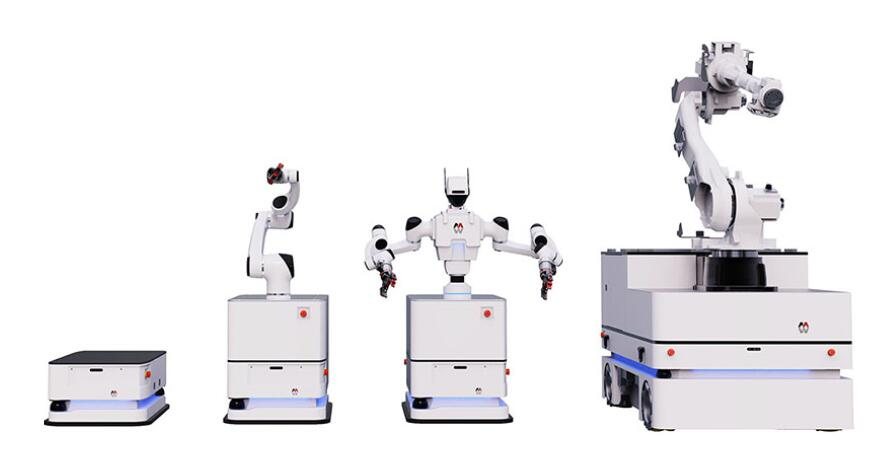
Industrial robots refer to multi-joint manipulators or multi-degree-of-freedom mechanical devices that can work intelligently under human control and can perfectly replace humans working on the production line. Compared with manpower, industrial robots have the characteristics of low cost, high efficiency and 24-hour work. In recent years, as domestic labor costs continue to rise, the labor advantage of my country's manufacturing industry is not obvious, the manufacturing industry urgently needs to transform to intelligence, and industrial robots are showing a strong development trend.
my country is a big consumer of industrial robots. Since 2013, it has become the world's largest consumer market for industrial robots for two consecutive years. There are often industrial robots in the fields of automobile manufacturing, electronics, rubber and plastics, military industry, aviation manufacturing, food industry, medical equipment and metal products. Among them, the automotive industry has the most applications, accounting for 38%.
広東省、江蘇省、上海、北京などは我が国の産業用ロボット産業の主な集中地域であり、産業用ロボットの保有台数は全国の産業用ロボット市場の半分を占めています。
However, due to the lack of core technology, the consumption of industrial robots in my country is heavily dependent on foreign companies, especially in core components such as reducers, servo motors, and controllers. Domestic robot companies in my country are restricted by others and can only purchase expensive foreign equipment, which requires domestic industries. Robot manufacturers continue to improve their technology, increase R&D level, and get rid of the control of China's industrial robot consumer market by foreign robot brands as soon as possible.
Considering that the current density of industrial robots in the global manufacturing industry is 55, while the density of China's industrial robots is only 21, which is much lower than that of developed countries such as Japan, South Korea, Germany and the United States, and in the context of intelligent manufacturing, the policy of "machine substitution" continues to be implemented. There is still a lot of room for growth. Related concept companies such as Inovance Technology, Robotics, Zhiyun Co., Ltd., Keyuan Co., Ltd., and Qinchuan Machine Tool will achieve better development under the robot dividend.
産業用ロボットの開発段階
産業用ロボットの開発は通常、次の 3 つの世代に分けられます。
1. 第一世代の産業用ロボット:
Usually refers to the “programmable industrial robots” that are currently commercialized and used internationally, also known as “teaching and reproducing industrial robots”, that is, in order for the industrial robot to complete a certain task, the operator will first complete the task. All kinds of knowledge (such as motion trajectory, operating conditions, operating sequence and operating time, etc.) of industrial robots can be "teached" through direct or indirect means.
After the industrial robots memorize this knowledge, they can "reproduce" Instructions, within a certain accuracy range, faithfully reproduce various taught actions repeatedly. In 1962, the first Unimate industrial robot of Universal Automation of the United States was put into use in General Motors of the United States, marking the birth of the first generation of industrial robots.
2、第2世代の産業用ロボット:
usually refers to an "intelligent robot" with some kind of intelligence (such as touch, force, vision, etc.). That is, after the sensors receive information such as touch, force and vision, the computer controls the robot's operating machine to complete the corresponding appropriate operations. In 1982, General Motors in the United States equipped the industrial robot with a vision system on the assembly line, thus announcing the advent of a new generation of intelligent industrial robots.
3、第 3 世代の産業用ロボット:
is the so-called "only-type industrial robot". It not only has a perception function, but also has certain decision-making and planning capabilities. The first generation of industrial robots is still in the laboratory research stage. After the birth-growth-maturity period, industrial robots have become indispensable core equipment in the manufacturing industry. There are about 750,000 industrial robots in the world fighting side by side with workers and friends on all production lines.
As a rising star of the robot family, special robots have a tendency to come from behind due to their wide range of uses. Special robots for various purposes such as humanoid robots, agricultural robots, サービスロボット、水中ロボット、医療ロボット、軍事ロボット、エンターテイメントロボットが登場し、急速に実用化に向かっています。産業用ロボットの分類
産業用ロボットは方式の違いにより以下のタイプに分類されます。
1. 産業用ロボットは、マニピュレータの座標形式により以下に分類されます。 (座標形式とは、マニピュレータのアームが移動する際の基準座標系の形式を指します。)
(1)直交座標系産業用ロボット
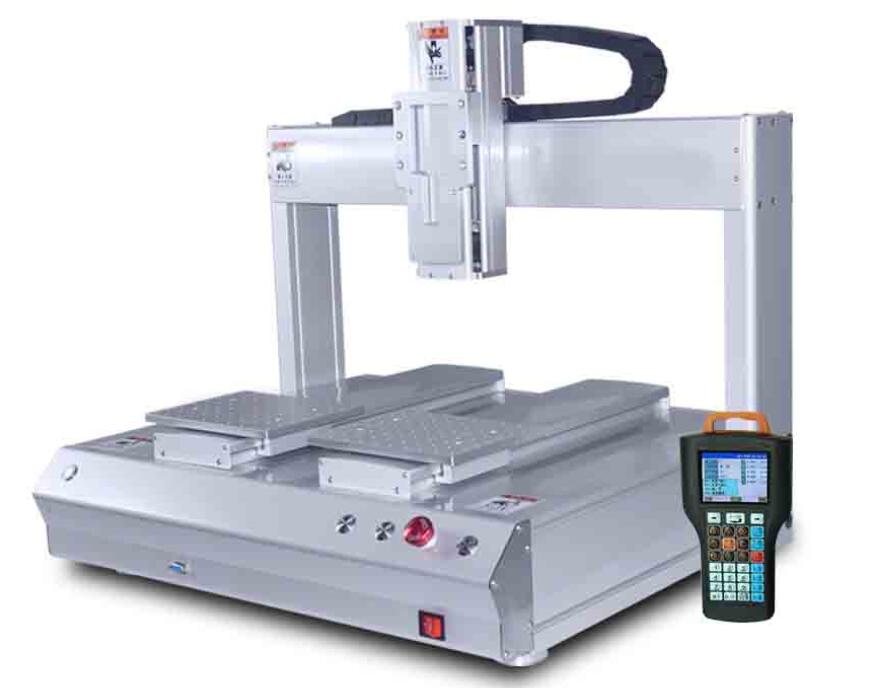
Its movement part is composed of three mutually perpendicular linear movements (namely PPP), and its working space is rectangular. Its moving distance in each axis can be read directly on each coordinate axis. It is intuitive, easy to program and calculate the position and posture, has high positioning accuracy, no coupling control, simple structure, but the body occupies a large space. The motion range is small, the flexibility is poor, and it is difficult to coordinate with other industrial robots.
(2) 円筒座標型産業用ロボット
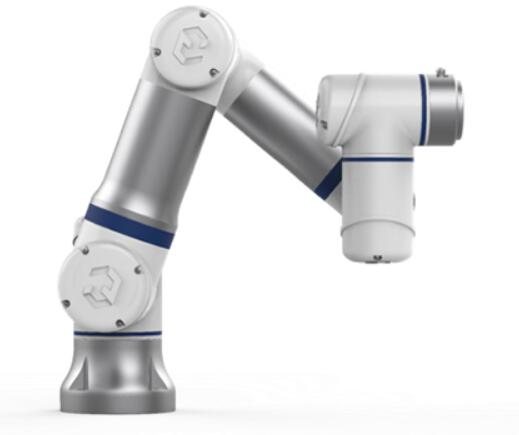
Its motion form is realized by a motion system composed of one rotation and two movements. Its working space is cylindrical. Compared with the rectangular coordinate industrial robot, under the same working space conditions, the body occupies a small volume. The range of motion is large, and its position accuracy is second only to Cartesian coordinate robots, and it is difficult to coordinate with other industrial robots.
(3) 球座標型産業用ロボット
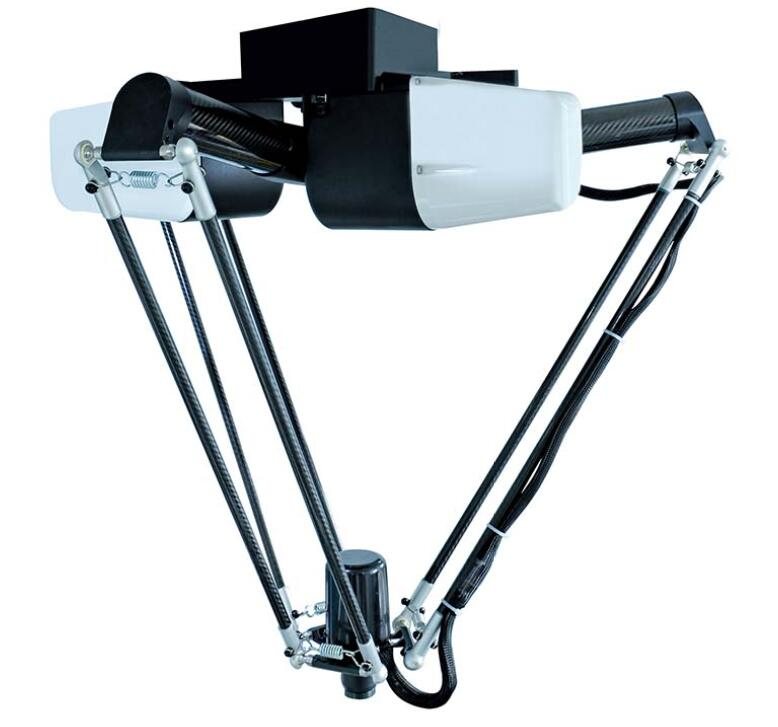
Also known as polar coordinate industrial robot, its arm movement consists of two rotations and one linear movement (ie RRP, one rotation, one pitching and one telescopic movement). Its working space is a sphere, which can make up and down pitching movements. And it can grasp the coordinated workpiece on the ground or teach low position, its position accuracy is high, and the position error is proportional to the arm length.
(4)産業用多関節ロボット
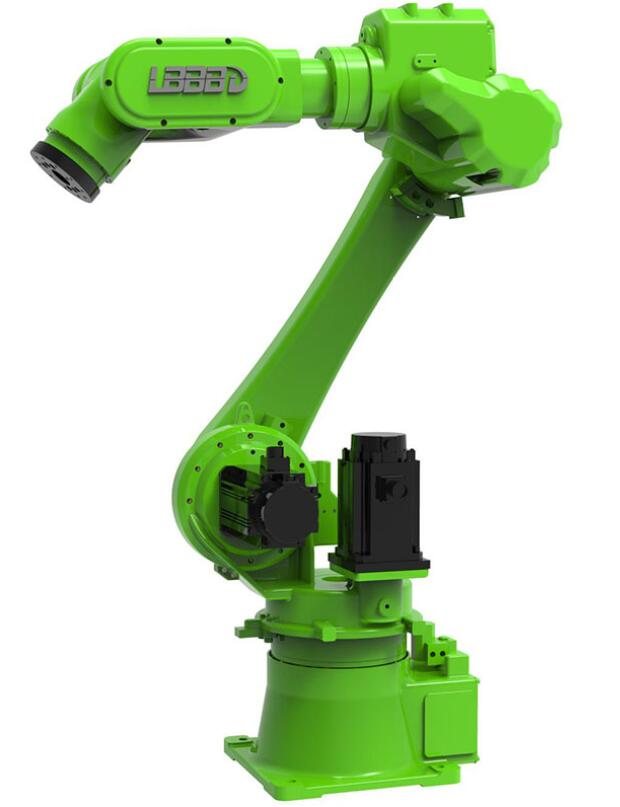
Also known as a rotary coordinate industrial robot. The arm of this industrial robot is similar to the upper limb of a human body. Its first three joints are the revolving joint (RRR). The industrial robot is generally composed of a column and a large and small arm. The column and the big arm are formed An elbow joint is formed between the shoulder joint, the upper arm and the forearm, which can make the upper arm rotate and pitch and swing, and the lower arm can make pitch swing.
その構造は最もコンパクトで柔軟性があり、設置面積が最小です。他の産業用ロボットと連携して動作することもできますが、位置精度が低く、バランスの問題があり、制御結合に問題があります。このタイプの産業用ロボットはますます広く使用されています。
(5)平面関節型産業用ロボット
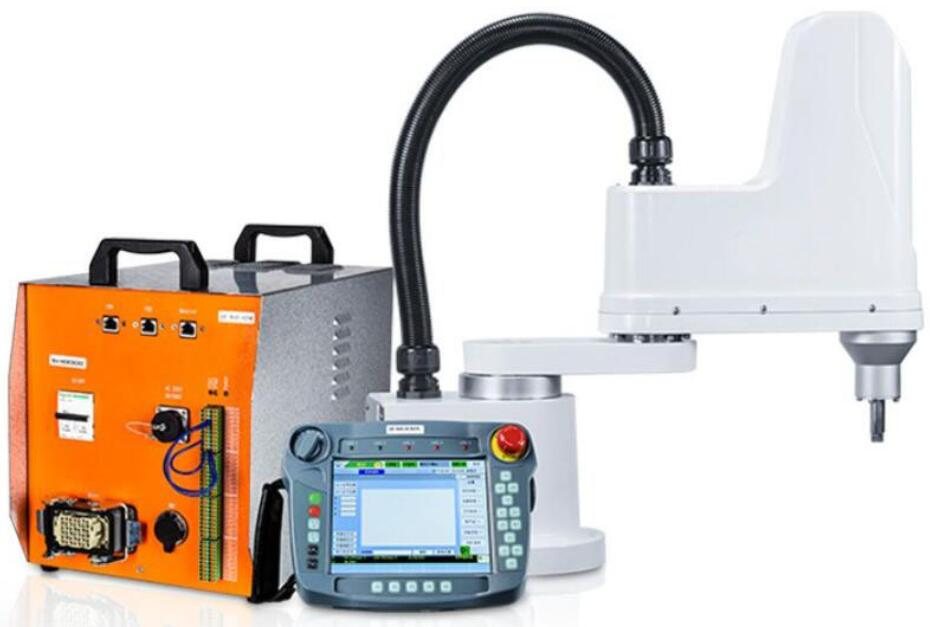
It uses a mobile joint and two rotary joints (PRR), the mobile joint realizes up and down movement, and the two rotary joints control the front and back, left and right movements. This form of industrial robot is also known as (SCARA (Seletive Compliance Assembly Robot Arm) assembly robot. It is flexible in the horizontal direction, and has great rigidity in the vertical direction. It has a simple structure and flexible movements, and is mostly used for assembly operations.
エレクトロニクス産業におけるプラグインおよびアセンブリなど、小型部品のプラグインアセンブリに特に適しています。2. 産業用ロボットは、駆動モードに応じて次のカテゴリに分類されます。
(1) 空気圧式産業用ロボット
This type of industrial robot uses compressed air to drive the manipulator. Its advantages are convenient air source, rapid action, simple structure, low cost, and no pollution. The disadvantage is that the air is compressible, resulting in poor working speed stability. The source pressure is generally only about 6kPa, so the snatch force of this type of industrial robot is small, generally only tens of Newtons, and the maximum is more than 100 Newtons.
(2) 油圧式産業用ロボット
The hydraulic pressure is much higher than the air pressure, generally about 70kPa, so the hydraulic transmission industrial robot has a large snatch capacity, which can reach thousands of newtons. This type of industrial robot has compact structure, smooth transmission, and sensitive action, but it has high requirements for sealing and is not suitable for working in high or low temperature environments.
(3) 電動産業用ロボット
This is the most used type of industrial robot, not only because of the large variety of electric motors, it provides a variety of options for industrial robot design, but also because they can use a variety of flexible control methods. In the early days, stepper motors were used to drive, and then DC servo drive units were developed. At present, AC servo drive units are also developing rapidly. These drive units either directly drive the manipulator, or are driven after deceleration through a device such as a harmonic reducer. The structure is very compact and simple.
産業用ロボット制御システム
ロボットシステムの構成は、ロボットの機構部、センサー群、制御部、情報処理部から構成されます。制御システムはロボット産業の中核部分です。1.産業用ロボット制御システムが実現すべき機能
ロボット制御システムは、マニピュレーターを制御して特定のタスクを完了するために使用されます。その基本的な機能は次のとおりです。
(1) メモリー機能:
作業順序、移動経路、移動モード、移動速度、生産プロセスに関連する情報を保存します。
(2)ティーチング機能:
オフラインプログラミング、オンライン教育、間接教育。オンライン指導にはティーチングボックスとガイド付き指導が含まれます。
(3) 周辺機器との連絡機能:
入出力インターフェース、通信インターフェース、ネットワークインターフェース、同期インターフェース。
(4) 座標設定機能:
ジョイント、絶対、ツール、ユーザー定義の 4 つの座標系があります。
(5) マンマシンインターフェース:
ティーチングボックス、操作パネル、表示画面。
(6) センサーインターフェース:
位置検出、視覚、触覚、力など
(7) 位置サーボ機能:
ロボットの多軸連携、モーション制御、速度・加速度制御、動的補償など
(8) 故障診断安全保護機能:
動作中のシステム状態の監視、障害状態での安全保護、および障害の自己診断。
2. 産業用ロボット制御システムの構成
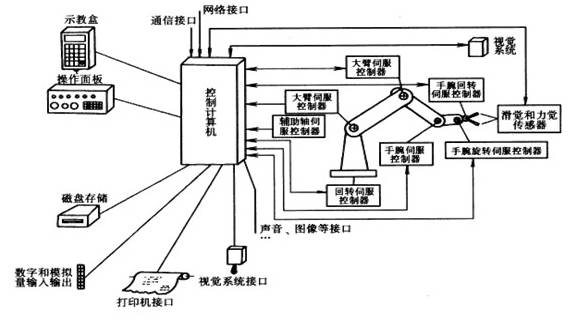 ロボット制御システムのブロック図(1) 制御コンピュータ:
制御システムの派遣および指揮組織。一般に、マイクロコンピュータおよびマイクロプロセッサは、Pentium シリーズ CPU やその他のタイプの CPU など、32 ビット、64 ビットなどです。
(2)ティーチングボックス:
ロボットの作業軌跡やパラメータ設定、人間とコンピュータの対話を学習し、独自の独立したCPUと記憶装置を備え、シリアル通信を通じてホストコンピュータとの情報対話を実現します。
(3) 操作パネル:
各種操作ボタンとステータスインジケーターで構成されており、基本的な機能操作のみを完了します。
(4) ハードディスクおよびフロッピー ディスクのストレージ:
ロボットの作業プログラムを保存するための周辺メモリ。
(5) デジタルおよびアナログの入出力:
各種ステータスや制御コマンドの入出力。
(6) プリンターインターフェース:
出力が必要な各種情報を記録します。
(7) センサーインターフェース:
ロボットの準拠制御を実現するための情報 (一般的には力センサー、タッチセンサー、視覚センサー) の自動検出に使用されます。
(8) 軸コントローラ:
ロボットの関節の位置、速度、加速度の制御を完了します。
(9) 補機制御:
グリッパポジショナ等、ロボットと連携する補助機器の制御に使用されます。
(10) 通信インターフェース:
ロボットと他のデバイス (一般にシリアル インターフェイス、パラレル インターフェイスなど) の間の情報交換を実現します。
(11) ネットワークインターフェース
1) Ethernet interface: Direct PC communication of several or single robots can be realized through Ethernet, the data transmission rate is up to 10Mbit/s, and the application program can be programmed directly on the PC with windows library functions, and the TCP/IP communication protocol can be supported , Load data and programs into each robot controller through the Ethernet interface.
2) フィールドバス インターフェイス: デバイス ネット、AB リモート I/O、Interbus-s、profibus-DP、M-NET などのさまざまな一般的なフィールドバス仕様をサポートします。
3. 産業用ロボット制御システムの分類
(1) プログラム制御方式:
各自由度に一定の規則的な制御関数を適用することで、ロボットは必要な空間軌道を実現できます。
(2) 適応制御システム:
When the external conditions change, in order to ensure the required quality or to improve the control quality with the accumulation of experience, the process is based on the observation of the state of the operating machine and the servo error, and then adjust the parameters of the nonlinear model until the error Until it disappears. The structure and parameters of this system can change automatically with time and conditions.
(3) 人工知能システム:
動作プログラムを事前に作成することは不可能ですが、動作中に取得した周囲の状況情報に基づいて制御効果をリアルタイムに判断する必要があります。
駆動モード:産業用ロボット駆動システムを参照。
運動方法:
(4) ポイントの種類:
requires the robot to accurately control the pose of the end effector, regardless of the path;
(5) トラックの種類:
ロボットは、教示された軌道と速度に従って移動する必要があります。
(6) 制御バス:
国際標準のバス制御システム。制御システムの制御バスとして、VME、MULTIバス、STDバス、PCバスなどの国際標準バスを使用します。
(7) カスタムバス制御システム:
制御システムバスとしては、メーカー自身が定義して使用するバスが使用されます。
(8) プログラミング方法:
物理設定プログラミングシステム。オペレータは固定リミットスイッチを設定することで、簡単なピッキングアンドプレース作業のみに使用できるスタートとストップのプログラム運転を実現します。
(9) オンラインプログラミング:
操作情報の記憶過程プログラミング法は、直接ティーチング(手から手へのティーチング)シミュレーションティーチングやティーチングボックスティーチングなど人間によるティーチングを通じて完成します。
(10) オフラインプログラミング:
実際のロボットに直接教示するのではなく、実際の作業環境から切り離し、高度なロボットとプログラミング言語を使用して遠隔からオフラインで教示プログラムを生成し、ロボットの軌道を生成します。
4. ロボット制御システムの構成
ロボット制御システムは、その制御方法に応じて 3 つのカテゴリに分類されます。
(1) 集中管理システム(集中管理システム):
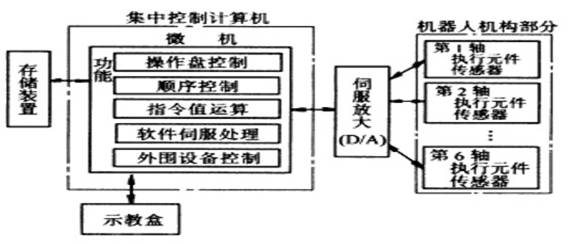 集中制御システムブロック図
すべての制御機能をコンピュータで実現します。構造がシンプルでコストも安いが、リアルタイム性が低く拡張が難しい。この構造は初期のロボットでよく使用されます。ブロック図を図に示します。
PC ベースの集中制御システムは、PC リソースのオープン性を最大限に活用し、良好なオープン性を実現できます。さまざまなコントロール カード、センサー デバイスなどを、標準の PCI スロットまたは標準のシリアル ポートおよびパラレル ポートを通じて制御に統合できます。システム。
The advantages of centralized control systems are: low hardware costs, easy information collection and analysis, easy to achieve optimal control of the system, better integrity and coordination, and more convenient PC-based system hardware expansion. Its shortcomings are also obvious: the system control lacks flexibility, and the control danger is easy to concentrate. Once a failure occurs, its impact is wide and the consequences are serious; because the real-time requirements of industrial robots are very high, when the system performs a large amount of data calculation, it will reduce the real-time performance , The system’s responsiveness to multitasking will also conflict with the system’s real-time performance; in addition, the system’s complex wiring will reduce the system’s reliability.
(2) マスタ/スレーブ制御システム:
Using master and slave two-level processors to realize all control functions of the system. The main CPU realizes management, coordinate transformation, trajectory generation and system self-diagnosis, etc.; the slave CPU realizes the motion control of all joints. Its composition block diagram, as shown in the figure.
マスタ・スレーブ制御方式はリアルタイム性が高く、高精度・高速制御に適していますが、システムの拡張性が低く、メンテナンスが困難です。
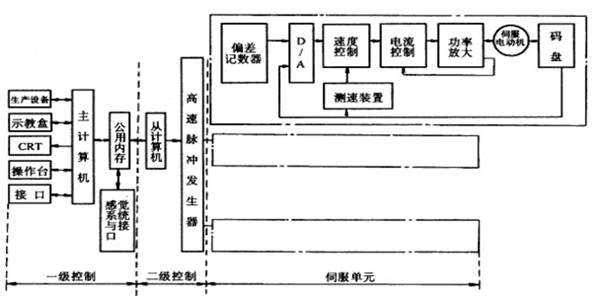 マスターおよびスレーブ制御システムのブロック図
(3) 分散制御システム:
システムの性質と方法に応じて、システム制御はいくつかのモジュールに分割されます。各モジュールには異なる制御タスクと制御戦略があります。各モードは主従関係または対等の関係にすることができます。
この方式はリアルタイム性が高く、高速・高精度な制御が実現しやすく、拡張も容易であり、インテリジェントな制御が実現できる。現在ではポピュラーな方法です。
The main idea is "decentralized control, centralized management", that is, the system can comprehensively coordinate and allocate its overall goals and tasks, and complete the control tasks through the coordination of subsystems. The entire system is functional, logical, and physical. It is decentralized, so the DCS system is also called a distributed control system or a distributed control system.
In this structure, the subsystem is composed of a controller and different controlled objects or devices, and each subsystem communicates with each other through a network. The distributed control structure provides an open, real-time and accurate robot control system. Two-level control methods are often used in distributed systems.
Two-level distributed control system, usually composed of upper computer, lower computer and network. The upper computer can carry out different trajectory planning and control algorithms, and the lower computer can carry out the research and realization of interpolation and subdivision and control optimization. The upper computer and the lower computer work in coordination with each other through the communication bus. The communication bus here can be in the form of RS-232, RS-485, EEE-488 and USB bus.
Now, the development of Ethernet and fieldbus technology provides robots with faster, stable and effective communication services. Especially the field bus, which is applied to the production site to realize two-way multi-node digital communication between microcomputerized measurement and control equipment, thus forming a new type of network integrated fully distributed control system-field bus control system FCS (Filed bus Control System) ).
In the factory production network, the devices that can be connected via fieldbus are collectively referred to as "field devices/instruments". From the perspective of system theory, industrial robots, as one of the production equipment of the factory, can also be summarized as field equipment. After the introduction of fieldbus technology in the robot system, it is more conducive to the integration of robots in the industrial production environment.
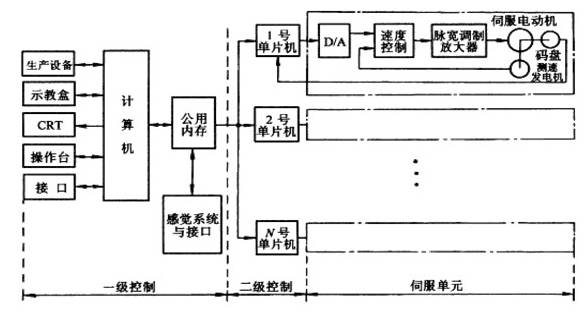 Block diagram of distributed control systemThe advantages of the distributed control system are: system flexibility is good, the risk of the control system is reduced, the use of multi-processor distributed control is conducive to the parallel execution of system functions, the processing efficiency of the system is improved, and the response time is shortened.
For industrial robots with multiple degrees of freedom, centralized control handles the coupling relationship between each control axis very well, and can be easily compensated. However, when the number of axes increases to make the control algorithm very complicated, its control performance will deteriorate. Moreover, when the number of axes in the system or the control algorithm becomes very complicated, it may lead to the redesign of the system.
対照的に、分散構造の各運動軸はコントローラーによって処理されます。これは、システムの軸間の結合が少なく、システムの再構成がより高度になることを意味します。
"Industry 4.0" refers to the fourth industrial revolution after steam engine, electrification and automation. It combines traditional industry with digital information technology and realizes intelligent production with the help of technologies such as big data and cloud computing. In China, "Industry 4.0" means the upgrading of the country's manufacturing industry. For this reason, China has specifically put forward the development goal of "Made in China 2025". The goal is to move from a major manufacturing country to a strong manufacturing country by 2025.


