


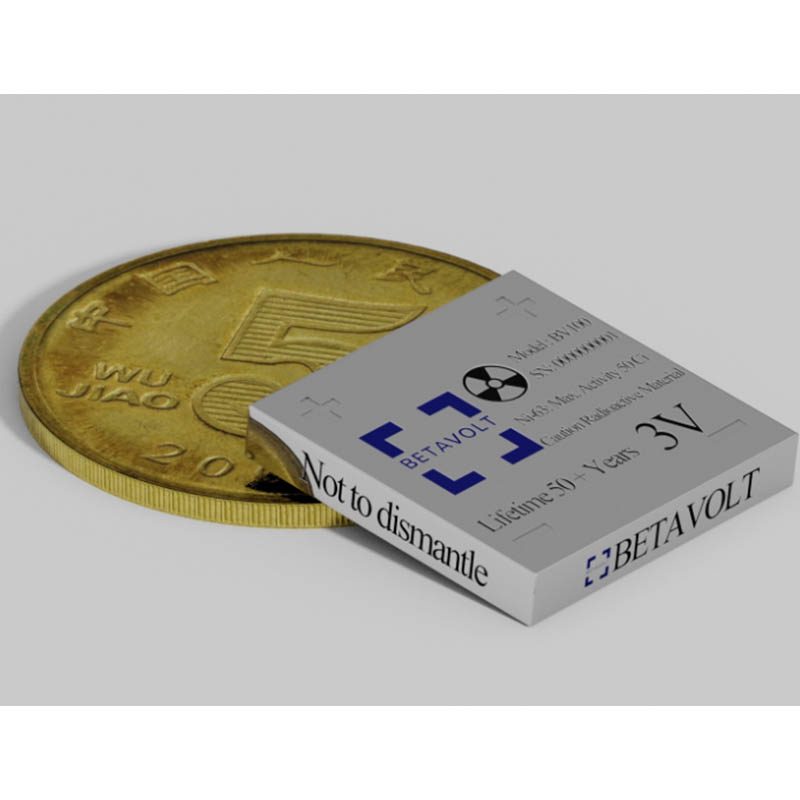
Atomic Energy Battery
The TR-ATEB01 is an automation system for packaging / filling. Lead time is 30 days; pricing is quoted per configuration. Certifications: CE documentation on request.
- Model
- TR-ATEB01
- Lead time
- 30 days
- Category
- Other Machinery
What This Platform Is For
Atomic energy batteries can generate electricity stably and autonomously for 50 years without charging or maintenance. They have entered the pilot stage and will be put into mass production on the market. Betavolt atomic energy batteries can meet the needs of long-lasting power supply in multiple scenarios such as aerospace, AI equipment, medical equipment, MEMS systems.
Commercial Terms
| Quotation | Priced per configuration — reply within 48 hours |
|---|---|
| Lead time | 30 days |
| MOQ | 100 units |
| Origin | China |
| Port of loading | Shenzhen, China |
| Incoterm | FOB Shenzhen / CIF on request |
| Payment | 30% deposit, 70% before shipment |
| Warranty | 24 months standard, 36 months optional |
Product Details
Application notes, construction drawings and video from the TROY engineering file — the same documentation shipped with the quotation.
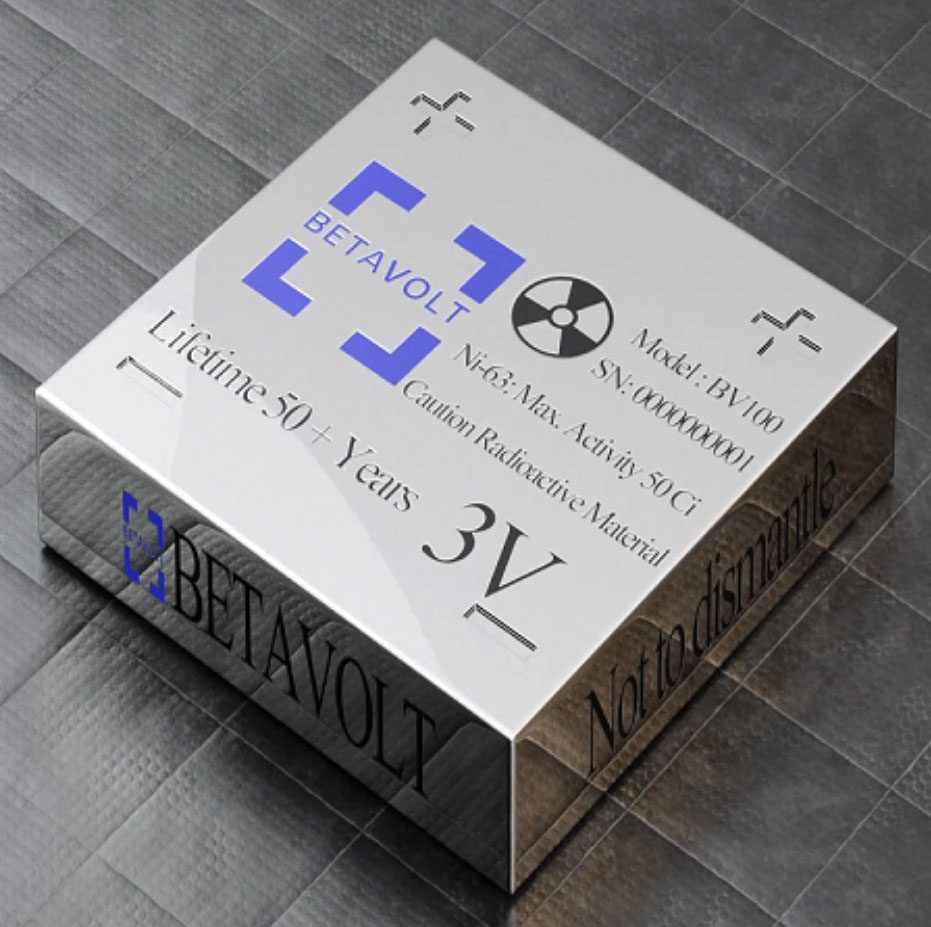
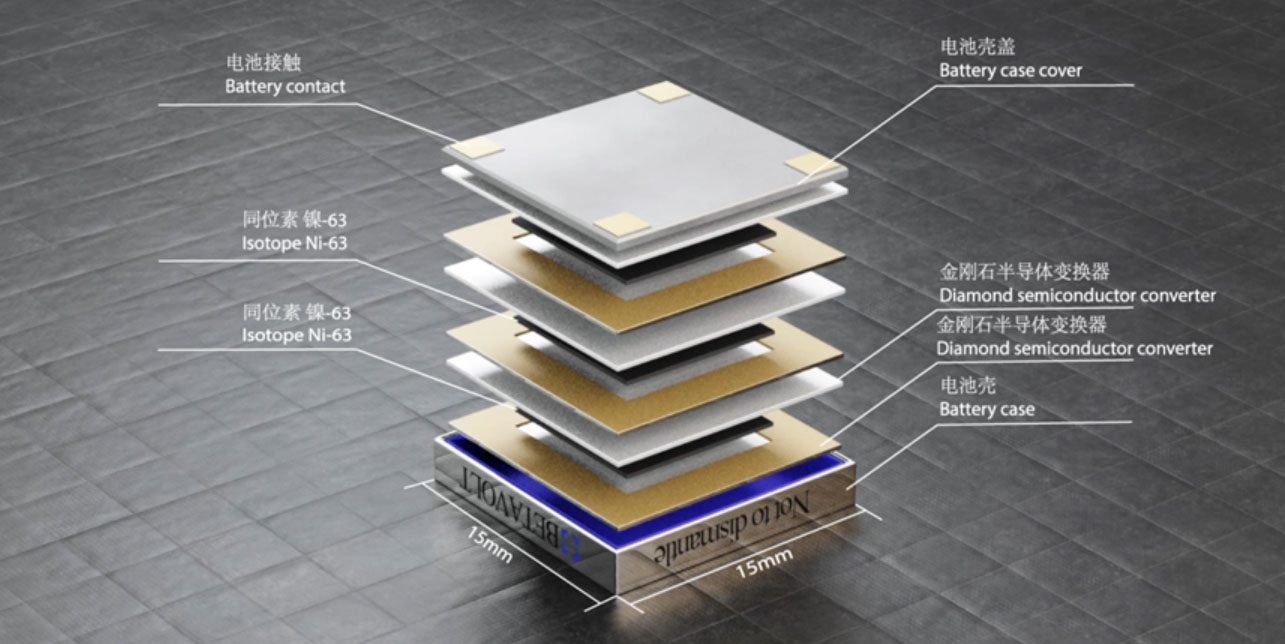
The atomic energy battery mainly uses nickel-63 as the energy source and diamond semiconductor as the energy converter. It is a DC power supply and can produce a pulse power supply with a higher lifespan by adding a supercapacitor as an energy storage device. The basic structure of this nuclear battery includes: converter, substrate, nickel-63 source, and battery protective layer.
The nickel-63 diamond beta volt battery is a stack of diamond semiconductor converters and 2μm thick nickel-63 sheets. The battery is modular. A module is composed of at least 2 converters and 1 layer of nickel-63. It is continuously Stacked to form a module group, multiple module groups are connected in series and parallel, and the power can be configured from a few microwatts to several watts. The minimum size of the atomic energy battery is 3x3x0.03㎜ (composed of 2 converters and 1 layer of nickel 63). Judging from the energy incident on the diamond semiconductor transducer device, the energy conversion rate of the battery reaches 8.8%. If used With higher purity nickel-63 radioactive sources, the power density of batteries will be further improved.
Atomic energy batteries are physical batteries, not electrochemical batteries. Their energy density is more than 10 times that of ternary lithium batteries. They can store 3,300 megawatt-hours in a 1-gram battery. They do not catch fire or explode in response to acupuncture and gunshots. Because it generates self-generated electricity for 50 years, there is no concept of the number of cycles of an electrochemical battery (2,000 charges and discharges). The power generation of atomic energy batteries is stable and will not change due to harsh environments and loads. It can work normally within the range of 120 degrees above zero and -60 degrees below zero, and has no self-discharge. The atomic energy battery developed by Betavolt is absolutely safe, has no external radiation, and is suitable for use in medical devices such as pacemakers, artificial hearts, and cochleas in the human body. Atomic energy batteries are environmentally friendly. After the decay period, the nickel-63 isotope as the radioactive source becomes a stable isotope of copper, which is non-radioactive and does not pose any threat or pollution to the environment. Therefore, unlike existing chemical batteries, nuclear batteries do not require expensive recycling processes.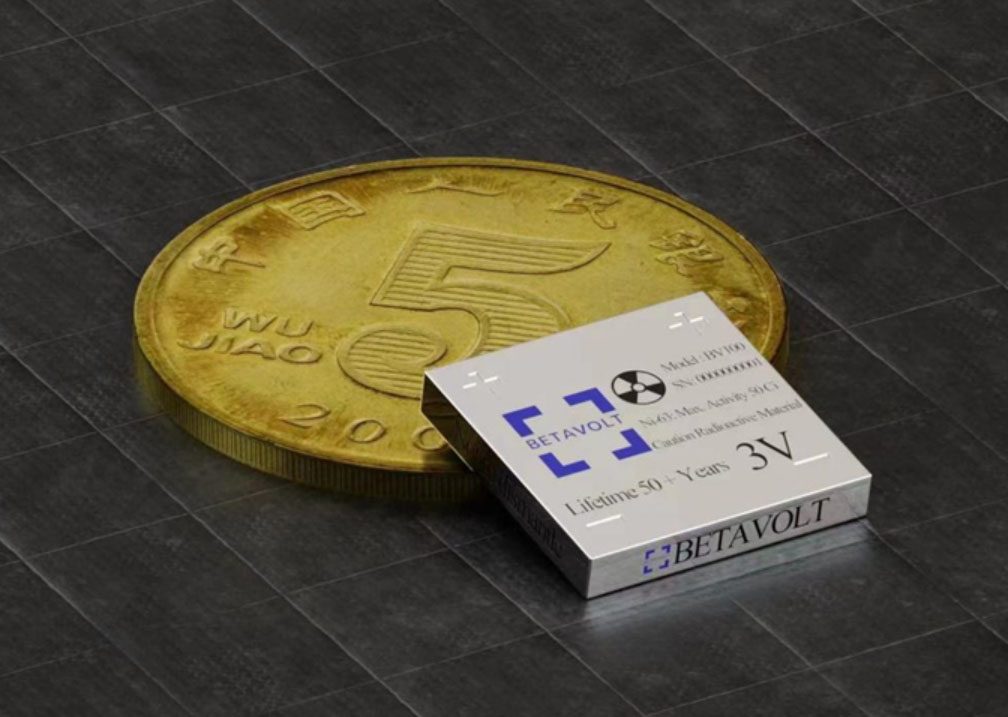
This product combines nickel-63 nuclear isotope decay technology and China's first diamond semiconductor (4th generation semiconductor) module to successfully achieve miniaturization, modularization and low cost of atomic energy batteries, starting the process of civilian use. This marks that China has achieved disruptive innovation in the two high-tech fields of atomic energy batteries and fourth-generation diamond semiconductors at the same time, putting it "way ahead" of European and American scientific research institutions and enterprises.
Atomic energy batteries can generate electricity stably and autonomously for 50 years without charging or maintenance. They have entered the pilot stage and will be put into mass production on the market. Betavolt atomic energy batteries can meet the needs of long-lasting power supply in multiple scenarios such as aerospace, AI equipment, medical equipment, MEMS systems, advanced sensors, small drones and micro robots. This new energy innovation will help China gain a leading edge in the new round of AI technological revolution.
Atomic energy batteries, also known as nuclear batteries or radioisotope batteries, work on the principle of utilizing the energy released by the decay of nuclear isotopes and converting it into electrical energy through semiconductor converters. This was a high-tech field that the United States and the Soviet Union focused on in the 1960s. Currently, there are only thermonuclear batteries used in aerospace. This kind of battery is large in size and weight, has high internal temperatures, is expensive, and cannot be used by civilians. In recent years, miniaturization, modularization and civilian use of nuclear batteries have been the goals and directions pursued by European and American countries. China's "14th Five-Year Plan and 2035 Vision Goals" also propose that the civilianization of nuclear technology and the multi-purpose development of nuclear isotopes are future development trends.
Nuclear batteries develop a completely different technological path, generating electric current through the semiconductor transition of beta particles (electrons) emitted by the radioactive source nickel-63. To do this, Betavolt's team of scientists developed a unique single-crystal diamond semiconductor that is just 10 microns thick, placing a 2-micron-thick nickel-63 sheet between two diamond semiconductor converters. The decay energy of the radioactive source is converted into an electrical current, forming an independent unit. Nuclear batteries are modular and can be composed of dozens or hundreds of independent unit modules and can be used in series and parallel, so battery products of different sizes and capacities can be manufactured.
Full Technical Data
| Model | TR-ATEB01 |
|---|---|
| Lead time | 30 days |
| Category | Other Machinery |
Values are nominal at 20 °C. Download the datasheet for cad models, torque curves and controller I/O maps.
Where It Runs
Sized and commissioned by TROY engineers.
Sized and commissioned by TROY engineers.
Sized and commissioned by TROY engineers.
Sized and commissioned by TROY engineers.
Buyer Questions
What are the key specifications of the TR-ATEB01?
Model TR-ATEB01. A full datasheet is available on request.
What is the lead time and MOQ for the TR-ATEB01?
Lead time is 30 days; MOQ is 100 units.
How is the TR-ATEB01 priced?
Pricing is quoted per configuration, including tooling and freight where applicable.
Get a Priced Proposal for TR-ATEB01
Include the part, target rate and destination port. An engineer — not a chatbot — replies within 48 hours.
Same Category
Custom Shaped NdFeB Magnet
Custom Magnetic Rotor Assembly
Sintered Ferrite Ring Magnet Y30
Reviewed by TROY Engineering · . Specifications are re-checked against the supplier datasheet at every quotation.