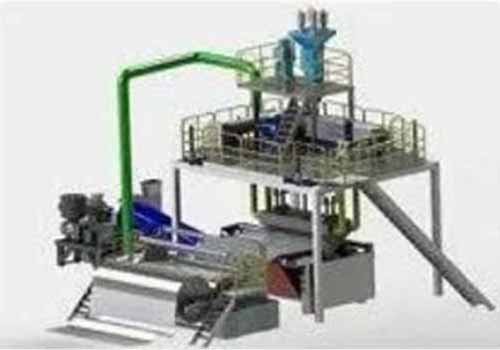
La tela fundida por soplado consiste en utilizar un flujo de aire caliente de alta velocidad para extraer la fina corriente de polímero fundido extruido desde el orificio de la boquilla del troquel, formando así fibras ultrafinas y recogiéndolas en la cortina de malla o rodillo, y al mismo tiempo uniéndose para convertirse en tela no tejida fundida por soplado.
The meltblown fabric widths of regular manufacturers are generally 1600mm, 2400mm, 3200mm, and the extruder diameters are usually 90mm, 105mm, 135mm. However, after the epidemic began, the small computers (that is, the ones used by the Yangzhong family workshop) were small in width, usually only tens of centimeters, and the screw diameters were mostly 45mm, 50mm, and 65mm.
Este tipo de máquina tiene bajo rendimiento y baja calidad, pero el costo es económico y el tiempo de entrega es rápido. El precio antes de la epidemia era sólo de 20.000 a 20.000, pero ahora ha subido a 200.000, pero sigue siendo mucho más barato que la extrusora de los fabricantes habituales. En la actualidad, elmáquina de tela soplada por fusiónde los 1600 fabricantes habituales del mercado se vende por más de 6 millones de yuanes y el plazo de entrega es de más de 2 meses.
El proceso de producción de tela fundida por soplado es principalmente el siguiente:
1. Preparación del derretimiento
2. Filtrar
3. Medición
4. La masa fundida se extruye por el orificio.
5. Derretir goteo y enfriamiento.
6. a la red
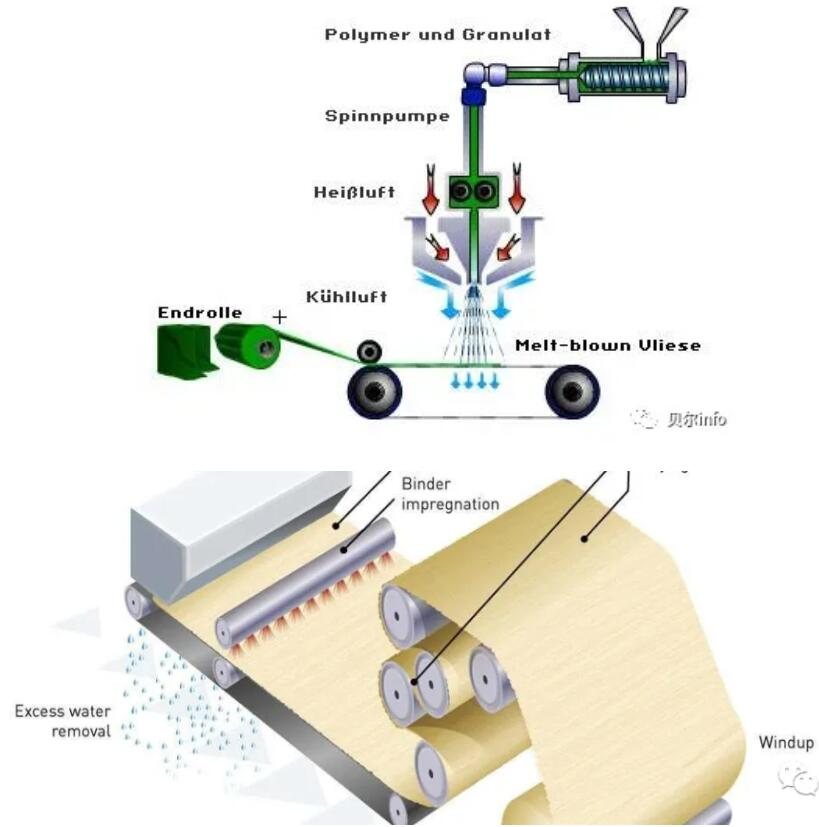
Descripción general y principio del equipo de tela soplada en fusión.
El soplado en fusión es un método que se basa en un flujo de aire a alta temperatura y alta velocidad para soplar el polímero fundido de modo que pueda estirarse rápidamente para preparar las fibras.
Después de que los chips de polímero se calientan y presurizan mediante una extrusora de tornillo hasta un estado fundido, llegan al orificio de la hilera en el extremo frontal de la boquilla a través del canal de distribución de la masa fundida y luego se estiran mediante dos flujos de aire convergentes de alta velocidad y alta temperatura para adelgazarlos.
La fibra adelgazada se enfría y solidifica en el dispositivo de malla para formar una tela no tejida fundida por soplado.
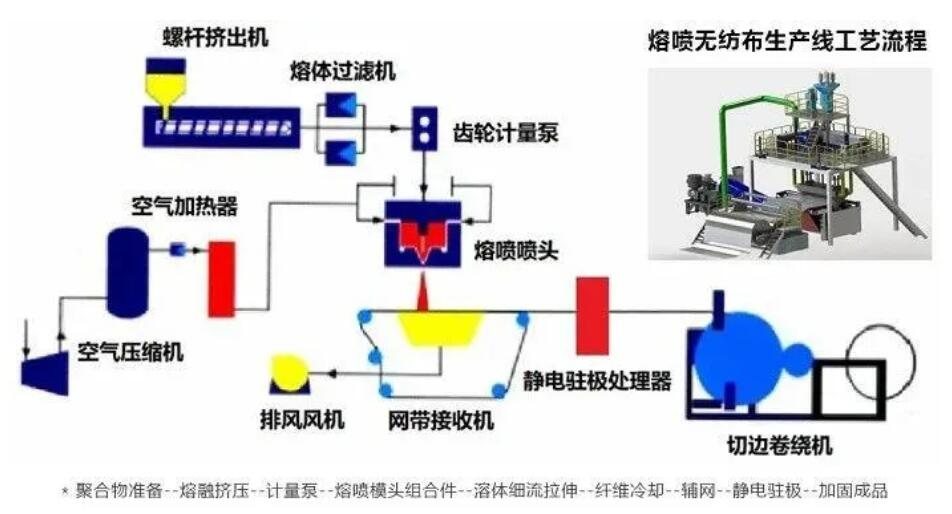
Componentes del equipo de tela soplada en fusión.
Equipos clave como cabezal de soplado por fusión, componentes del equipo del sistema de carga automática, máquina de limpieza ultrasónica, calentador de aire, ventilador centrífugo, extrusora de tornillo, máquina formadora de banda por soplado por fusión, máquina bobinadora fuera de línea por soplado y máquina cortadora fuera de línea por soplado.
El componente central del equipo de tela soplada en fusión: hilera
The spinneret for melt spinning is a representative spinneret for the manufacture of synthetic fibers such as polyester and nylon. The thermoplastic resin is heated and melted, and it is extruded through the spinneret in air or water at a certain speed and cooled. Spinning method that solidifies into fibers.
The core technology is the small nozzle on the spinneret. This nozzle is not only small in size, only 0.15mm, but also has a complex hole pattern on such a small nozzle, which is extremely difficult to process, and the nozzle processing process requires Several months. If the processing accuracy is not high, the final meltblown cloth produced will not meet the corresponding technical requirements, which will affect the protective performance of the mask.
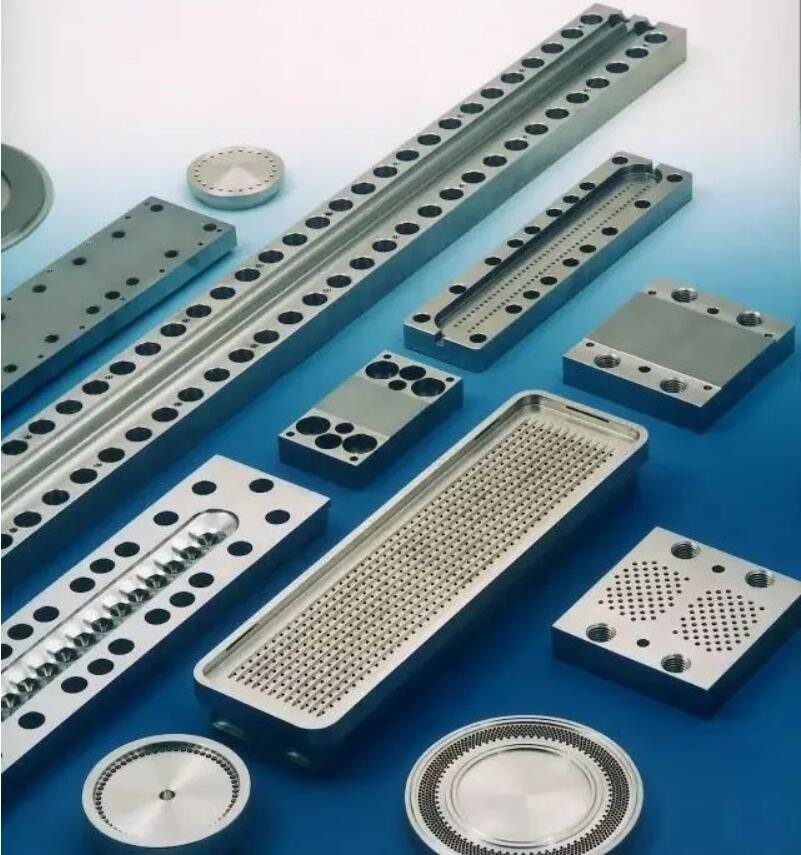
Estructura de la hilera de tela soplada en fusión
The structure of the spinneret is divided into three forms according to the shape of the spinneret, round, fan and rectangular. At present, circular plates and rectangular plates are used more at home and abroad. In order to be suitable for different kinds of chemical fiber spinning occasions, round spinnerets are divided into flat plate type, flange plate type, plate ring, flange ring, etc.: rectangular spinneret is divided into flange rectangle and flange groove rectangle, etc. , It is mostly used for short fiber spinning with more holes.
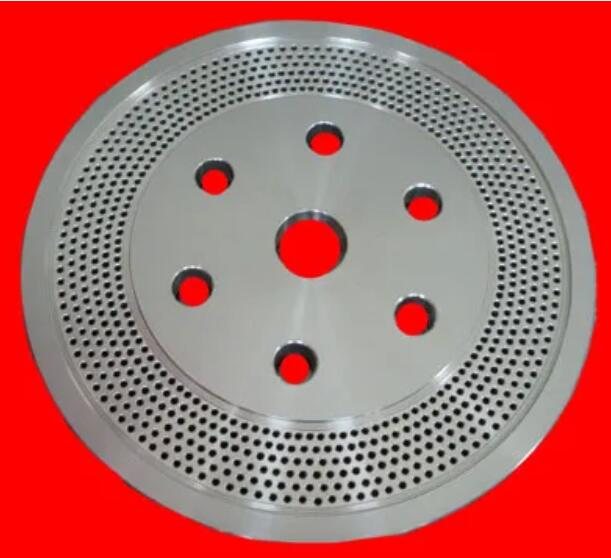
Estructura de hilera de tela soplada en fusión
Cabezal de troquel fundido
The die head includes a die head main body, a spinneret and an air plate. The spinneret and the air plate are detachably installed in the die head body. There is a spinneret hole in the spinneret, and there are several gaps between the spinneret and the air plate. There are several gas circulation channels in the main body of the die head, and the gas circulation channels are connected with the gap groove. The outer wall of the die head body is provided with a gas pipe connection end, which is connected to the gas collection cavity through a gas pipe Through, one end of the spinneret hole of the spinneret is fixedly connected with an interval flow stabilizing piece, and the other end of the spinneret is fixedly connected with a pipe connection device.
El orificio de la hilera está conectado al puerto de descarga del extrusor de tornillo a través del dispositivo de conexión de tubería conectado.
In meltblown equipment, meltblown die is one of the core components to realize high polymer wire drawing. The design and accuracy directly affect the length, uniformity, toughness, fineness and many other aspects of the wire drawing, thereby affecting the quality of the final coil. Have a decisive impact.
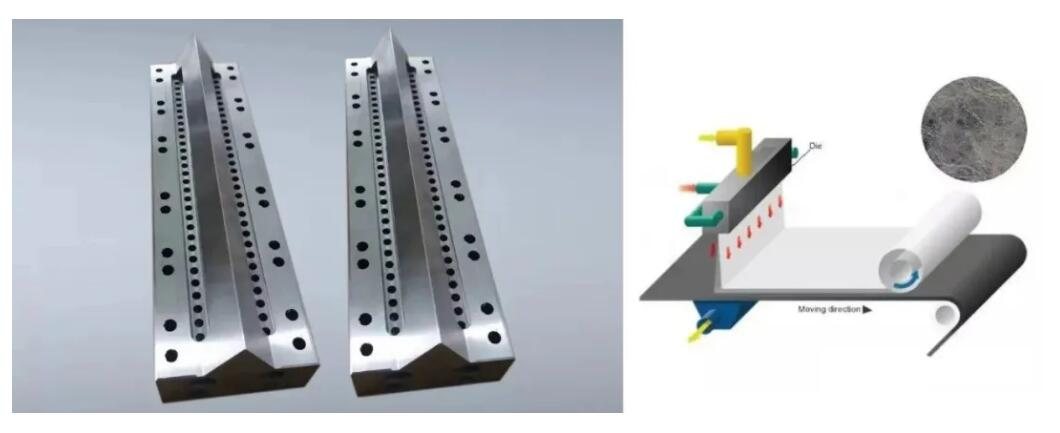
Estructura del cabezal de troquel fundido
Calentador de aire fundido
That is, the pipeline heater is composed of a body and a control system. The heating element is made of stainless steel pipe as a protective sleeve, high temperature resistance alloy wire, crystalline magnesium oxide powder, formed by a compression process, and the control part adopts advanced digital circuits and integrated circuit triggers. , High back pressure thyristor and other components constitute an adjustable temperature measurement and constant temperature system to ensure the normal operation of the electric heater.
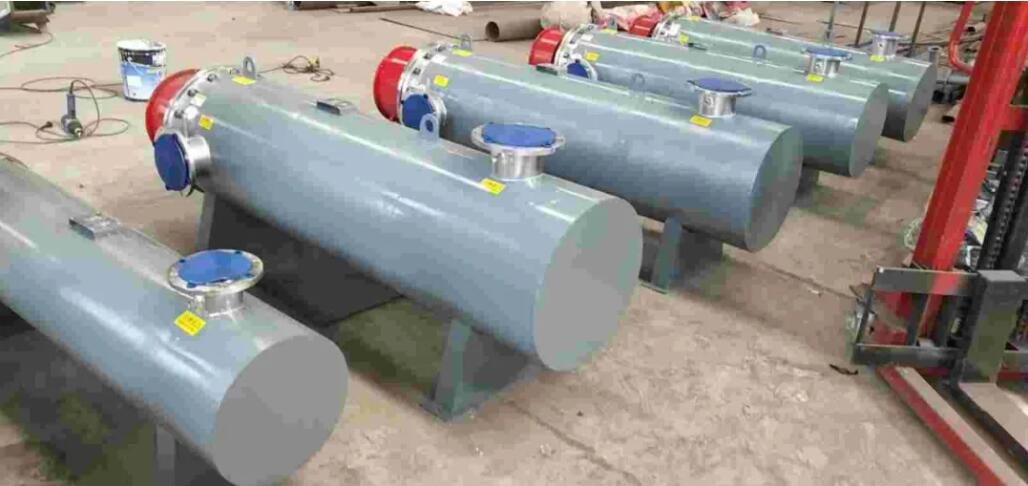
Calentador de aire fundido
Polypropylene materials are extracted from petroleum. Currently, Sinopec and other companies can produce them in large quantities, but the equipment that produces polypropylene as melt blown cloth, especially the core components and spinnerets, mainly depends on imports. These suppliers mainly include Japan's Kasen spinneret, German Enka, and Japanese spinneret. Japanese suppliers occupy the most important position. With the current output of several companies, it is far from satisfying the market demand.
Therefore, the production capacity of masks ultimately depends on the output of the melt blown cloth production equipment, and the core spinneret nozzle of the melt blown cloth production equipment is very difficult to produce. The processing time takes several months, and the output cannot be greatly increased in a short time. And the production capacity is very limited, which also makes the mask production can only maximize the use of current equipment and increase production by extending the working time of the production line.
Configuración del dispositivo principal
1. Extrusora de tornillo; 2. Bomba dosificadora; 3. Dispositivo de soplado de material fundido; 4. Red receptora; 5. Dispositivo de bobinado; 6. Dispositivo de alimentación.
El equipo de la línea de producción continua de telas no tejidas sopladas en fusión tiene aproximadamente 6 m de alto, 5 m de ancho y 20 m de largo. El equipo de producción es el siguiente:
(1) Extrusora de tornillo: el diámetro del tornillo es generalmente de 100 a 120 mm y la relación longitud/diámetro es 30. Su propósito es derretir las rodajas.
(2) Bomba dosificadora: Su función es medir con precisión, controlar la salida y la finura de la fibra. Es una bomba de engranajes que suministra continuamente la masa fundida a la hilera.
(3) Filtro de masa fundida: Su función es filtrar las impurezas de la masa fundida para evitar obstruir los orificios de la hilera.
(4) Cortina de red de transporte: la fibra fundida y soplada se recibe y distribuye uniformemente en la red y se transporta hacia adelante. Debajo hay un ventilador de succión para descargar el aire caliente que baja desde la parte superior.
(5) Spinning box: It is the key equipment of the melt-blown process. There is a strip-shaped spinneret, which is covered with a long row of spinneret holes. Generally, there are about 1500 nozzle holes per m. The two sides of the spinneret are equipped with hot air nozzles, and there are hot air nozzles underneath, which form an angle of 50b with the nozzle holes. After the fiber is ejected, the high-speed hot air is used to stretch the air flow immediately to blow the fiber and become superfine fiber.
(6) Sistema de alimentación: Está compuesto por 3 tolvas medidoras, las cuales se utilizan para medir lonchas blancas, masterbatch y aditivos. Los 3 componentes ingresan al mezclador que se encuentra debajo para mezclarse uniformemente y luego ponerse en producción.
(7) Soplador y calentador de aire caliente: proporcionan la temperatura y presión del aire caliente utilizado en el dibujo del flujo de aire giratorio, utilizan electricidad para calentar y consumen mucha energía.
(8) The coiling machine adopts automatic coiling, and the melt blown cloth is packaged in rolls. Meltblown nonwovens are characterized by ultra-fine fibers, and the smallest fiber diameter can reach 0.5Lm, generally between 1~5Lm. The finer the fiber, the better the quality of meltblown cloth, but the output is relatively reduced. Because the fiber is ultra-fine, its specific surface area is large, and the adsorption capacity is strong, which is the most prominent advantage of melt blown cloth.
Si está interesado en las máquinas para fabricar telas fundidas por soplado, puede visitar el enlace para obtener más detalles y una demostración en video a continuación:https://www.troysupply.com/1200-1600mm-width-melt-blown-fabric-machine_p130.html
¡Muchas gracias de TROY!