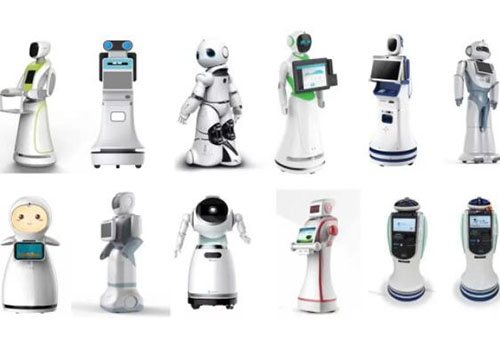
Theo "Báo cáo thống kê robot toàn cầu năm 2020" được công bố, năm 2019, doanh số bán robot hậu cần toàn cầu đã tăng 110% và robot y tế tăng 28%.
The International Federation of Robotics (IFR) reported in Frankfurt, Germany on October 28 that the global sales of professional service robots increased by 32% to 11.2 billion USD (2018-2019). The new crown epidemic will further stimulate the service robot market. The current surge in market demand for robot disinfection solutions, factory and warehouse robot logistics solutions, and home delivery robots shows this trend.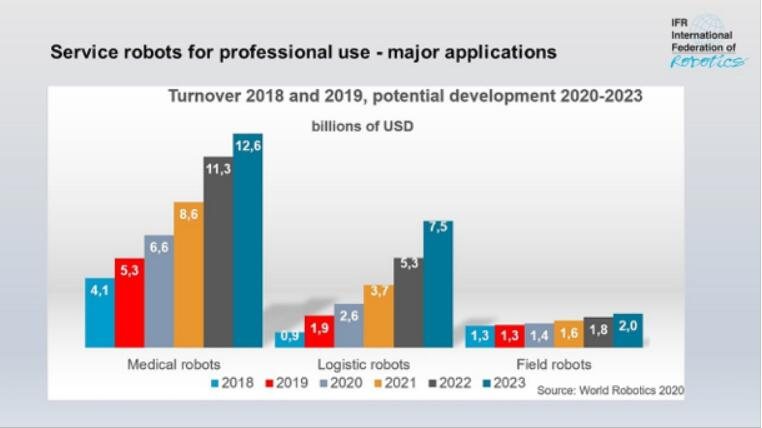 Theo Báo cáo thường niên về robot toàn cầu IFR2020, doanh số bán robot y tế năm 2019 chiếm gần một nửa (47%) tổng doanh số của robot y tế.robot dịch vụ chuyên nghiệp, trong đó hệ thống robot phẫu thuật đóng góp nhiều nhất vì robot dịch vụ như vậy có giá cao nhất.
In 2019, sales of medical robots reached 5.3 billion U.S. dollars, an increase of 28% year-on-year, a record high. By 2022, the sales potential of medical robots will more than double and is expected to reach 11.3 billion US dollars. Among them, about 90% of medical robots come from suppliers in the United States and Europe.
Robot dịch vụ chuyên nghiệp-robot hậu cần
Năm 2019, doanh số bán hoặc cho thuê robot hậu cần đã tăng 110% lên 1,9 tỷ đô la Mỹ và phần lớn doanh thu đến từ robot ứng dụng trong nhà.Robot di động tự độngđã được sử dụng trong kho sản xuất kỹ thuật số và cũng là một phần của sản xuất thông minh hiện nay. Do đó, doanh thu hàng năm của robot hậu cần có thể tiếp tục duy trì mức tăng trưởng mạnh mẽ từ 40% hoặc thậm chí cao hơn.
IFR Chairman Milton Guerry said: "In the manufacturing process, the investment cost of logistics service robots can be quickly recovered. If it runs uninterrupted for 24 hours, the investment of logistics service robots can be recovered within 2-3 years, which is actually even faster. The service life is 15 years, and the operating cost is about 5% of the annual investment. A well-developed system can usually be at least 98% efficient."
 The current popular "Robot as a Service (RaaS)" business model lowers the threshold for customers to achieve automation through robots. The advantage of this model is that customers do not need to invest in hardware, so the company does not need to have fixed funds, fixed costs, and does not require specialized robot operators.
The driving force for the application of robotic logistics systems in non-manufacturing industries mainly comes from the warehousing solutions implemented by large e-commerce companies. Hospitals also have great potential and use professional service robots to assist in handling hospital logistics. In the field of professional service robots, about 90% of the logistics robots in the above applications are produced in Europe and North America, and about 10% are in Asia.
Robot hiện trường Robot dịch vụ chuyên nghiệp
Field robots include agriculture, dairy, animal husbandry and other field robots. Sales in 2019 increased by 3% year-on-year to reach US$1.3 billion. The new crown epidemic may have boosted the application of such robots. For example, due to travel restrictions, workers in Eastern Europe cannot work in Western Europe during the harvest season as usual, resulting in a labor shortage. Local farmers may use field robots to solve this problem. Compared with the previous year, the sales growth of agricultural robots is expected to exceed 30%.
Robot dịch vụ cá nhân và gia đình
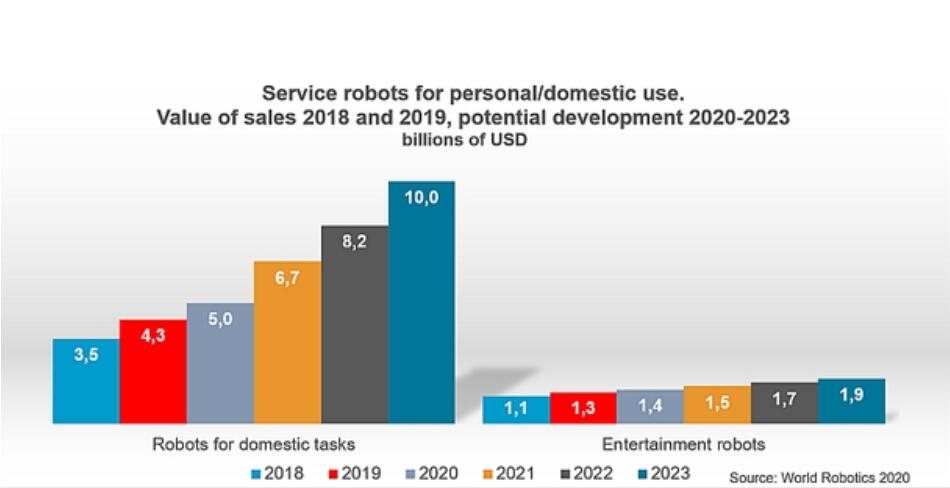
Robot dịch vụ cá nhân và gia đình được sản xuất cho thị trường đại chúng chủ yếu đề cập đến lĩnh vực robot gia đình, bao gồm robot hút bụi và robot.robot lau sàn, robot cắt cỏ và robot giải trí. Năm 2019, tổng doanh số bán robot dịch vụ cá nhân và gia đình vượt 23,2 triệu chiếc, tăng 34% so với cùng kỳ năm trước; doanh thu tăng 20% đạt 5,7 tỷ USD.
In recent years, the unit prices of the two most important products-robot vacuum cleaners and toy robots have been declining. Currently, the basic robot vacuum cleaner sells for less than $100. In 2019, 75% of the world's domestic service robots-vacuum cleaners and floor cleaners, lawn mowers and other household robots-were produced by American companies. Asian companies account for 19% of the global market, and European companies account for 6%.
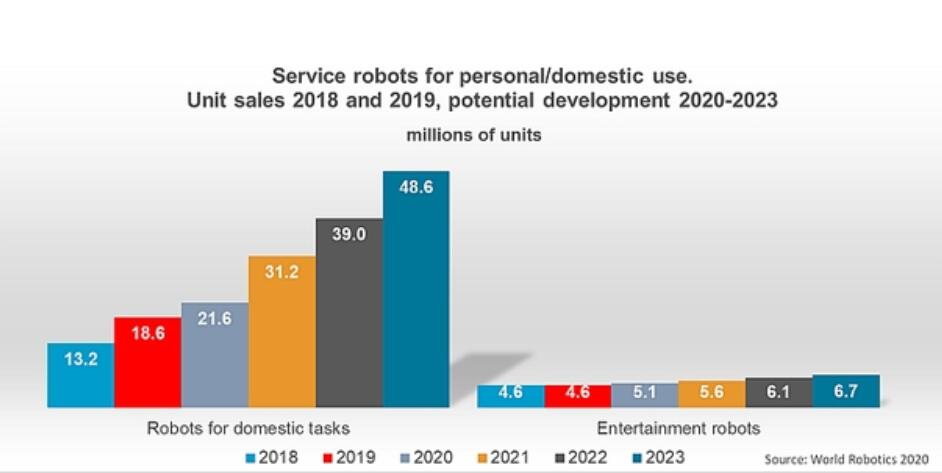 Assistive robots for the elderly/the disabled are a rapidly growing market. In 2019, sales of assistive robots reached US$91 million, an increase of 17% year-on-year. Numerous research projects around the world have gathered in the field of service robots, and many countries attach great importance to this market with great development potential. Unlike most entertainment robots, assistive robots for the elderly/disabled are high-tech products.
Milton Guerry, Chủ tịch Liên đoàn Robot Quốc tế, cho biết: “Chúng tôi kỳ vọng doanh số bán robot dịch vụ chuyên nghiệp và robot dịch vụ cá nhân sẽ tiếp tục duy trì mức tăng trưởng mạnh mẽ trong tương lai”.