The Chinese market has a broad prospect. In the future, there will be a strong market space in the electronics, light industry, hotel, service and other industries, and there are still many application scenarios to be developed. Therefore, it can be speculated that in the next 5 years, the competition in the collaborative robot industry market will become more intense. Some companies will try their best to lower product prices to gain a competitive advantage in price.
And another part of the companies will continue the lifeline of existing technology research and development and acquire customers with new technology, high quality and high prices. From the perspective of corporate strategy research, we hope that most companies in China will adopt the latter. We can't deny that in order to survive, enterprises seek immediate benefits and survive at low prices. However, from the perspective of national and corporate technology development strategies, emphasis on technological research and development and the cultivation of talents is the key link for Chinese domestic corporate products to replace imported products.
Nous espérons vous montrer un aperçu du marché international des robots collaboratifs à travers notre perspective. Faites en sorte que davantage de personnes comprennent les robots collaboratifs et prêtent attention au marché des robots.
The sudden new crown epidemic in 2020 has caused immeasurable losses to the land of China and the world. By the time the report was submitted, we had not yet obtained detailed statistics and analysis of the impact on the world. Therefore, the variables affected by the epidemic are not included in the forecast data of the report. Please understand. Prévisions à l’échelle du marché de l’industrie mondiale des robots collaboratifs
According to data from Japan’s Yano Economic Research Institute, the world collaborative robot market is expected to reach 850 billion yen in 2024, which is approximately 54.6 billion yuan in scale. Collaborative robots will be widely used in new industrial fields such as food, cosmetics, and pharmaceuticals, and service industries such as catering and hotels.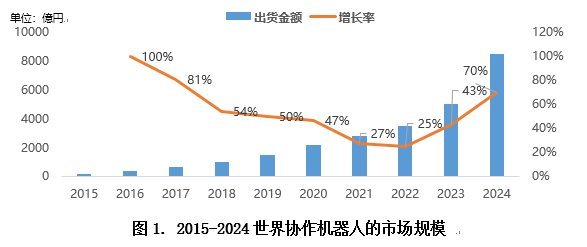
Tendances de développement et tendances des cobots dans le monde
Grâce à l'enquête menée auprès de 14 grandsrobot collaboratifentreprises dans le monde et la comparaison des informations sur les produits, nous pouvons juger de l'orientation du développement des robots collaboratifs à partir des aspects suivants. (Voir le contenu du cinquième numéro)
1. Du point de vue du prix, le prix d'un robot collaboratif est d'environ 1 million de yens, soit environ 70 000 yuans, et le prix d'un produit à fonction unique ou d'une fonction désignée ou d'un produit miniaturisé est d'environ 15 000 yuans. Le bas prix est la tendance du marché des robots collaboratifs.
2 From the aspect of operating and setting functions, collaborative robot manufacturers have developed convenient functional software for customers, and some companies have introduced intelligent terminal control systems and APPs. In the future, the use of smart terminals is the direction of development of manipulating collaborative robots.
3. Du point de vue de l'éducation et de la formation des opérateurs, étant donné que l'exploitation et le mouvement desbras robotiques à grande échellesont dangereux, il est nécessaire de mettre en œuvre une éducation et une formation spéciales sur la sécurité et le fonctionnement du personnel travaillant avec des robots industriels. Lebras robotiquedu robot collaboratif est facile à installer et ne nécessite pas de formation particulière en droit.
Ainsi, dans l'espace limité de l'entreprise, vous pouvez apprendre par vous-même en vous référant aux explications des produits, aux documents de référence vendus sur le marché et à diverses informations sur Internet. Faciliter la culture des talents et le développement secondaire des applications de produits.
Les caractéristiques de la demande des clients finaux des entreprises utilisant des robots
1. In order to ensure product quality, more companies need to purchase collaborative robots. Because of a single simple process, maintaining concentration for a long time, even skilled employees is a great burden. Fatigue and changes in physical condition will lead to a decline in the quality of work. If a robot arm that can work in a narrower working space, work longer or repeat simple actions multiple times, it can free people's hands and ensure the quality of production.
À l’avenir, les tâches plus simples et répétitives dans les secteurs des services comme l’industrie, la restauration et l’hôtellerie seront remplacées par des robots collaboratifs. Ce sera un maillon clé pour les entreprises afin de garantir la qualité des produits et de fournir des services efficaces.
2. The company aims to improve productivity. Compared with humans, collaborative robots can increase the working time and run multiple machines in parallel, can maintain the set speed for work, complete the expected work plan, and greatly improve production efficiency. Labor-intensive, standard product production companies will use collaborative robots in large numbers.
3. The enterprise needs to realize business recombination. In the past, industrial robots set the scope and content of the work, and then worked according to the specified program. If you need to change the work content, the process of moving the device is very cumbersome and complicated. Nowadays, companies have increasingly higher requirements for production activities, and being able to flexibly change the scope of work and business content is the actual demand of many companies.
Grâce à des paramètres simples, la capacité à faire face aux emplois existants et à la recombinaison des activités constitue l'orientation future du développement des robots collaboratifs.
robot collaboratif, cobot.