The Chinese market has a broad prospect. In the future, there will be a strong market space in the electronics, light industry, hotel, service and other industries, and there are still many application scenarios to be developed. Therefore, it can be speculated that in the next 5 years, the competition in the collaborative robot industry market will become more intense. Some companies will try their best to lower product prices to gain a competitive advantage in price.
And another part of the companies will continue the lifeline of existing technology research and development and acquire customers with new technology, high quality and high prices. From the perspective of corporate strategy research, we hope that most companies in China will adopt the latter. We can't deny that in order to survive, enterprises seek immediate benefits and survive at low prices. However, from the perspective of national and corporate technology development strategies, emphasis on technological research and development and the cultivation of talents is the key link for Chinese domestic corporate products to replace imported products.
Esperamos mostrarle una visión general del mercado internacional de robots colaborativos a través de nuestra perspectiva. Hacer que más personas comprendan los robots colaborativos y presten atención al mercado de los robots.
The sudden new crown epidemic in 2020 has caused immeasurable losses to the land of China and the world. By the time the report was submitted, we had not yet obtained detailed statistics and analysis of the impact on the world. Therefore, the variables affected by the epidemic are not included in the forecast data of the report. Please understand. Pronóstico a escala de mercado de la industria mundial de robots colaborativos
According to data from Japan’s Yano Economic Research Institute, the world collaborative robot market is expected to reach 850 billion yen in 2024, which is approximately 54.6 billion yuan in scale. Collaborative robots will be widely used in new industrial fields such as food, cosmetics, and pharmaceuticals, and service industries such as catering and hotels.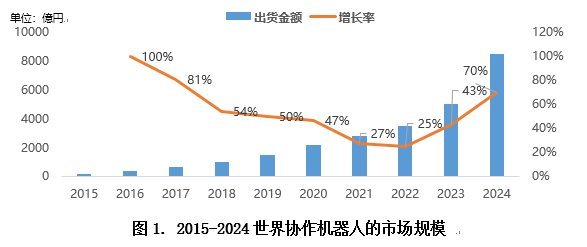
Tendencias de desarrollo y tendencias de los cobots en el mundo.
A través de la encuesta de 14 principalesrobot colaborativoEmpresas en el mundo y la comparación de la información del producto, podemos juzgar la dirección del desarrollo de los robots colaborativos a partir de los siguientes aspectos. (Consulte el contenido del quinto número)
1. Desde la perspectiva del precio, el precio de un robot colaborativo es de aproximadamente 1 millón de yenes, o alrededor de 70.000 yuanes, y el precio de un producto de función única o de función designada o producto miniaturizado es de aproximadamente 15.000 yuanes. El precio bajo es la tendencia del mercado de los robots colaborativos.
2 From the aspect of operating and setting functions, collaborative robot manufacturers have developed convenient functional software for customers, and some companies have introduced intelligent terminal control systems and APPs. In the future, the use of smart terminals is the direction of development of manipulating collaborative robots.
3. Desde la perspectiva de la educación y capacitación del operador, porque la operación y el movimiento debrazos robóticos a gran escalason peligrosos, es necesario implementar educación y capacitación especial sobre seguridad y operación para el personal que trabaja con robots industriales. Elbrazo robóticodel robot colaborativo es fácil de instalar y no requiere formación especial en derecho.
Por lo tanto, en el espacio limitado de la empresa, puede aprender usted mismo consultando explicaciones de productos, materiales de referencia vendidos en el mercado e información diversa en Internet. Facilitar el cultivo de talentos y el desarrollo secundario de aplicaciones de productos.
Las empresas que utilizan robots-características de la demanda del cliente final
1. In order to ensure product quality, more companies need to purchase collaborative robots. Because of a single simple process, maintaining concentration for a long time, even skilled employees is a great burden. Fatigue and changes in physical condition will lead to a decline in the quality of work. If a robot arm that can work in a narrower working space, work longer or repeat simple actions multiple times, it can free people's hands and ensure the quality of production.
En el futuro, las tareas más simples y repetitivas en sectores de servicios como la industria, la restauración y la hostelería serán sustituidas por robots colaborativos. Este será un vínculo clave para que las empresas garanticen la calidad de los productos y proporcionen servicios eficientes.
2. The company aims to improve productivity. Compared with humans, collaborative robots can increase the working time and run multiple machines in parallel, can maintain the set speed for work, complete the expected work plan, and greatly improve production efficiency. Labor-intensive, standard product production companies will use collaborative robots in large numbers.
3. The enterprise needs to realize business recombination. In the past, industrial robots set the scope and content of the work, and then worked according to the specified program. If you need to change the work content, the process of moving the device is very cumbersome and complicated. Nowadays, companies have increasingly higher requirements for production activities, and being able to flexibly change the scope of work and business content is the actual demand of many companies.
A través de configuraciones simples, la capacidad de hacer frente a trabajos existentes y la recombinación de negocios es la dirección de desarrollo futuro de los robots colaborativos.
robot colaborativo, cobot.