Motorcycle displacement usually climbs in small, polite steps. These four do not. They are the outer edge of what the word can mean — a hand-built 23-unit special, the ceiling of series production, a car engine bolted into a street-legal frame, and a concept that was never meant for a road at all.
ARCH Method143: the last word in limited-run, hand-built excess
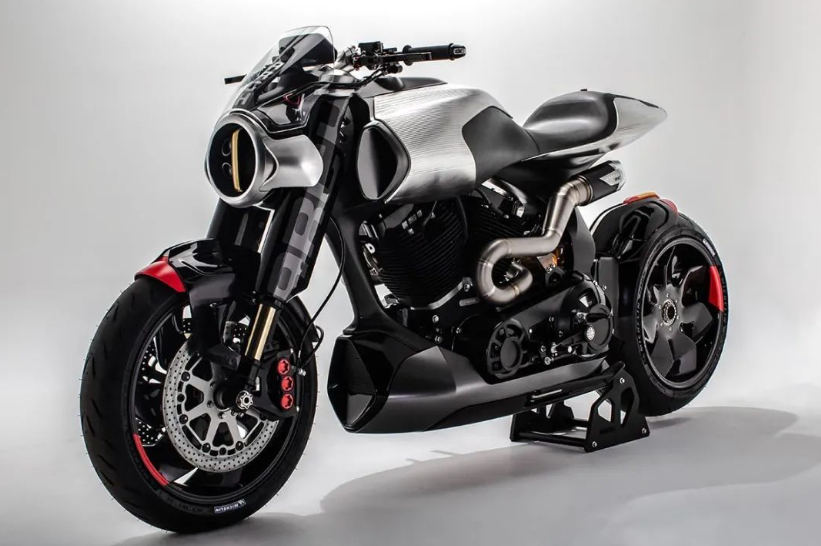
2,343 cc — the smallest of the four, and the one where displacement is designed the deepest. The Method143 comes from ARCH Motorcycle, founded by Keanu Reeves and Gard Hollinger. It appeared at EICMA in Milan in 2017, 23 were built for the world, and the price started above US$100,000.
At its centre is a 143-cubic-inch V-twin developed with S&S: 2,343 cc, roughly 162–170 hp, 205 N·m of peak torque. Those numbers are not outrageous. What earns the Method143 its place is how it exists: ARCH dropped a production V-twin into a carbon-fibre monocoque that doubles as fuel tank, airbox and primary structure, holding dry weight to 241 kg. Suspension is a bespoke Öhlins specification, the swingarm is machined by Suter Industries — the Moto2 chassis supplier — the exhaust is full titanium and the wheels are BST carbon items.
The Method143 is, in effect, a concept bike that was cashed in. ARCH set out to build the kind of machine that normally never leaves a design studio, then made 23 of them real and ownable. It has the smallest engine here, but it points in the opposite direction from the rest of this list: not the intimidation of a bigger number, but every millilitre translated through chassis, suspension and materials into a motorcycle you can actually ride, lean and feel.
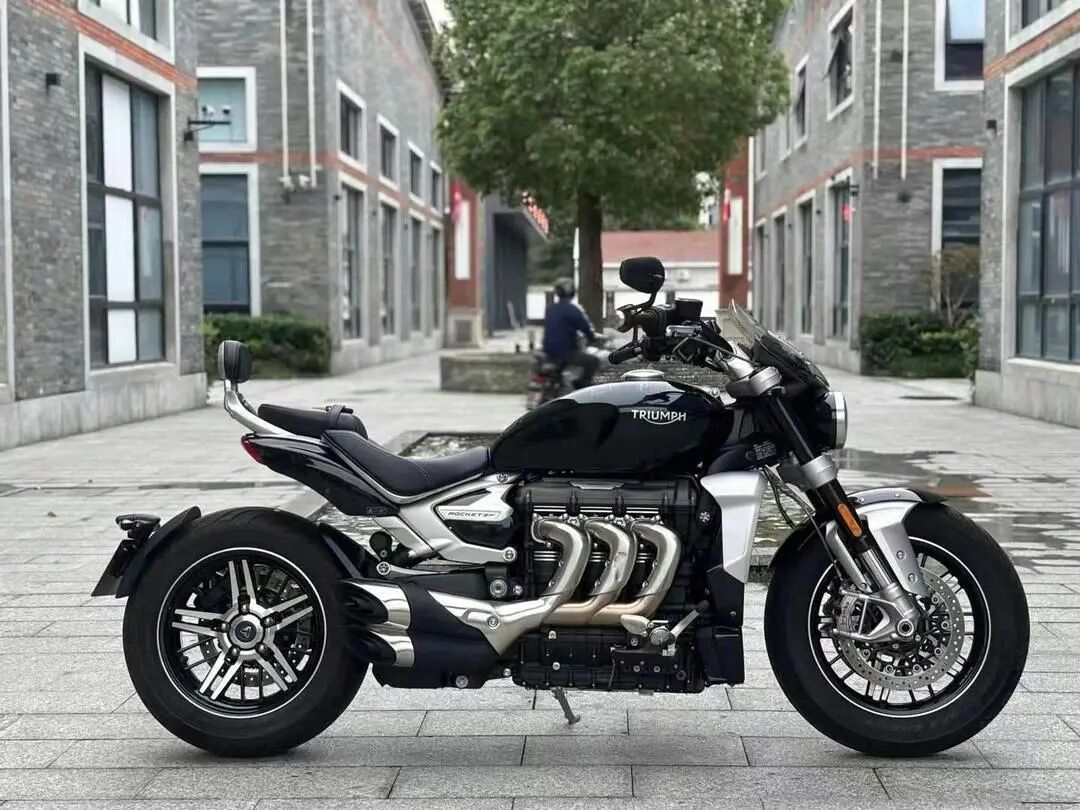
Triumph Rocket 3: the absolute ceiling of series production
2,458 cc — 115 cc further, and you reach the name nobody can get around. The Rocket 3's inline three displaces 2,458 cc, releases 221 N·m at 4,000 rpm, and has been measured at 2.73 seconds to 100 km/h — past 100 km/h in first gear.
The hard part was never making it big. It was keeping a 2.5-litre powertrain with motorcycle proportions and motorcycle controllability: 291 kg is restrained for the class, and shaft drive with a low centre of gravity makes it far less clumsy in slow corners than the numbers suggest. No production motorcycle you can buy and legally ride carries a larger engine.
Its dominance rests on a simple fact: it is the gatekeeper of the displacement ceiling inside production rules, and it still turns that displacement into everyday usable performance rather than a line on a spec sheet. The 115 cc between the Method143 and the Rocket 3 draws the fine border between limited-run hand refinement and mainstream series production — one proves with 23 units how deep displacement can be designed, the other proves through a global dealer network how large it can be built.
Boss Hoss: the undisputed king of street-legal
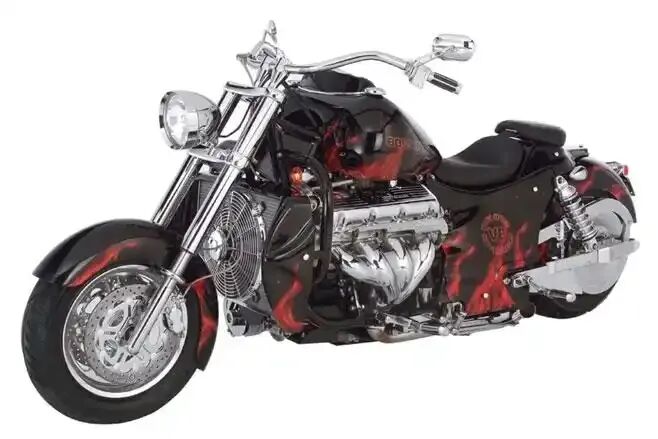
8,127 cc — a jump from "motorcycle engine" to "powertrain transplant". Going from 2,458 cc to 8,127 cc is not a progression, it is a break by an order of magnitude. The factory in Dyersburg, Tennessee has done the same thing since the 1990s: fit a Chevrolet V8 into a motorcycle and make it road legal.
The current flagship is an 8.1-litre big-block V8: 8,127 cc, 600 hp, 772 N·m, sent through a two-speed semi-automatic developed with Winters Performance that uses a torque converter instead of a clutch. Dry weight is 556 kg, the wheelbase runs past two metres, the rear tyre is a 300-section, the tank holds 32 litres, and prices start around US$71,000.
Riding it is not a matter of managing revs and gears the way a motorcycle engine asks you to. It is closer to driving a bare, two-wheeled car powertrain. With the ARCH and the Rocket 3, displacement was still motorcycle displacement — designed, tuned and constrained around a two-wheel use case. At Boss Hoss it is no longer designed at all; it is moved across whole. The company turned the V8 motorcycle from an absurd idea into a small but genuinely purchasable product category, and in doing so made displacement stop being a performance parameter: here it is the physical presence of the engine itself.
Dodge Tomahawk: the gap displacement cannot cross
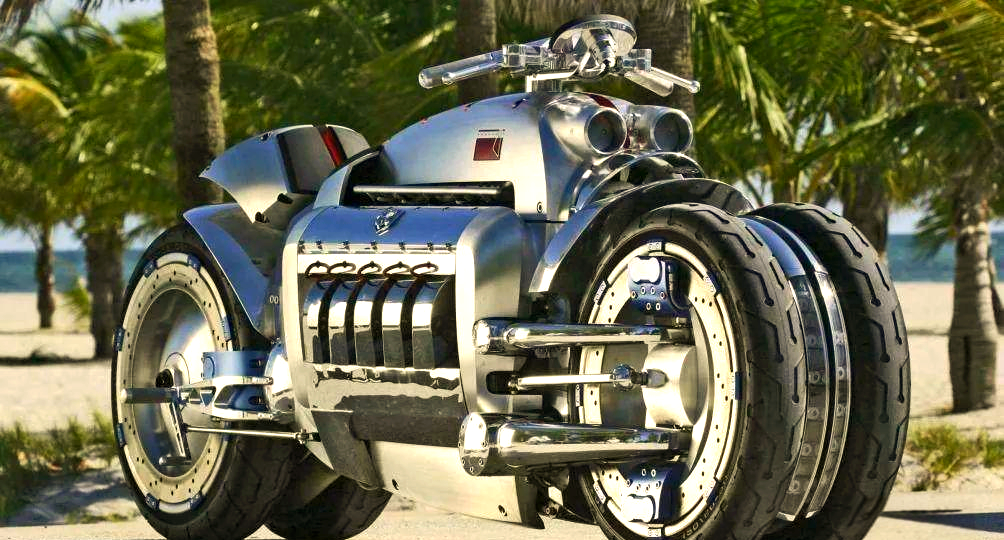
8,277 cc — only 150 cc more than the Boss Hoss, and a completely different animal. In 2003 Chrysler dropped the Dodge Viper's 8.3-litre V10 into a motorcycle frame unmodified: 8,277 cc, about 500 hp, and a theoretical top speed of 676 km/h.
To manage that, it uses four wheels in two closely spaced pairs, front and rear; parked, it does not even need a side stand. But it was never built for public roads. The law does not let it on them, so it can only prove, on closed ground, how far the physical boundary of a motorcycle can be pushed once displacement is released from regulation and practicality.
The Tomahawk sits at the top of this list not because of the extra 150 cc but because it turns displacement into a pure engineering spectacle: not street legal, not mass produced, not intended for anyone to ride to the shops — only to answer the question of what you could fit between two wheels if every rule were ignored.
What the ladder actually measures
Four motorcycles, four different answers to the same question. One refines displacement until every cubic centimetre is accounted for; one mass-produces it to the legal ceiling; one transplants it whole from a car; and one abandons legality to see how far the idea stretches. Read together, they are less a ranking than a map of what engineers do when a single number stops being enough.
Translated from the Chinese original published by 摩托攻略 (Motor Guide) on 29 October 2026. Photographs courtesy of the original article.